


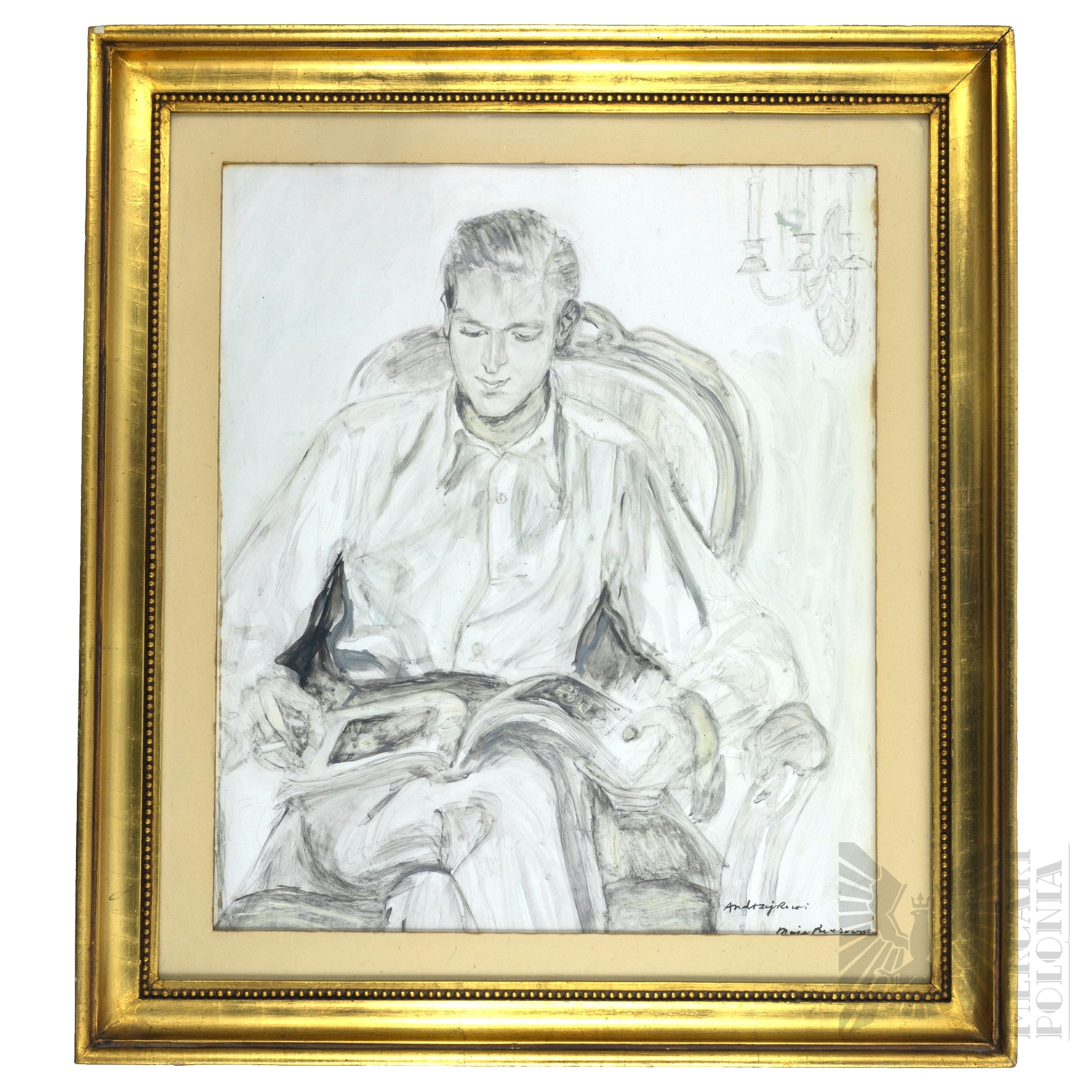
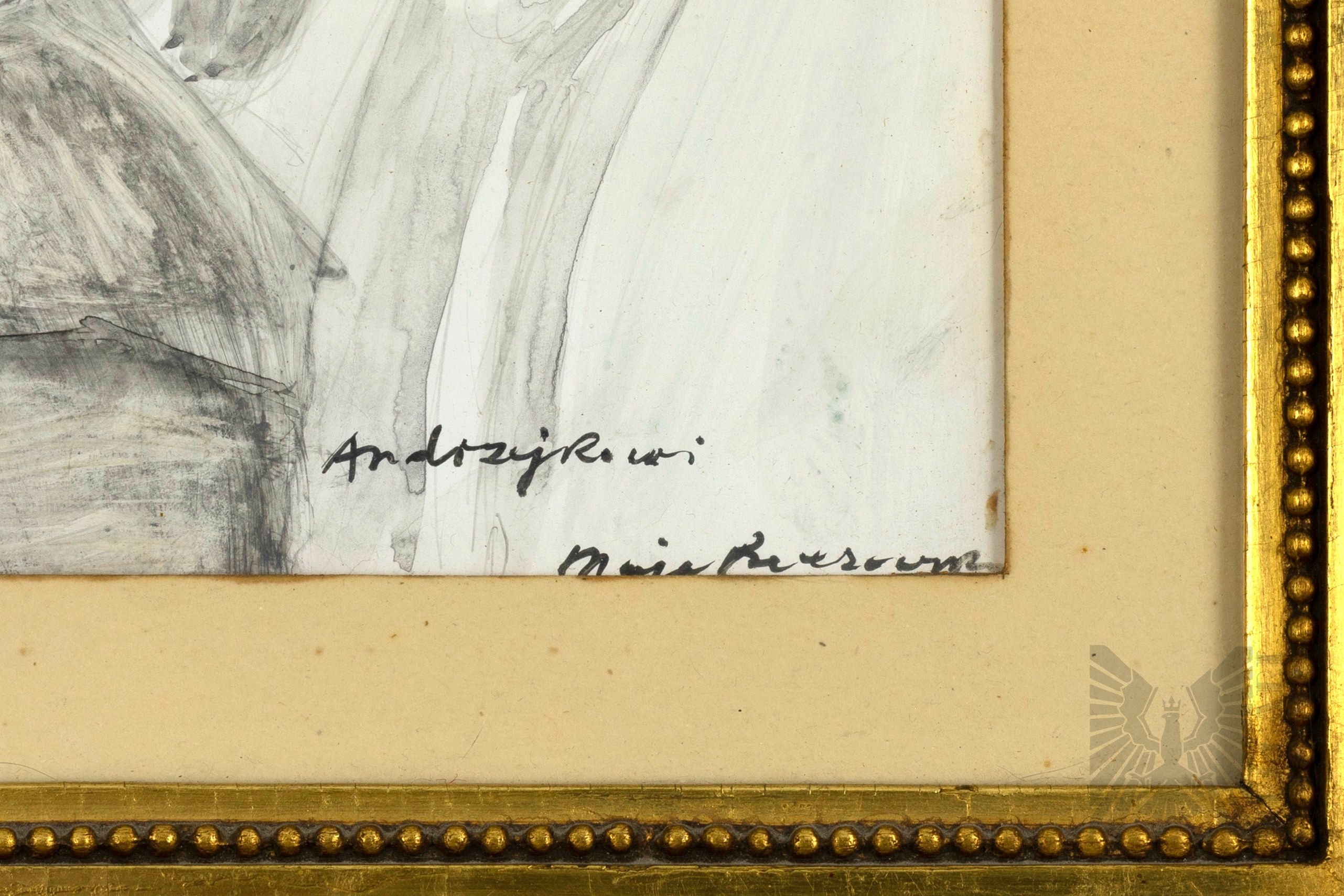
Dedication: "To Andrzej, Maja Berezowska"
Mixed media on paper.
Dimensions inside the mat: 34 × 40 cm
Frame dimensions: 48 × 54.5 cm
In the lower right corner, a handwritten dedication and signature: “To Andrzej / Maja Berezowska.”
A portrait of a young man sitting in a spacious, upholstered armchair. The subject is depicted en face, in a relaxed, natural pose, with one leg crossed over the other. His head is slightly tilted, and his gaze is directed toward an open, richly illustrated album resting on his lap. The gesture of his hand holding a page of the book and his focused expression lend the depiction the character of an intimate observation.
The composition is based on the soft outline of the armchair, which envelops the model’s silhouette and visually draws attention to the face and the open album. The figure is rendered freely, with the lightness of contour characteristic of Berezowska. The artist varies the intensity of her lines: she renders the face and hands subtly, while she builds the folds of the clothing, the armchair’s upholstery, and the lower part of the composition using energetic strokes and broad, gray washes. A few accents of blue and green break up the work’s nearly monochromatic color scheme.
A sketchily outlined fragment of the interior, along with the outline of a chandelier visible in the upper right corner, serves merely as a discreet complement to the scene. The understated background and the drawing’s almost studio-like quality in places reinforce the impression of immediacy. This is not a typical caricature by Berezowska, but rather an intimate psychological portrait—a record of a private moment of concentration.
In the context of the work’s previous owners, the dedication “To Andrzej” indicates that the piece was given to Andrzej Czernik, a member of the Czernik family bearing the Orwat/Orwał coat of arms.
Maja, whose real name was Maria Berezowska, was one of the most recognizable Polish female draftsmen, illustrators, and caricaturists of the 20th century. She studied in St. Petersburg, at the Maria Niedzielska School of Fine Arts for Women in Kraków, and in Munich. She made her debut in 1916 in Kyiv. During the interwar period, she collaborated with publications such as *Cyrulik Warszawski* and *Szpilki*, creating caricatures, book illustrations, portraits, and set designs.
From 1933 to 1936, she lived in Paris. She gained fame for a series of satirical drawings depicting Hitler, after which—following the intervention of the German embassy—she was brought before a French court. During the occupation, she was arrested, imprisoned at Pawiak, and then deported to Ravensbrück. Even in the camp, she secretly sketched portraits of her fellow prisoners. After the war, she returned to Warsaw and continued her work as an illustrator, theater artist, and portraitist. Her works are distinguished by fluid, energetic lines, her ability to synthesize characters, and her combination of psychological observation with subtle humor.
There are discrepancies in the literature regarding the artist’s year of birth. Traditionally, including in the auction market, the year 1898 is cited, whereas the Encyclopedia of Polish Theater—based on a copy of an occupation identification card preserved at the Pawiak Prison Museum—indicates the date of April 13, 1893. The artist died on May 31, 1978, in Warsaw.
Mounting: wide passe-partout, wooden frame, profiled and gilded, with a beaded ornament along the inner edge; the work is mounted behind glass.
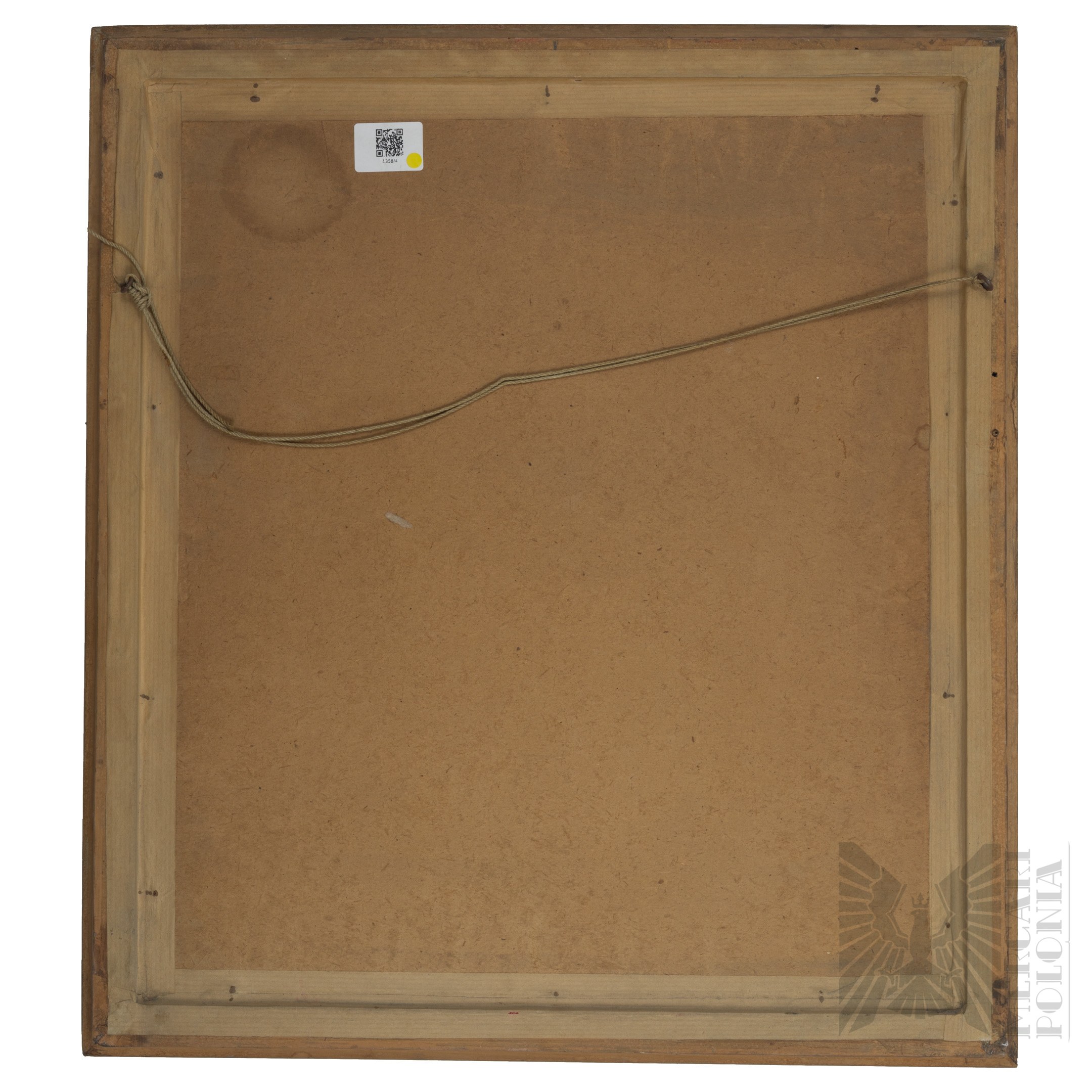
Condition: as shown in the photos.











최근 확인한 경매
경매품 리스트를 확인하려면 로그인하세요
관심있는 경매품
경매품 리스트를 확인하려면 로그인하세요