


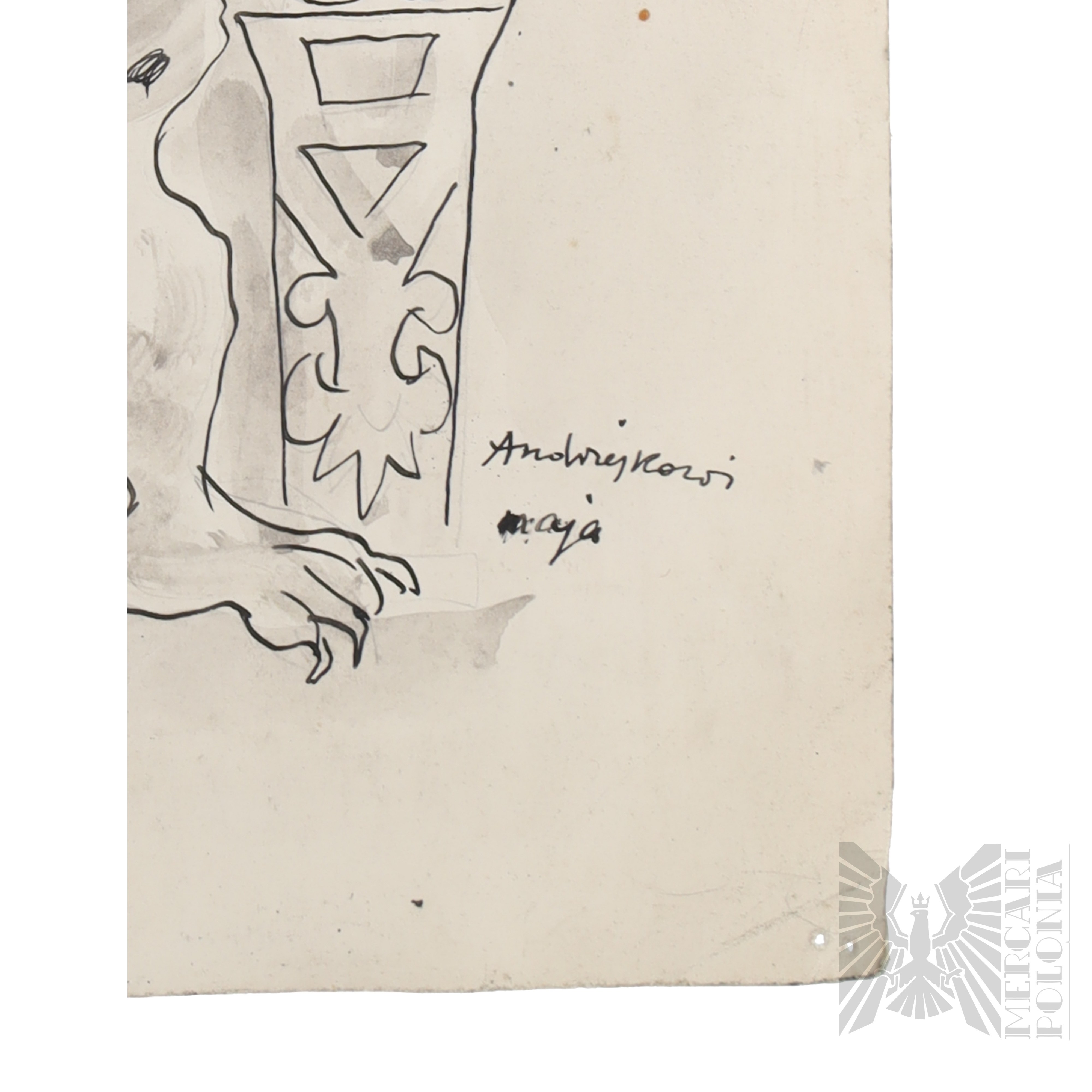
Signed “To Andrzej from Maja.” On the reverse, a stamp reading “Andrzej Czernik,” from the collection of Andrzej Czernik of the Orwał/Orwat coat of arms
Dimensions: 25 cm × 33 cm
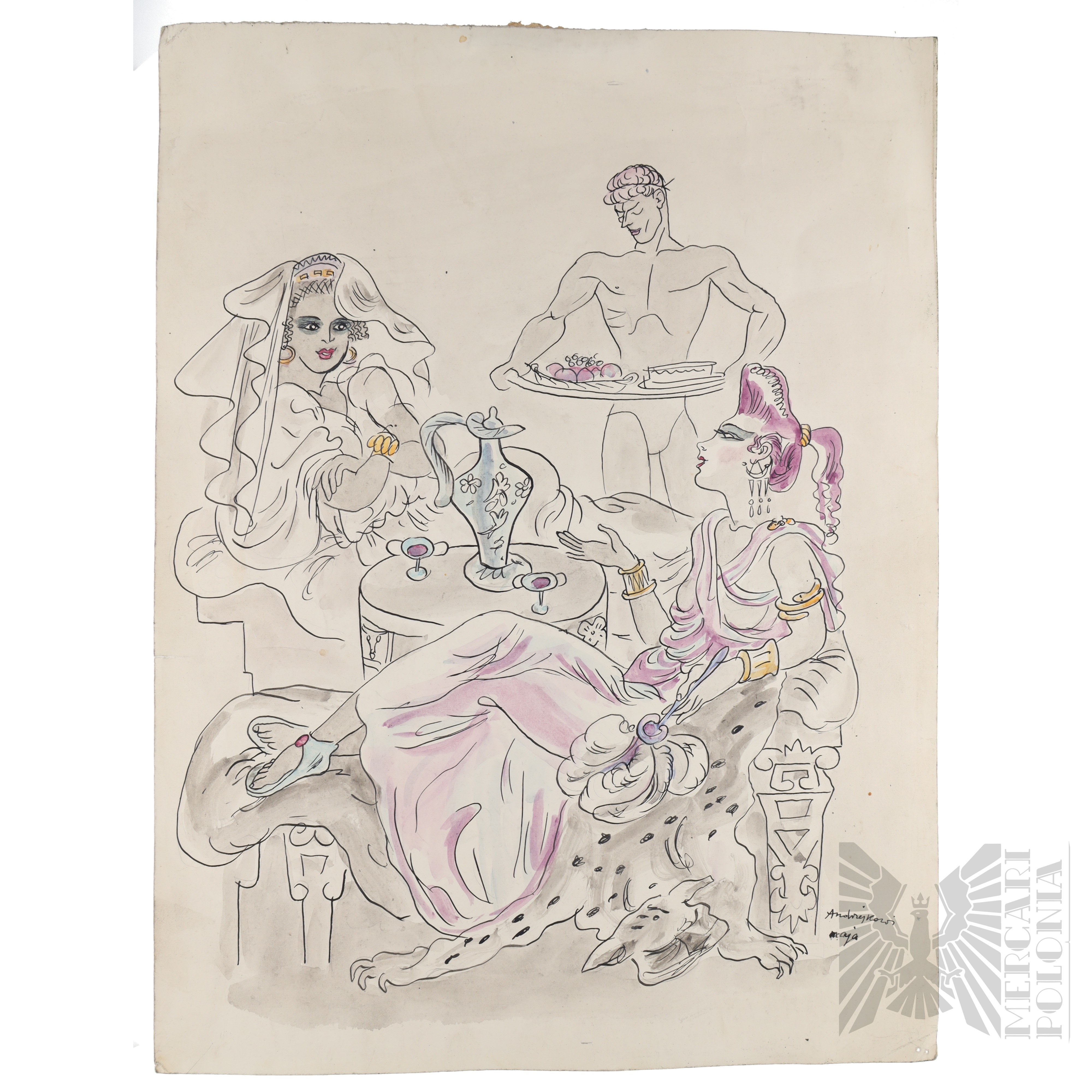
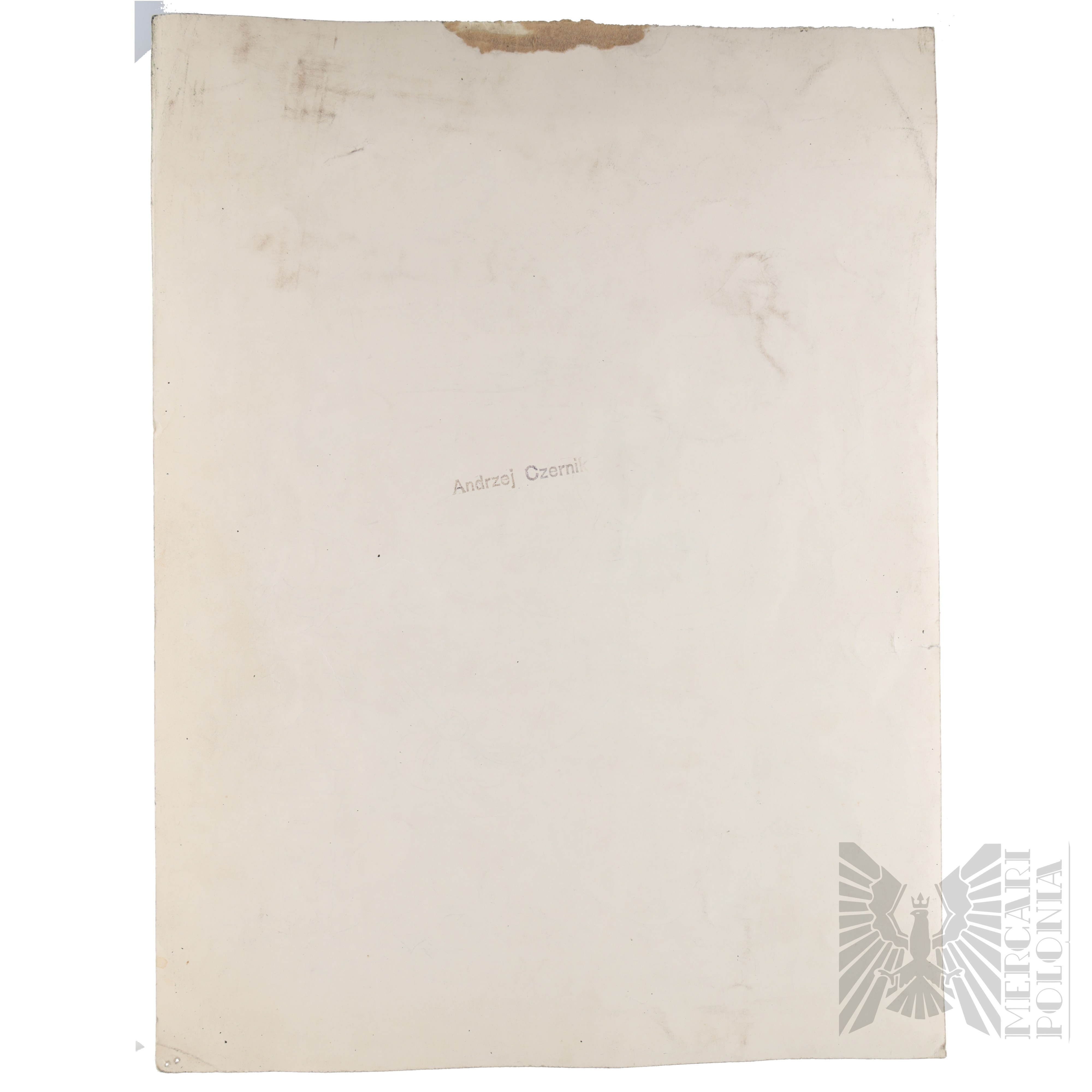
Composition executed in watercolor and ink on paper, undated. Sheet measuring 25 × 33 cm. In the lower right corner is a handwritten dedication that also serves as a signature: “To Andrzej / Maja.” On the reverse side is a violet-gray ownership stamp reading “Andrzej Czernik.”
On the vertically oriented sheet, the artist depicts four figures participating in a lavish, fantastical feast. The foreground is occupied by a woman reclining almost horizontally on a fabric-upholstered chaise longue. Her body extends diagonally from the lower left corner toward the center of the painting. The figure is dressed in a loose-fitting, softly draped gown, accented with subtle splashes of pink and purple. Her hair is piled high on her head, and she wears wide bracelets on her wrists. Her left foot extends casually beyond the chaise longue, while in her right hand she holds a spoon with a small pink delicacy. Beneath her lies the pelt of a predatory animal, recognizable by its schematically rendered head, paws, and spotted fur.
In the background, on the left, sits a third woman, depicted in full face, with large, dark-rimmed eyes and red lips. Her head and shoulders are enveloped in a light-colored veil. She is dressed in a richly draped robe and adorned with golden earrings, a headband, and a bracelet.
The central part of the composition is filled by a low, oval table on which stand two glasses containing a pink liquid and a tall jug with a slender neck, decorated with delicate floral motifs. Behind the table, the artist has placed a naked, muscular young man depicted as a servant. The man stands upright, his head bowed toward the seated women, holding a large tray of fruit and a rectangular platter. His figure, with broadly defined shoulders and a narrow waist, is rendered in a decorative and almost sculptural manner.
The scene is constructed primarily using free, fluid ink lines. The thin outline occasionally gives way to bolder, calligraphic strokes, particularly in the depiction of the face, hands, and folds of the fabric. Diluted gray watercolor renders the bedding, tableware, and architectural elements, while sparingly applied shades of pink, purple, blue, and golden yellow draw attention to the costumes, jewelry, and dishes. A significant portion of the sheet remains unpainted, allowing the multi-figure scene to retain the lightness characteristic of illustrations and satirical drawings.
“The Feast” belongs to a genre of social and erotic depictions characteristic of Berezowska’s work. The motif of a fantastical, quasi-Oriental, or antiquated court serves here as a backdrop for a playful subversion of gender and power conventions. Richly dressed women rest, drink, and savor dishes, while a naked man serves as an object of their gaze. The reversal of the traditional arrangement—in which the female nude was presented for the male viewer’s judgment—gives the scene a subversive, emancipatory tone. The eroticism, however, is not literal: it is subordinated to humor, theatrical gestures, and the deliberate stylization of the characters.
Maria “Maja” Berezowska was born in 1898 in Baranovichi and died in 1978 in Warsaw. She was a painter, draftswoman, illustrator, caricaturist, and set designer, considered one of the most important Polish creators of satirical drawings of the 20th century. A special place in her body of work was occupied by depictions of male-female relationships, erotic arabesques, and salon scenes, rendered with lightness, irony, and a clear fondness for her female protagonists. In the interwar years, she published drawings in the Polish and French press. Her caricatures of Adolf Hitler, published in 1935 in the Parisian weekly *Ici Paris*, led to a trial in Berlin. During the occupation, she was arrested by the Gestapo, imprisoned at Pawiak, and then deported to the Ravensbrück concentration camp. After the war, she resumed her artistic activities, collaborating with theaters and the magazines *Przekrój* and *Szpilki*, among others. Her work combines decorative lines, the tradition of caricature, her experience as an illustrator, and an affirmative approach to physicality.











최근 확인한 경매
경매품 리스트를 확인하려면 로그인하세요
관심있는 경매품
경매품 리스트를 확인하려면 로그인하세요