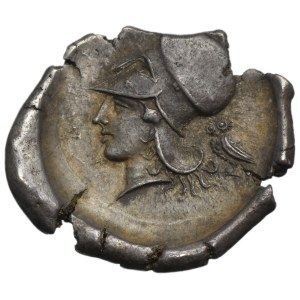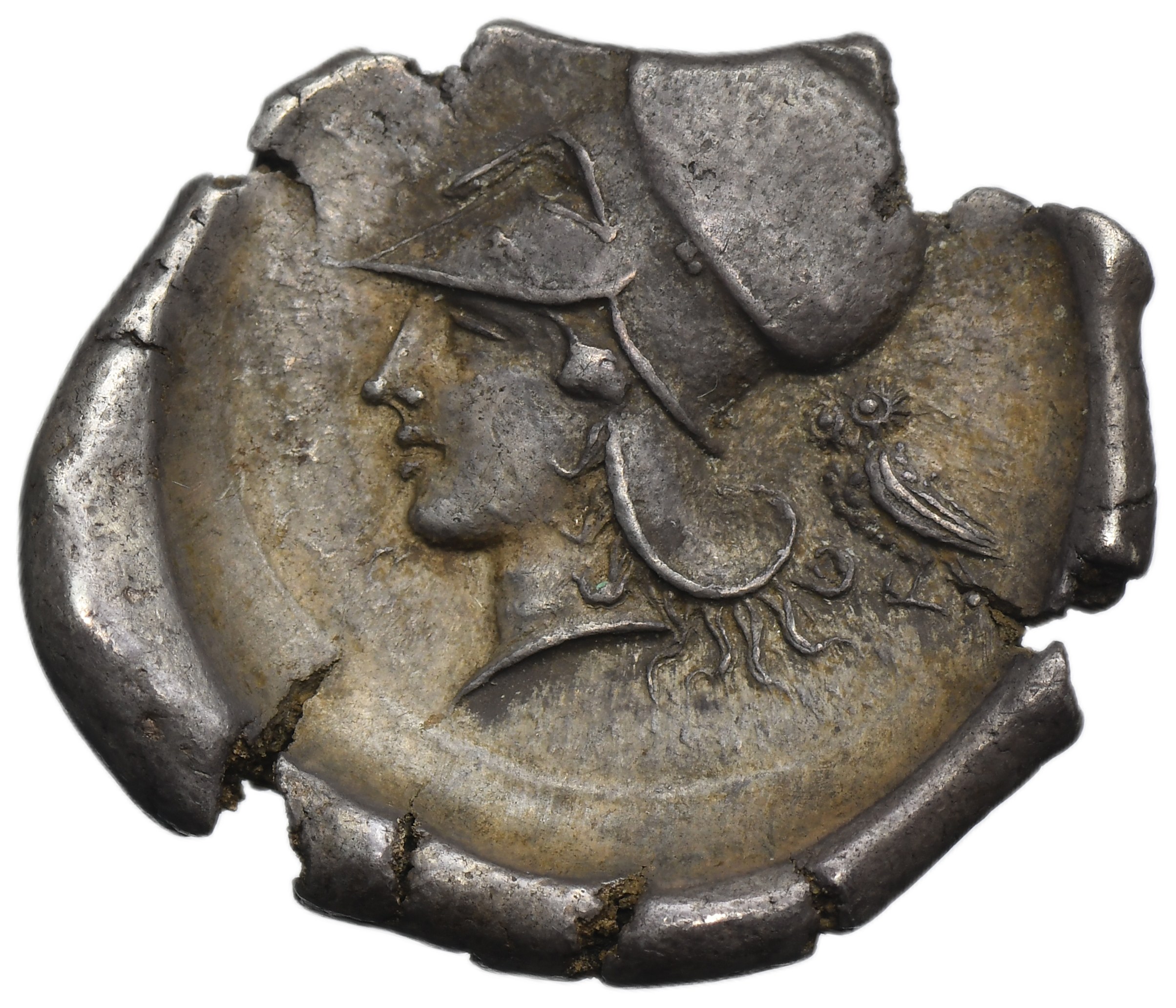
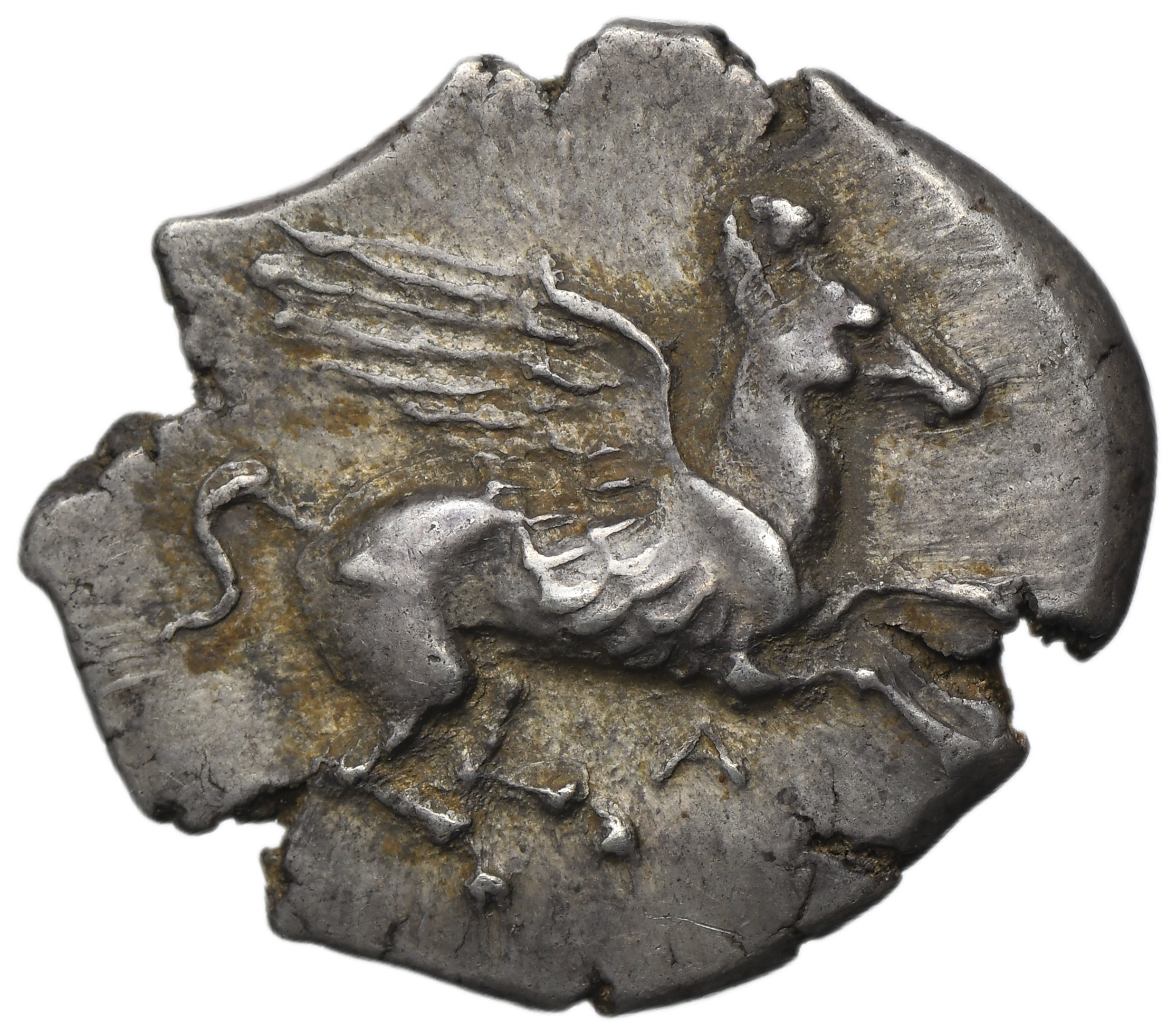
The stater of Ambrakia belongs to the characteristic group of Corinthian-type staters, issued by Corinth and numerous cities within its economic and cultural sphere. Ambrakia, situated in Epirus on the Ambracian Gulf, was founded as a Corinthian colony during the Archaic period, and its close ties with the mother city were clearly reflected in its coinage.
The obverse depicts Pegasus flying right, one of the most recognizable symbols of Corinth. Below the winged horse appears the letter A, identifying the issue with Ambrakia. The reverse features the head of Athena wearing a Corinthian helmet, facing left.
The combination of Pegasus and Athena was not accidental. According to Greek mythology, Athena helped Bellerophon tame Pegasus by providing him with a golden bridle. These two motifs formed the principal iconographic programme of Corinthian coinage and were subsequently adopted by its colonies and other cities striking coins according to the Corinthian standard.
These issues also played an important economic role. Corinthian staters and their local counterparts circulated widely throughout western Greece, Epirus and southern Italy, forming one of the most distinctive monetary systems of the Greek world during the 4th century BC. Owing to its location and close connections with Corinth, Ambrakia participated actively in this extensive network of exchange.
The present specimen, dated to c. 360–338 BC, is a characteristic example of the adaptation of traditional Corinthian imagery to the autonomous coinage of its colony.
Ex NAC Autumn Sale 95, 1995, Lot 202.
Ex. Fritz Rudolf Künker, eLive Auction 81, Lot 7045.
Greece
Epeiros, Ambrakia, Stater 360-338 BC
Obverse: pegasus flying right, letter A below it
Reverse: head of Athena in Corinthian helmet left
Diameter 26 mm, weight 8.76 g