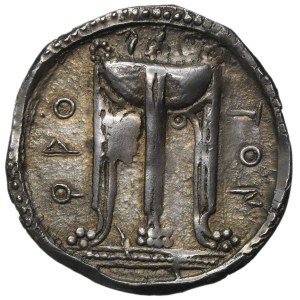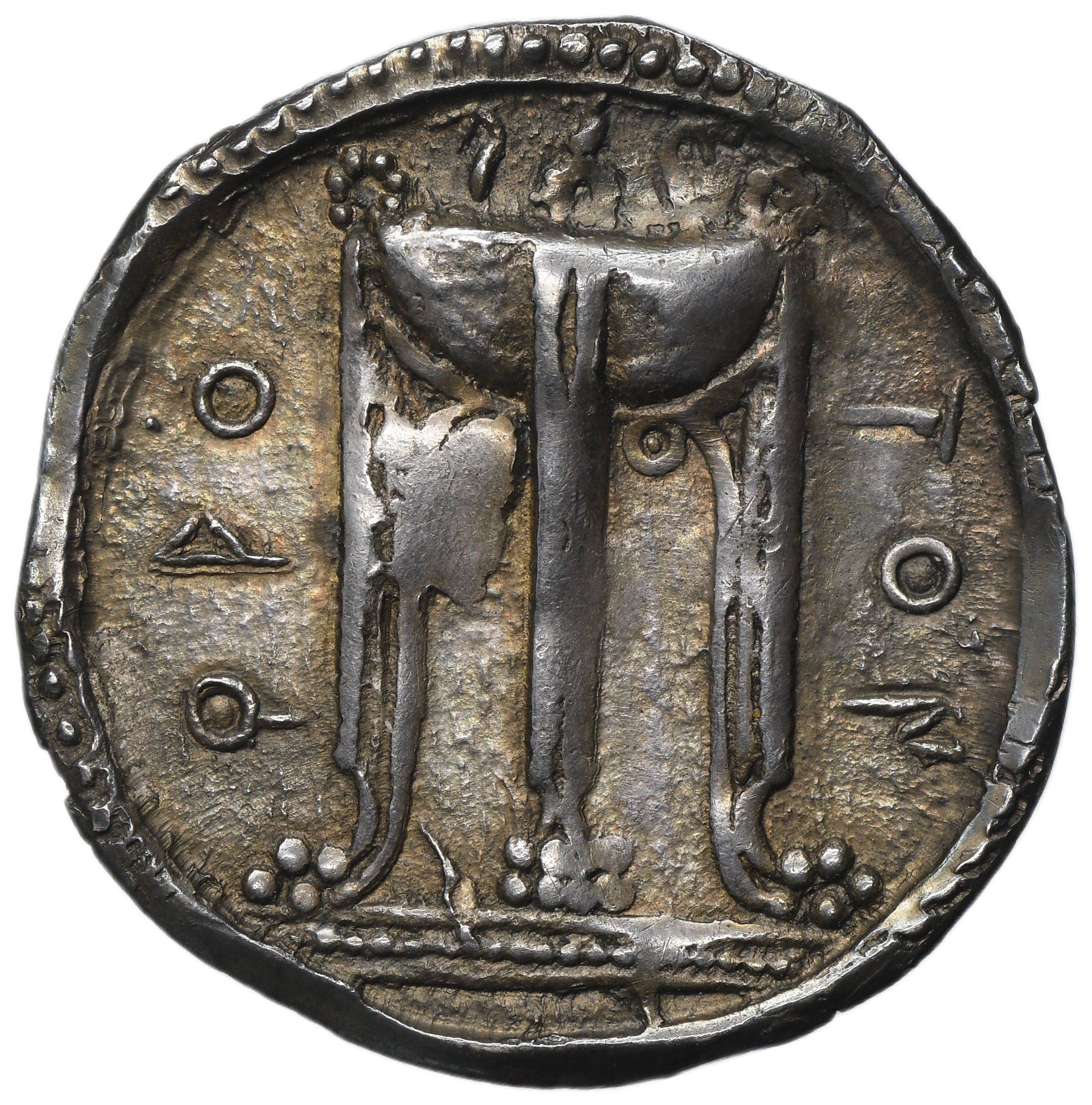
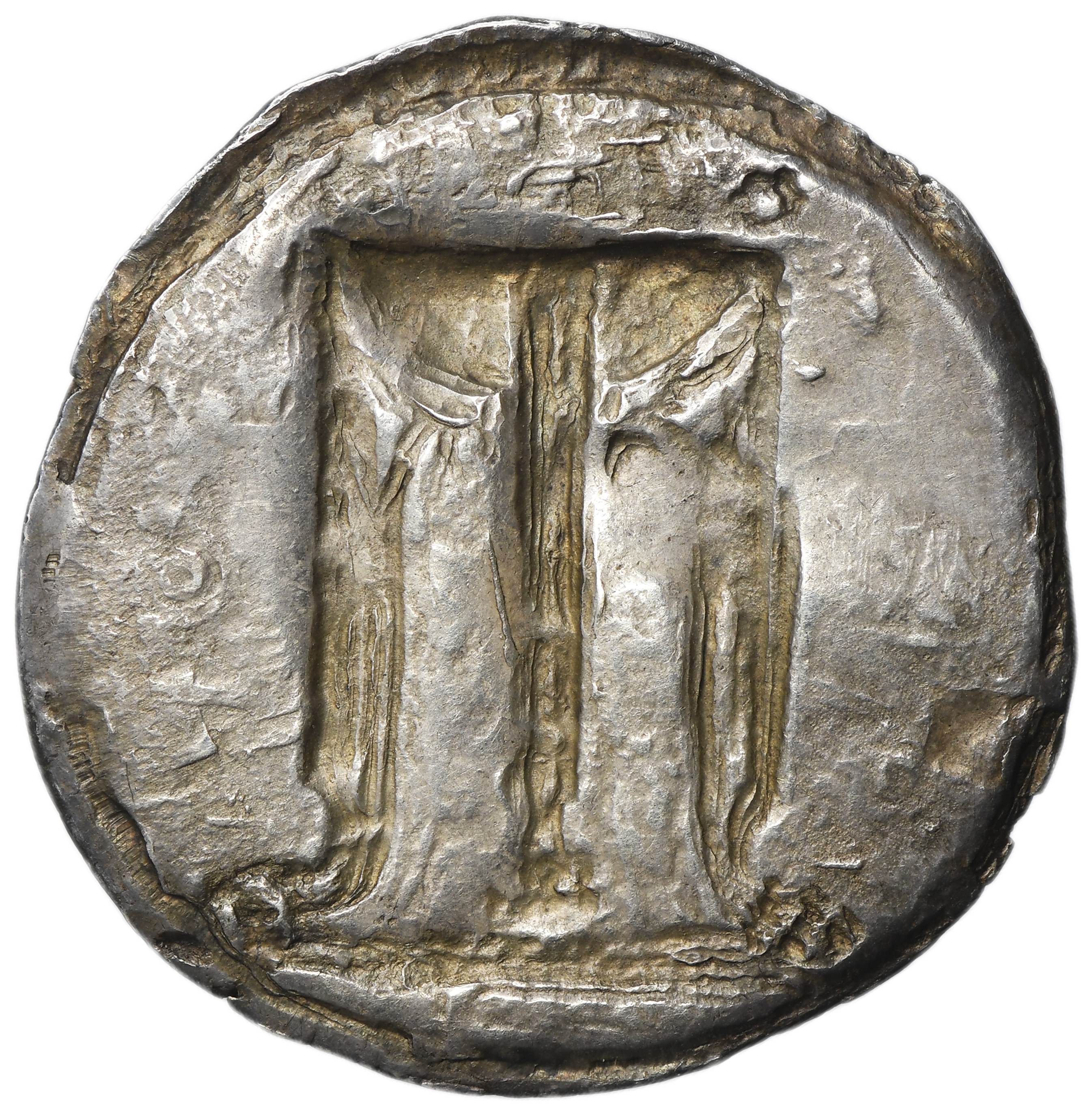
The stater of Kroton belongs to the most characteristic examples of Archaic coinage of Magna Graecia. Kroton, founded by Achaean colonists on the coast of southern Italy, had already developed into one of the region’s most important political and economic centres by the 6th century BC. During the second half of that century, the city began issuing its distinctive silver staters struck using the incuse technique.
The most remarkable feature of these coins is the method used to produce the reverse. The tripod depicted in relief on the obverse is mirrored by a corresponding sunken, incuse representation on the reverse. This technique is characteristic of the early coinage of several cities in southern Italy and remains one of the most distinctive features of the Archaic issues of Magna Graecia.
The central motif, the tripod of Apollo, remained the principal numismatic emblem of Kroton for centuries. Its presence was associated with the cult of Apollo and the city’s strong connections with the Delphic Oracle. The sanctuary of Apollo at Delphi played a particularly important role in the tradition surrounding the foundation of Kroton, making the tripod a readily recognizable symbol of the religious and political identity of the polis.
The present specimen represents an early stage in the development of Kroton’s coinage. Its Archaic style, broad flan, tripod of Apollo and incuse reverse form a composition characteristic of some of the earliest silver issues of southern Italy.
From the collection of Dr. H. M., acquired on 25 October 1962 from Münzen und Medaillen AG, Basel (with the original invoice), and subsequently offered at Peus Nachf. Auction 428, Frankfurt am Main, 2021, lot 41.
Ex. Fritz Rudolf Künker, Auction 402, Lot 563.
Beautiful old cabinet tone.
Greece
Bruttium, Kroton, Stater 530-500 BC
Obverse: tripod, QPO in left field, stork standing left in right field
Reverse: incuse tripod
Diameter 30 mm, weight 6.79 g