


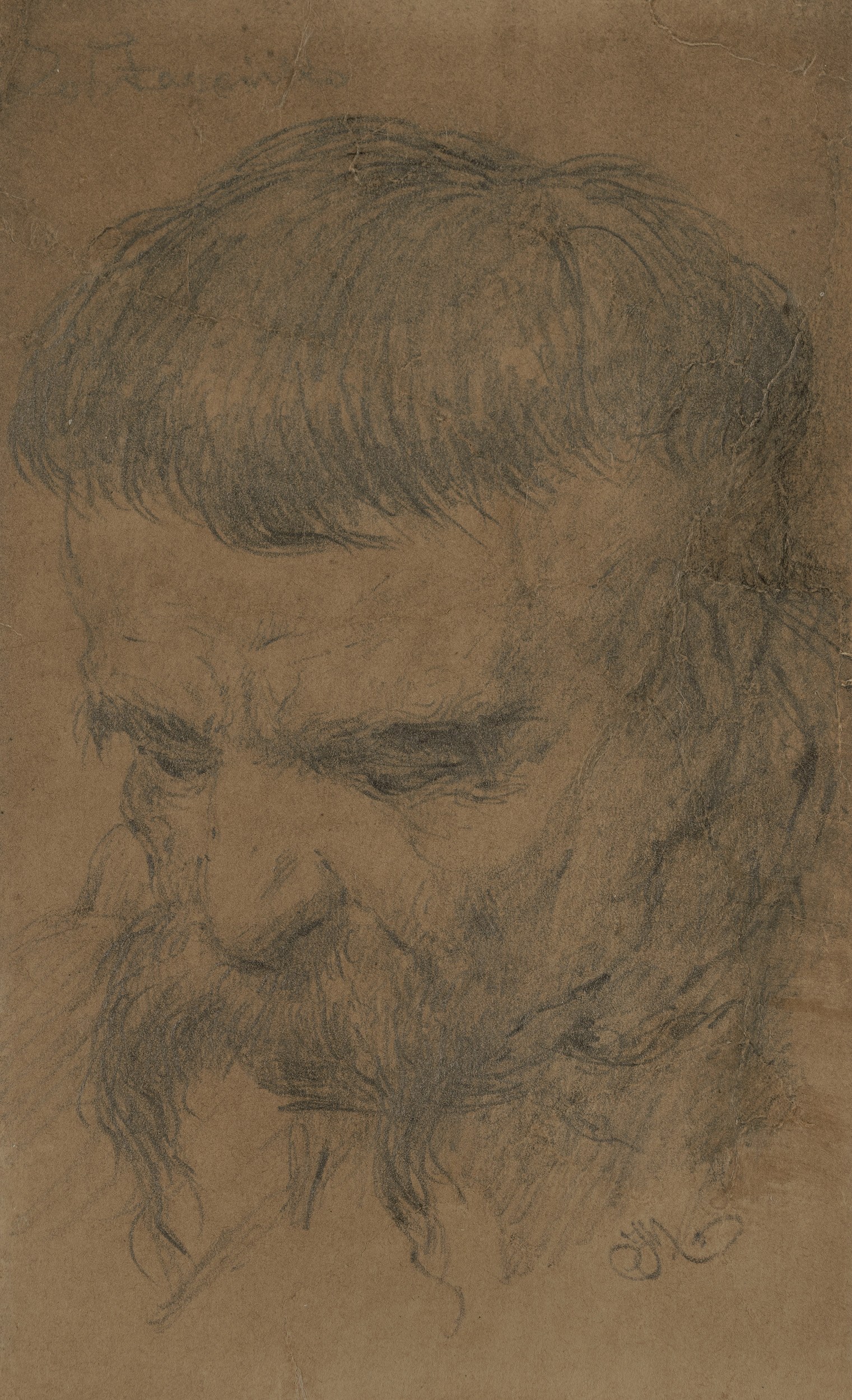
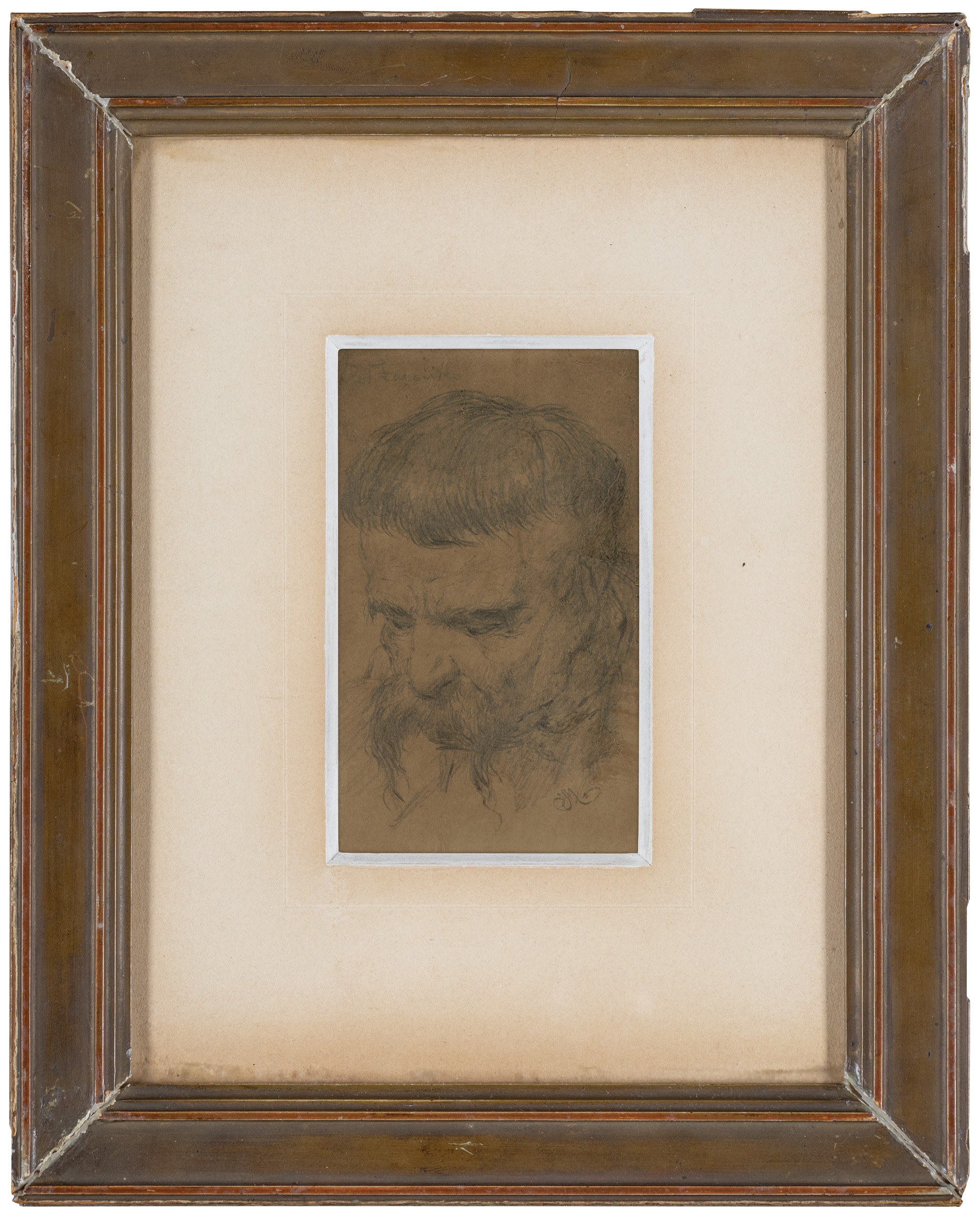

11.5 x 7.1 cm - pencil, paper
Signed p.d.: JM [initials tied], l.g.: Zolotareńko
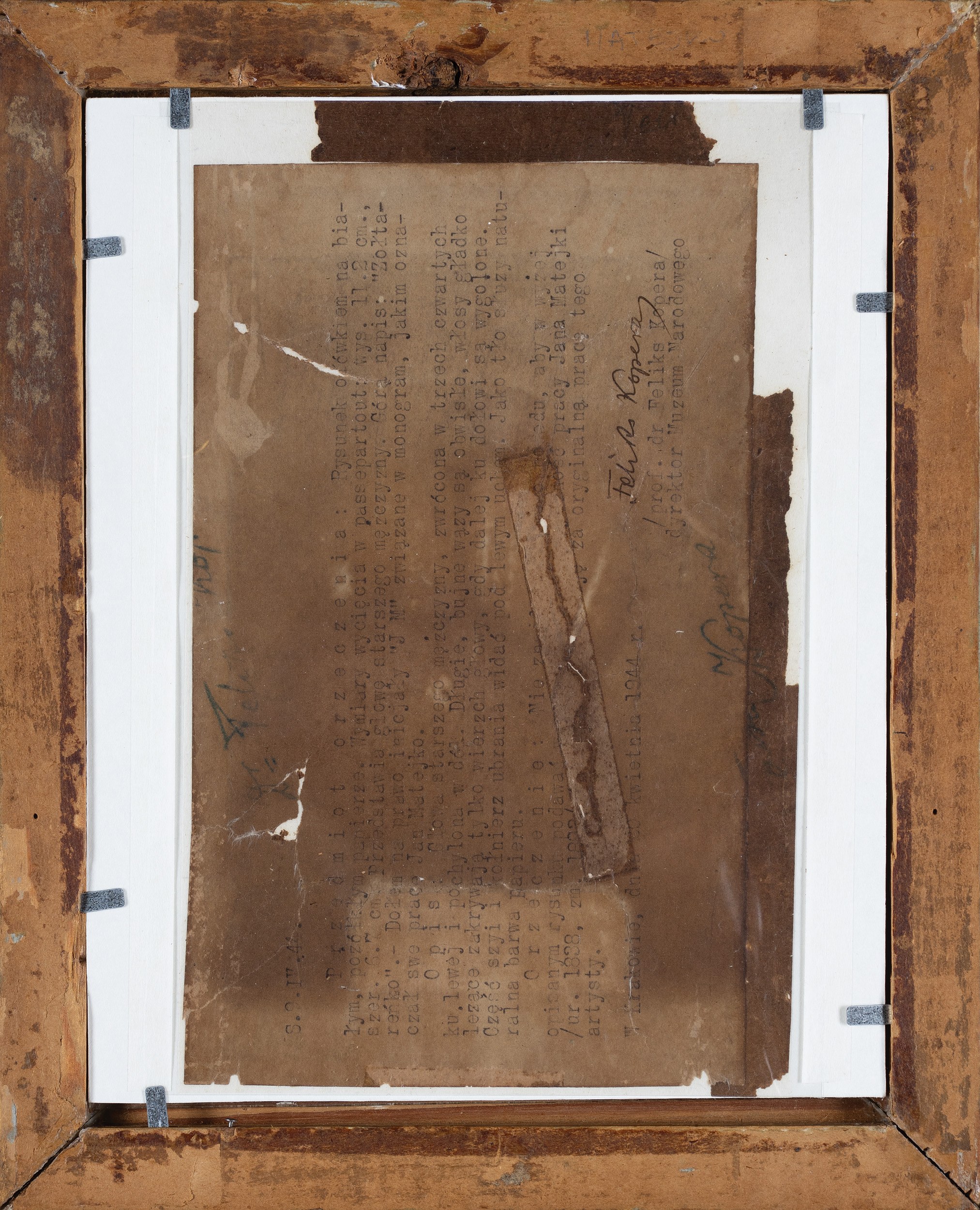
On the back a certificate from Prof. Dr. Feliks Kopera, 1944, confirming the authenticity of the drawing.
Zolotarenko (Ivan Mykyforovych Zolotarenko; d. 1655), depicted in the drawing, was the son of a wealthy townsman from Korsun who joined the Cossacks. With his endurance, strength and mastery of the saber, he instilled fear in his enemies. He attracted the attention of the Cossack hetman - Bohdan Khmelnytsky, who was looking for ruthless warriors. In 1652 Khmelnytsky married Zolotarenko's sister Anna, and appointed him colonel of the Nizhin regiment.
The same year saw the Battle of Batoh in the Braclaw region, which resulted in thousands of Polish soldiers being taken into Sultan's captivity. At the time, the triumphant Zolotarenko was said to have suggested murdering all the prisoners, saying that a dead dog does not bite. This is what happened. Khmelnitsky ransomed the Poles from captivity and then ordered them all to be put to death.
In 1654 Khmelnitsky concluded the Pereyaslav Settlement with the tsar, and Zolotarenko was appointed interim hetman over the Cossacks for the expedition to Belarus. His brutality caused him to become surrounded by legends; he was considered the incarnation of the devil. As a result, the Polish clergy became involved in defeating him.
Priests and members of the Jesuit order unequivocally claimed that there was nothing divine in the Colonel of Nizhyn, only the devil. After a long search, they managed to find a man who undertook to kill the devil in exchange for the forgiveness of all sins and the protection of his children and future grandchildren. The man was organist Thomas, a well-known shooter in Old Bychow. A bullet was prepared, for the making of which a sacred silver cap was melted down, "reinforced" with prayers.
In 1655, Zolotarenko and his army reached the mighty Belorussian fortress - Stary Bychow. The attempt to capture it brought death to thousands of Cossacks. During the long siege, the colonel from Nijinsk repeatedly personally led his men into battle. This was taken advantage of by organist Thomas, who - hidden on the bell tower - hit Zolotareenko with an accurate shot as he rode his horse nearby. The shot was not fatal, however; only the infection of the wound brought death to the Cossack hetman.
This, however, was not the end of stories related to Zolotareenko. According to accounts, his corpse repeatedly came to life during transport to Ukraine. Macabre scenes were said to have occurred during his funeral held by Bohdan Khmelnytsky in the newly erected church in Chehryn. Zolotarenko reportedly began moaning and moving on the catafalque, after which he arose and shouted to those gathered to flee. Panic broke out, resulting in people trampling each other, and a fire broke out from the overturned candles. The church burned down, and with it more than four hundred mourners. This story, based on the oral account of a witness - Daniel Wyhovsky - was heard in 1616 and later written down by Wespasian Kochowski in Klimaktery.
Jan Matejko (Krakow 1838 - Krakow 1893) - the most outstanding Polish historical painter; he began his painting studies under W. Łuszczkiewicz and W. K. Stattler at the Krakow School of Fine Arts (1852-1858). He then studied at the Munich Academy under H. Anschütz (1859) and for two months at the Vienna Academy under C. Ruben (1860). After his studies he lived and worked in Cracow. In 1873 he took over as director of the School of Fine Arts there, holding this position until his death. He traveled extensively - he made numerous trips to Paris (in 1865-1880), Vienna (1866-1888), in 1872 he was in Constantinople, and a year later in Prague and Budapest, he also visited Italy (1878-1879 and 1883). He was a member of numerous academies and art societies, including the Académie des Beaux-Arts (1873) and the French Institute (1874) in Paris, the Berlin Academy of Art (1874), the Raphael Academy in Urbino (1878) and the Künstlersgenossenschaft in Vienna (1888). He became a member of the Scientific Society of Cracow in 1864, and received an honorary doctorate of philosophy from Jagiellonian University in 1887. He was the creator of great and well-known canvases, including the Sermon of Skarga, Rejtan, the Union of Lublin, Batory at Pskov, the Battle of Grunwald, the Prussian Homage and Kosciuszko at Raclawice. He also painted portraits and, less frequently, religious or genre scenes. Drawing played an important role in his work - the artist produced, among other things, the album Ubiory w Polsce od 1200 do 1795 and the drawing series Poczet królów i książąt polskich. In 1889-1891, together with a team of students, he worked on the polychrome of St. Mary's Church in Cracow. The painter's family home, on Florianska Street in Krakow, has housed a museum dedicated to him since 1898 - the Matejko House (a branch of the MNK).













최근 확인한 경매
경매품 리스트를 확인하려면 로그인하세요
관심있는 경매품
경매품 리스트를 확인하려면 로그인하세요