


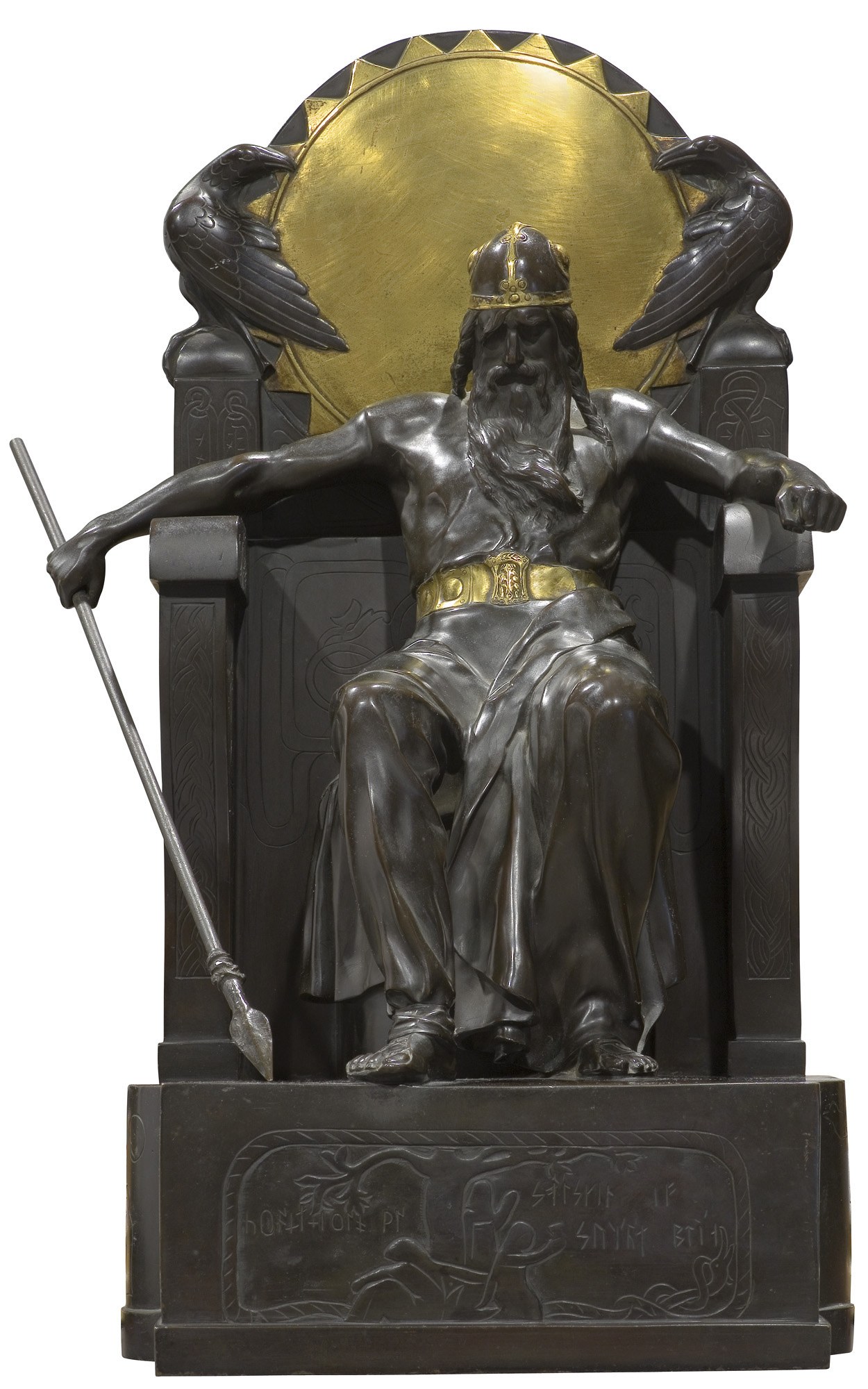
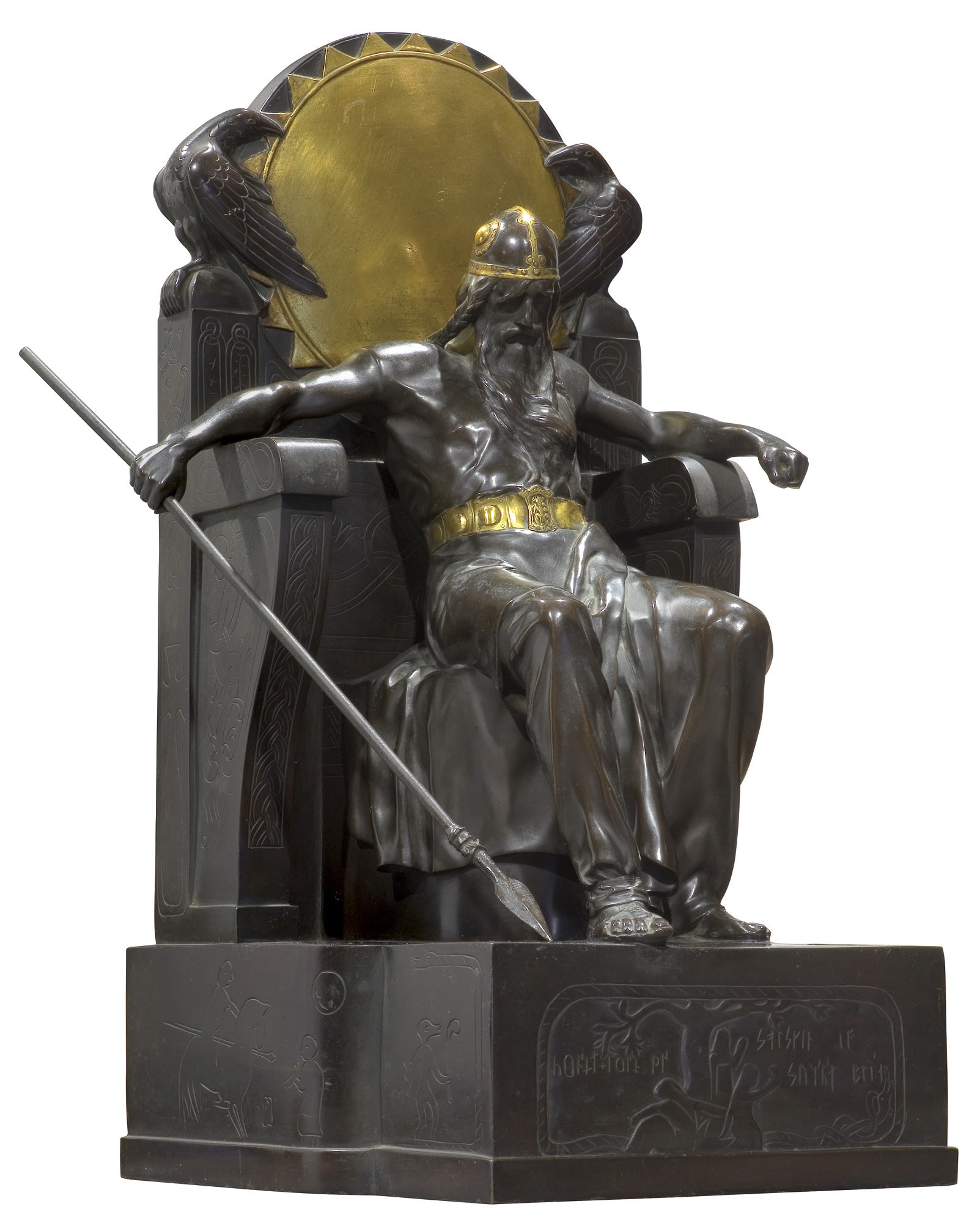
46.5 x 24.0cm - cast bronze, chiseled, fire-gilded other titles: SLEEPING WODAN, WODAN ON THE THRONE, ODYN
signature on base: R. Maison Foundry mark: GUSS v. A. BRANDSTETTER MUNCHEN
state of preservation: minor rubbing of patina and gilding
Provenance: sculpture purchased in an antique shop in Buenos Aires in 2006.
Bibliography:
Geiger Karin, Tausch Sabine, Rudolf Maison (1854-1904). Regensburg-Műnchen-Berlin, Universitätsverlag Regensburg, 2016.
Małgorzata Najwer, Hermann Hendrich's The Temple of Legends and Parsifal and the Castle of Gral, "Quart," no. 3(9)/2008, pp. 42-63, il.
Plastiken und Ölgemälde moderner Meister: Nachlass Prof. Rud. Maison, München, Sammlung Bankier R. Molenaar, Berlin und anderer Besitz, Auktion in München in der Galerie Helbing, [ catalog of works from the collection of R. Molenaar, Galerie Helbing April 28, 1913, Munich, 1913, cat. nos. 5, 6.
Wodan (Wotan) is the Old High German god of war, victory and death, equivalent to the Anglo-Saxon Woden and the Scandinavian Odin. Wodan-Odyn is depicted as a well-built middle-aged man with long, curly hair and a long beard. His right eye socket is empty after he gave up his eye for water from the spring of wisdom. In his right hand he holds the spear Gungnir, and behind him sit two ravens - Hugin (Thought) and Munin (Memory). Odin sits on the throne of Hlidskjalf, from which all that happens in the nine worlds can be seen.
Wodan, as a monumental marble sculpture, was created for the famous Sagenhalle, the Hall of Fairy Tales, which opened in 1903. The hall was built in the Valley of the Seven Houses in Szklarska Poreba on the initiative of Hermann von Herdrich (1854-1931), a native of Harz who settled in the Karkonosze Mountains, a charismatic painter fascinated by Germanic mythology and ancient pagan beliefs. The wooden building, reminiscent in form of Old Germanic architecture, was designed to exhibit a series of eight large-format paintings depicting the history of the Krkonoše Mountain Spirit. The interior design is described by Malgorzata Najwer as follows: "The collection was supplemented - usually smaller in format - by paintings more or less, sometimes completely unrelated to the Sudetes. Several sculptures were meant to lend the salon the seriousness of Wagner's Gesamtkunstwerk. Among them, at the entrance, a large statue of Liczyrzepa (...) greeted visitors, while further on was Rudolf Maison's Sleeping Wotan" (M. Najwer, Hermann Hendrich..., p. 49). During World War II, all of the Sagenhalle's furnishings were lost. The building fell into disrepair and was finally demolished.
The offered sculpture is a bronze reduction of the famous composition. Maison, who delighted his contemporaries with the immensely detailed yet naturalistic modeling of his sculptures, put Wodan in the hands of bronzers who certainly lived up to his expectations. The casting is of excellent quality, and is devoid of the slightest imperfections. Both the bronzing treatment and the precise yet light chisel work and engravings betray the hand of expert craftsmen. Special attention should be paid to the fire gilding. Made using a traditional technique that requires high skill, it is thicker and more durable, hence also more costly than the electroplated gilding that was already widely used at the time.
Another piece of Wodan, also with gilding, is in the collection of the Munich City Museum. The castings are not numbered, hence it is difficult to determine how many pieces the sculpture was made in. Nevertheless, it can be expected that most of them did not survive the war period or after the end of the war, when the bronzes were melted down to obtain the raw material so necessary at the time. Many of them, due to their ideological content, were deliberately destroyed in the process. Hence, on the antiquarian market, Wodan Maison must be considered a rarity.
Rudolf Maison (Regensburg 1854 - Munich 1904) - today is considered one of the more significant German sculptors of the Wilhelm era. He studied architecture in Munich and became a professor in 1891. In 1892 he was one of the founders of the Munich Secession. In 1895 he became an honorary member of the Royal Academy of Fine Arts, and later also of the Munich Academy of Fine Arts and the Vienna Artists' Cooperative. The beginning of his brilliant career is linked to King Ludwig II's commission for a fountain of fame for Herrenchiemsee Palace. Many of his works, including the most monumental ones, such as the statue of Emperor Frederick in front of the Bode Museum in Berlin and the decorations of the new Reichstag building, have not survived to the present day. In 2016, the Regensburg Historical Museum hosted a monographic exhibition of the artist, recalling his work.













최근 확인한 경매
경매품 리스트를 확인하려면 로그인하세요
관심있는 경매품
경매품 리스트를 확인하려면 로그인하세요