


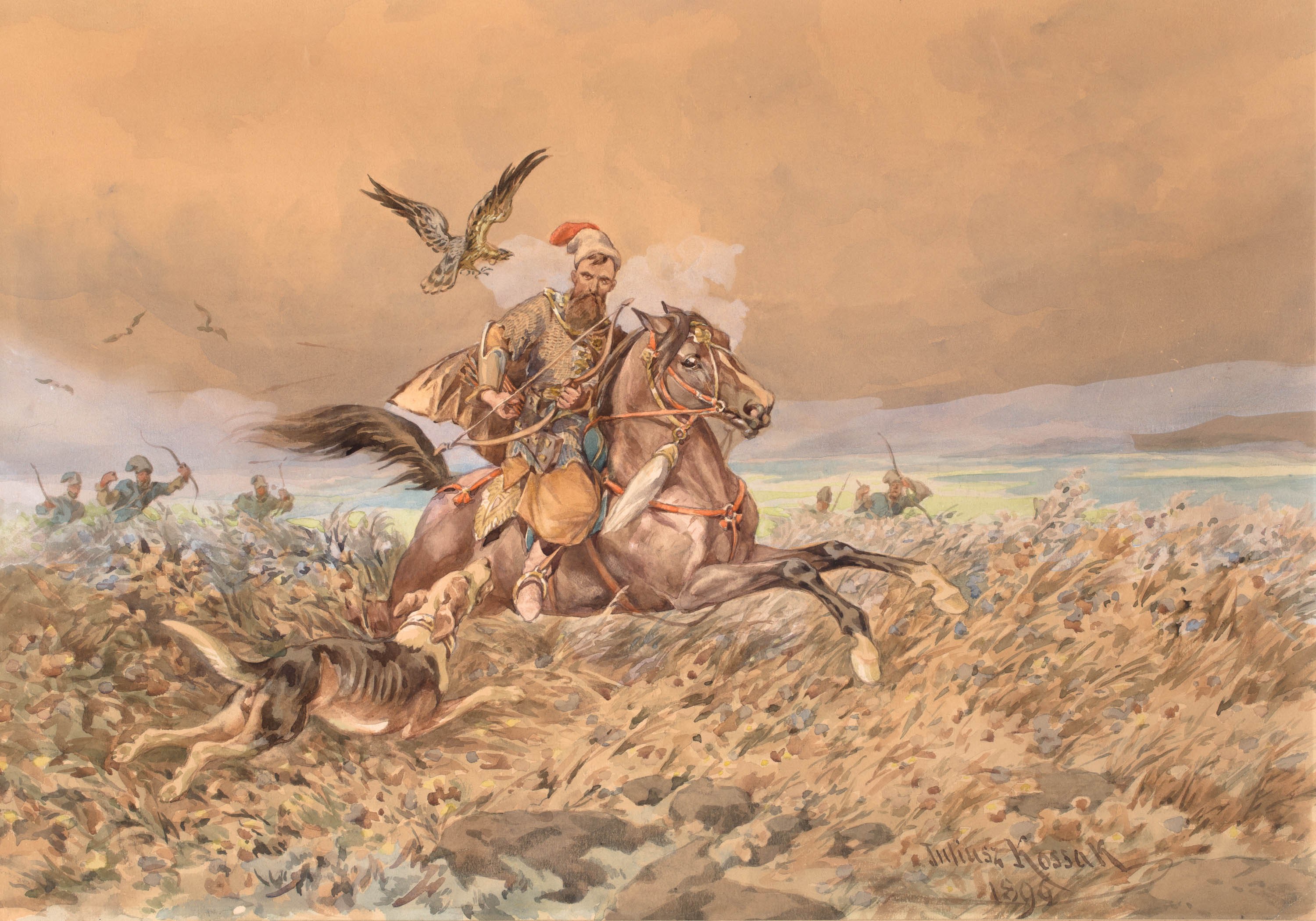
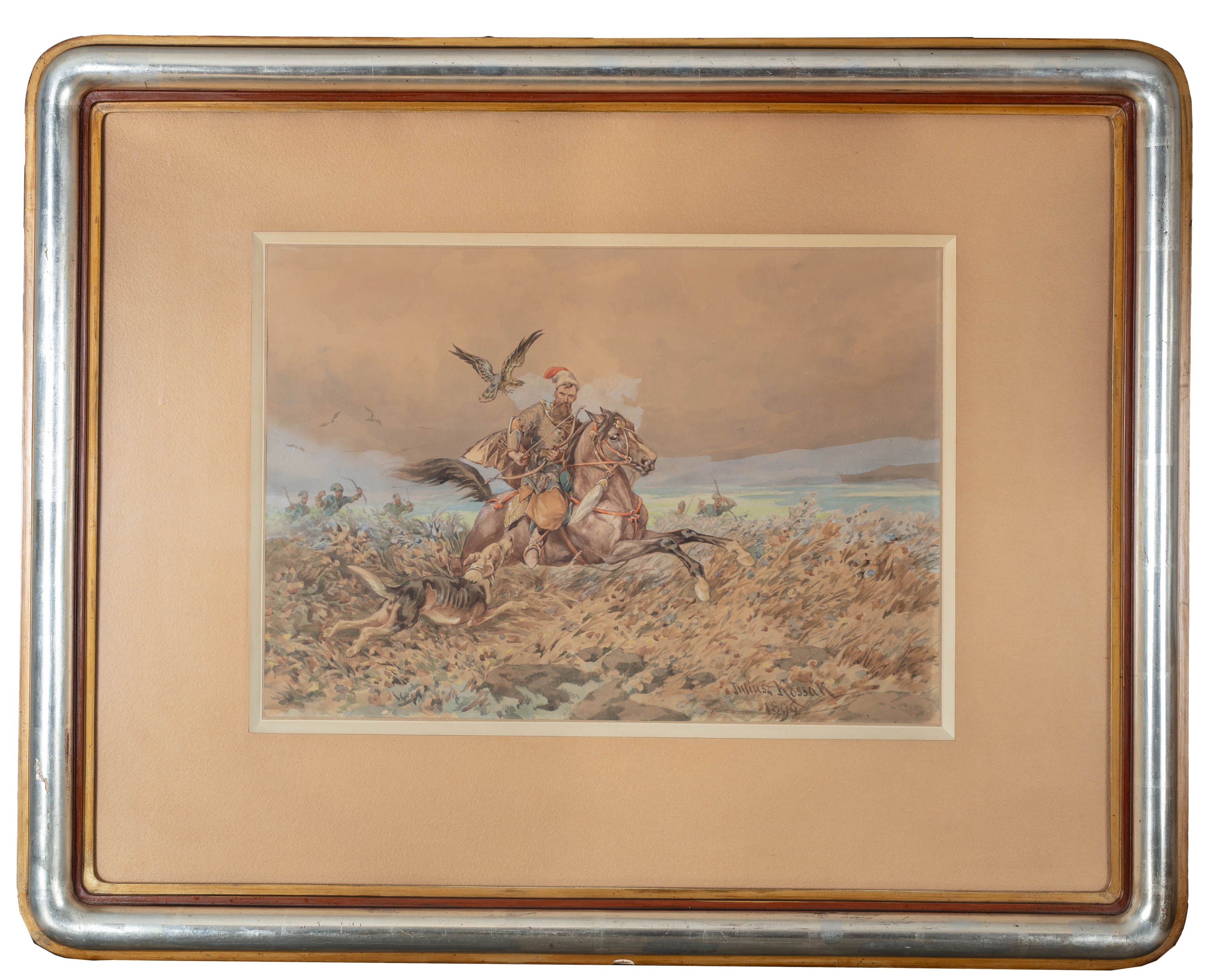
watercolor, paper, 40.4 × 57.3 cm in light passe-partout
Signed and dated p. d.: "Juliusz Kossak/1899"
Attached to the painting is a copy of Wacława Milewska's 2015 opinion.
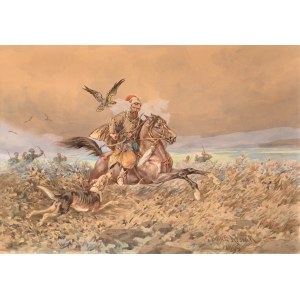
The featured watercolor shows the Cossack Hetman Zhmiya during a hunt. The work is an artistic interpretation of the poem "Zhmiya" by Juliusz Slowacki - a poetic romance from Ukrainian legends in six songs. Juliusz Slowacki considered "Zhmiya" to be the most outstanding among the works published in 1932. He rejoiced "that the whole nation came alive in this song, that the poet erected whole walls there, where others extracted bricks from the wall." (J. Tretiak: On Słowacki and "Letters," Majeta Publishing House) The eponymous Viper was the son of a Turkish bash exiled from Natolia, who, as a result of a false denunciation, fled to Sich, where in time he became the leader of the free Cossacks. "With the thud of a horse he flies through the heather. It is our lord, Viper, Hetman of the Lowlands. White are the raised clouds of dew, From under the horse's hooves the frightened crows flocked, sat down on the cross. The red cap flashes in the storm, The steel armor flashes in the storm: - "Hello, Hetman! Hello, Hetman! " - (Juliusz Słowacki, "Viper," Złoczow1923, p. 12)
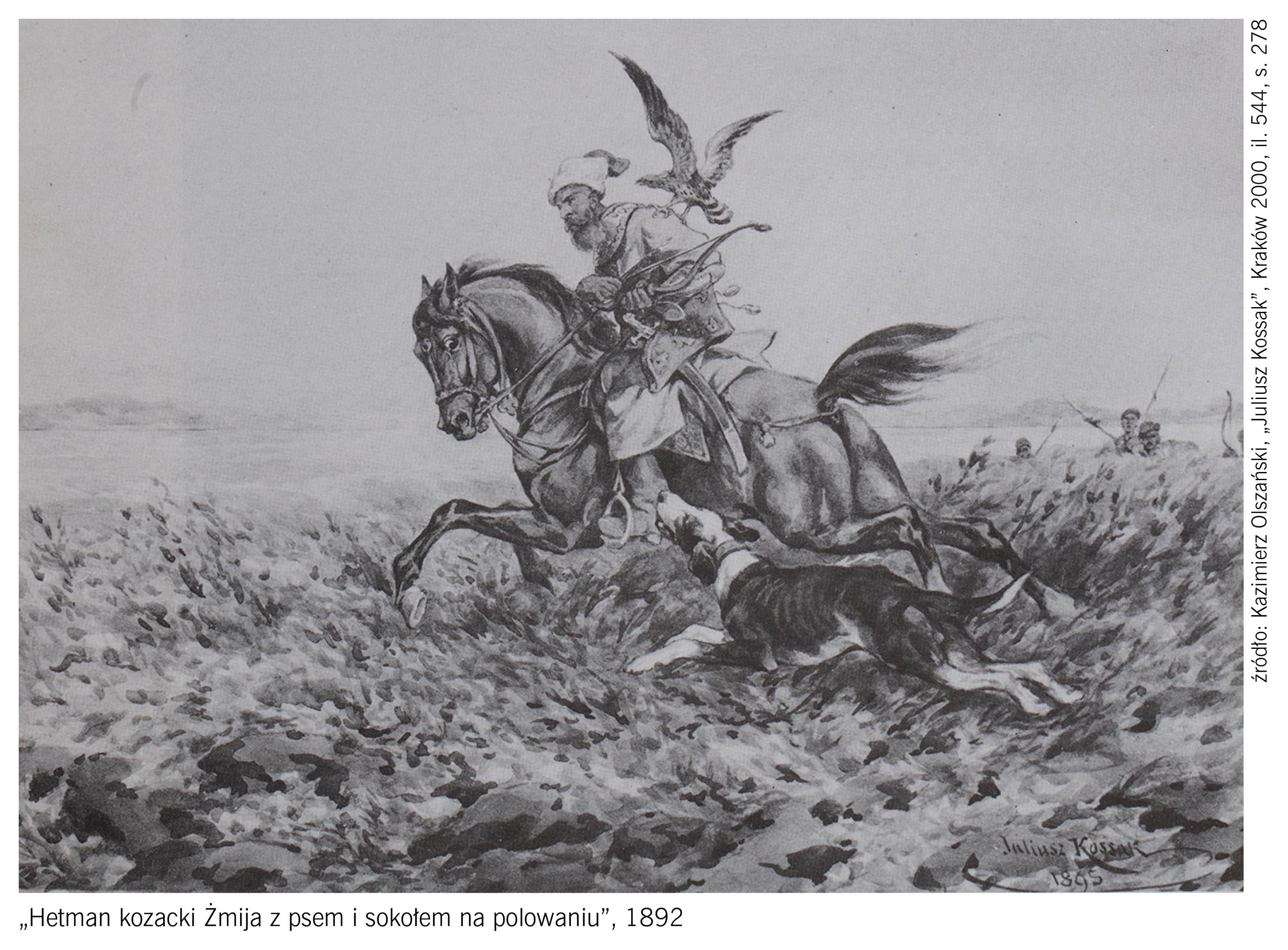
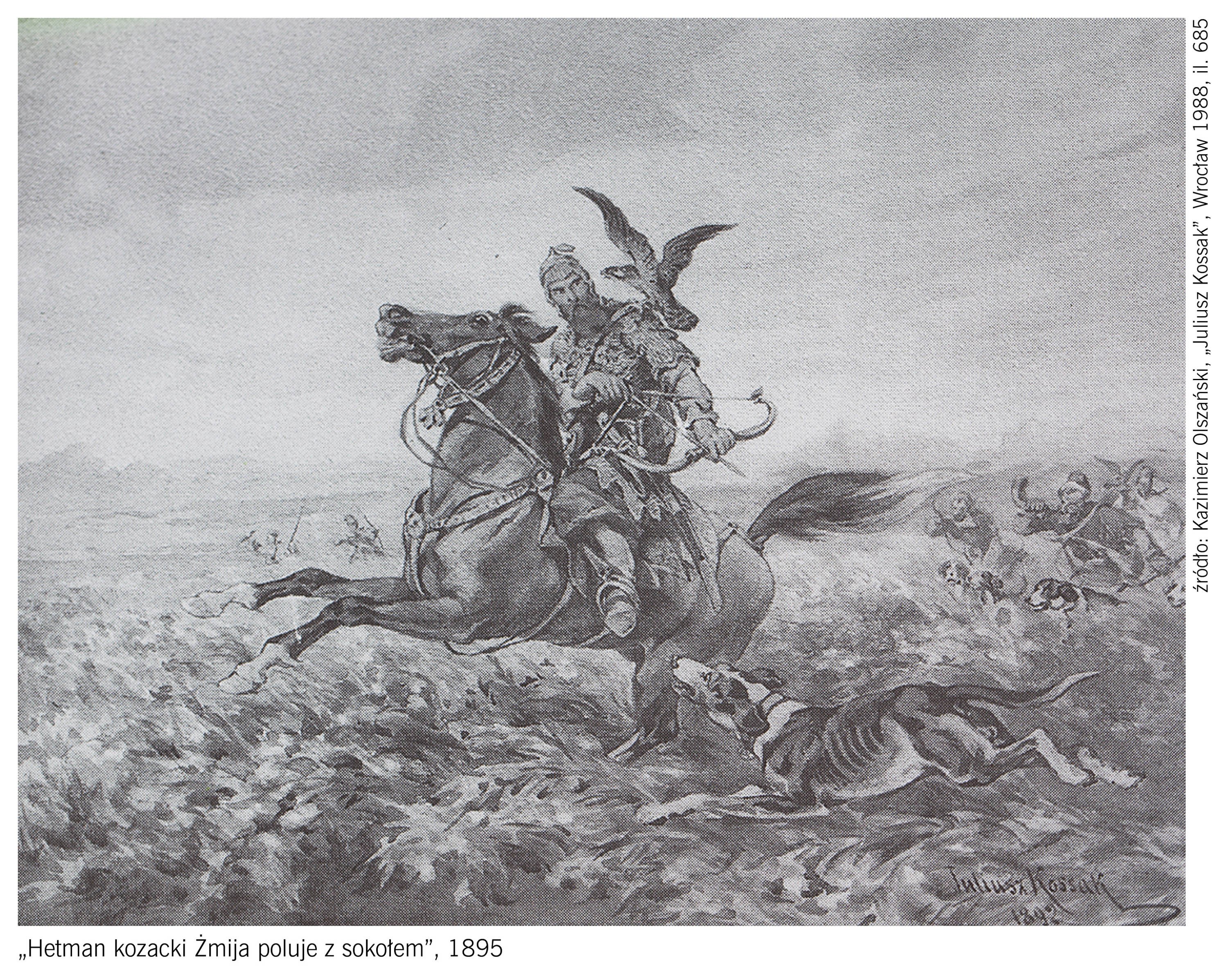
"Hunting scenes were one of the main themes of Juliusz Kossak's work. He painted them from the mid 1840s until the last months of his life. He knew the subject exquisitely, as he was invited to the magnate estates of the Potocki, Dzieduszycki, Branicki, Stadnicki, Sapieha, Tarnowski families, as well as to the manors of the nobility, participating dozens of times in hunting for big game, small game and fowl. He immortalized these events, capturing portraits of the most important members of the families participating in the hunts, riding groomed, thoroughbred horses, surrounded by hunters, hounds leading packs of well-maintained hunting dogs and a crowd of invited guests. A special form of hunting scenes were equestrian portraits of aristocrats, with greyhounds and stallions. He also painted historical hunting scenes, e.g. "Jan III Sobieski's hunt for deer" 1884, "Jan III Sobieski's hunt with falcons for herons", "Hunting trip with a falcon", 1868 (Upper Silesian Museum, Bytom). His excellent knowledge of hunting laws, made him the illustrator of Wincenty Pol's "The Year of the Hunter", a kind of hunting calendar, and at the same time a natural science work containing a description of the changing natural phenomena and the image of the sky during the year. He made twelve drawings illustrating descriptions of the aura of vegetation, the behavior of various species of animals, and hunting customs and laws specific to each month of the year." "The art of hunting with game birds survived in the Borderlands of the Republic until the end of the 18th century and disappeared with the spread of firearms in hunting. Falcons also testify to the high social status of the prime mover, as they were very expensive birds because they were rare, for which trips were made to Crimea, Sweden or Norway, and difficult to catch. Falcons trained or, as birders said, groomed for hunting had the value of thoroughbred horses in the time of King John III Sobieski. Falconry was maintained mainly at royal courts and magnate residences. Hunting with falcons had been the privilege of the rulers and the mighty aristocracy for centuries." "Juliusz Kossak took up the subject of the Cossack Hetman - Zmia - several times in his works. The first version of the watercolor was created in 1892. (il. I) It was a faithful pictorial representation of Słowacki's poem. The 1895 variant, on the other hand, is characterized by greater freedom and freedom from the strict literary original. (il. II) The featured watercolor, as well as the cited earlier examples, depicts a hunting scene on the steppe. "For the purpose of the work's plot, Słowacki made Zmija the son of a Turkish bash, exterminated by order of the Sultan, as a result of a slanderous denunciation by another dignitary who wished to take his position. Zmiya, as the son of a traitor, was exiled from Natolia. In the hands of the bash was left his beloved, Zulema. Zmiya fled to Sich, where years later he became the leader of the free Cossacks. He lived a double life. He secretly professed the Mohammedan faith, and sometimes, disguised in Turkish garb, ventured out alone on the steppe, costing the life of a wild goon. He was adored by the Cossacks, but deep down he hated them. Sometimes he would sneak out alone from his castle in Chartomelik and join Turkish wadas venturing into Zaporizhzhia, burning Cossack settlements with them and slaughtering the Cossack population. But he also more than once led Cossacks on expeditions to the Bosphorus, burning and looting Turkish towns. He dreamed of revenge against the man who had ruined his life. Before one of his expeditions, Hetman Viper, dressed in Turkish garb, set out on horseback on the steppe in his customary manner. His companions, wanting to make food supplies, set out to hunt suhak (steppe antelope) with dogs and falcons. They spotted a lone Turkish knight among the tall grasses. They attempted to capture or kill him. Shots rained down in the direction of the hetman. In his direction ran one of the greyhounds and flew one of the falcons. The Cossacks' arrows did not reach Zmiya, but they killed his favorite animals, which recognized him even in disguise and wanted to greet him." Cossacks are surprised by this armor of gold, It must be some Tartar chief? Let the ogres go: one of the ogres is already catching up with him, ha! You'll see! The stallion is an old one, it will do well, It jumps on his chest - and in terrible agony It will rip his life out, crush him, choke him - It has already caught up with him - an unexpected thing! Jumps on his chest, licks his hands, At his feet he lays down, - howls, hisses: After all, this is an ogre! - Hetman's ogar! The first of the stallions! So famous in Sicha! Sometimes he tracked down a Tartar in a ravine And today he found his master in a Tartar. And the Tartar is flying and breaking the grass. Look! - and a falcon perched on his shoulder, How strange! Strange! The Hetman's falcon! He sat on his shoulder, ruffles his feathers, It seems that with his wing he nags him on the run. J. Slowacki, Viper. A poetic romance from Ukrainian tales in six songs, song I, v. 199-220, in (the quoted excerpts are from the 2015 opinion by Ms. Waclawa Milewska).


![Juliusz Kossak (1824-1899), Wincenty Pol, winieta do Mohorta, [1860]](https://img1.one.bid/img/366/53247_1w.webp)










최근 확인한 경매
경매품 리스트를 확인하려면 로그인하세요
관심있는 경매품
경매품 리스트를 확인하려면 로그인하세요