Description
Bronze, wood; height 17 cm
Asking price 2800
Estimate 3500 - 4000
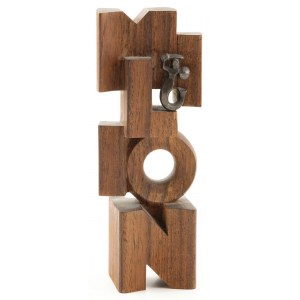
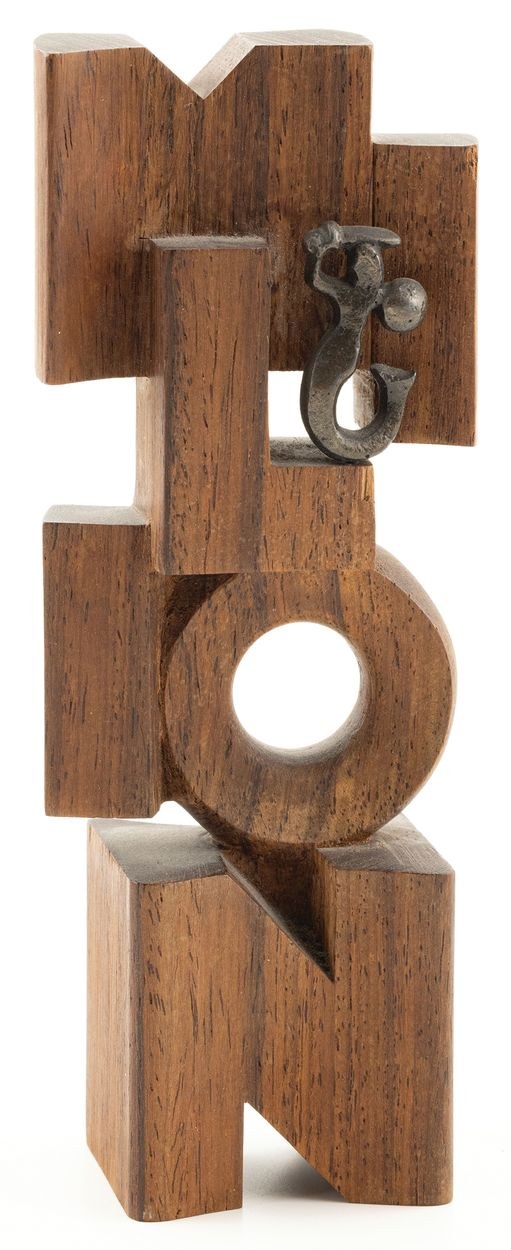
Warsaw, first reached one million residents in 1924. The second time Warsaw recorded a million residents was in 1955. To mark the occasion, sculptor Stanislaw Sikora designed a small statue called "Million" - a small vertical inscription of "million" with the city's symbol - a mermaid - placed in its center. The intimate sculpture was made in wood, the artist's favorite material. In the work one can see certain motifs, references to the sculpture of the so-called Zakopane school, but also the motif of the mermaid, undertaken by the sculptor as a hobby, processed here as a symbol of the city. The artist attached great importance to simple form and economy of means: The search for the simplest forms, which nevertheless have the ability to express and feel the shape of nature, seems to be the most important sculptural issue for Stanislaw Sikora.
Stanislaw SIKORA
1911 Stryszawa - 2000 Warsaw
He received the basics of his artistic education at the State School of Wood Industry in Zakopane. In Warsaw, with which he became associated for the rest of his life, he studied at the Academy of Fine Arts. An important area of Sikora's activity was medal making. His favorite materials included, besides wood, marble, bronze, granite and ceramics. His works were repeatedly exhibited and awarded at home and abroad. Among other awards, the artist won First Prize and Gold Medal in the prestigious international competition in Arezzo in 1965, Grand Prix at the International Exhibition of Painting and Sculpture for the Grand Prize of Prince Rainer III in Monte Carlo. He is also the author of monuments, including the Murdered at Mautthausen, the Swiatowid in Copenhagen and the composition "Poland" in London, as well as statuesque sculptures: Andrzej Frycz Modrzewski, Nicolaus Copernicus, Fryderyk Chopin and Maria Skłodowska- Curie. Among the extremely successful are the artist's gravestone monuments, which complemented the monumental monumental sculpture. Among them it is worth mentioning those created for Tadeusz Kulisiewicz, Stanislaw Dygat or Stefan Jaracz.