


Guido Reni
Bologna 1575 - 1642 Bologna, attributed
Saint Sebastian
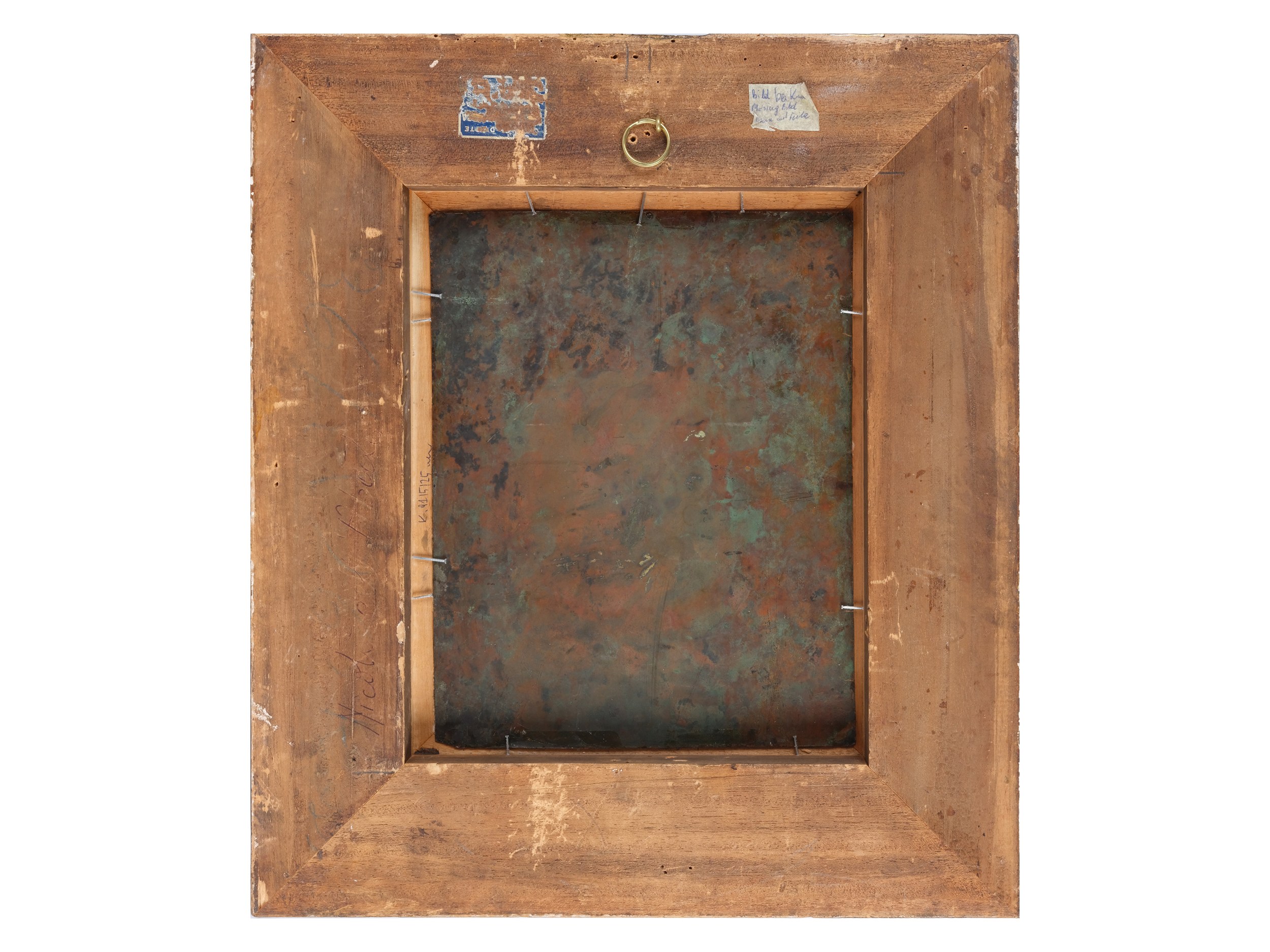
Oil on copper
23.5 x 18.5 cm, with frame 38 x 33 cm
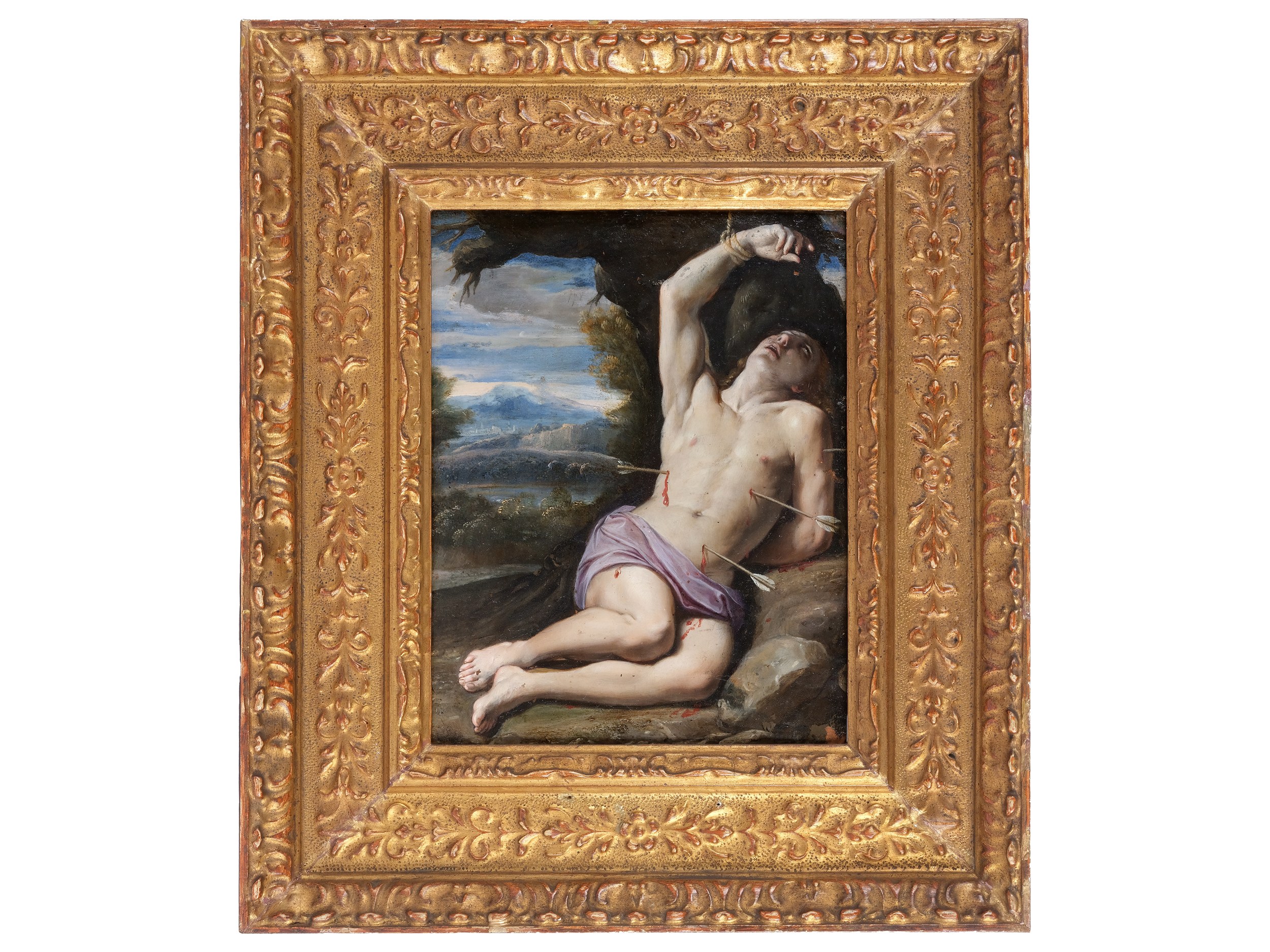
This is a depiction of Saint Sebastian, attributed to Guido Reni. Guido Reni was born in Bologna in 1575 and is considered one of the most important painters of the Italian Baroque period. After training with Denys Calvaert and the Carracci, he developed a style that combined naturalistic observation with classical harmony. During his stay in Rome from 1601 onwards, he engaged in artistic dialogue with Caravaggio, whose dramatic use of light he transformed into an idealized, almost supernatural style of painting. After returning to Bologna in 1614, Reni ran a successful workshop and, with his religious paintings, shaped the image of a spiritualized, aesthetically transfigured piety. His figures, bathed in light and imbued with grace, embody a balance of beauty, suffering, and redemption.
Saint Sebastian was a Roman officer who was persecuted under Emperor Diocletian for his Christian faith. After being tied to a tree and pierced by archers, he initially survived, reaffirmed his faith, and was eventually beaten to death. In art, Sebastian has since been regarded as a symbol of suffering and spiritual purity—a martyr whose body hovers between pain and grace.
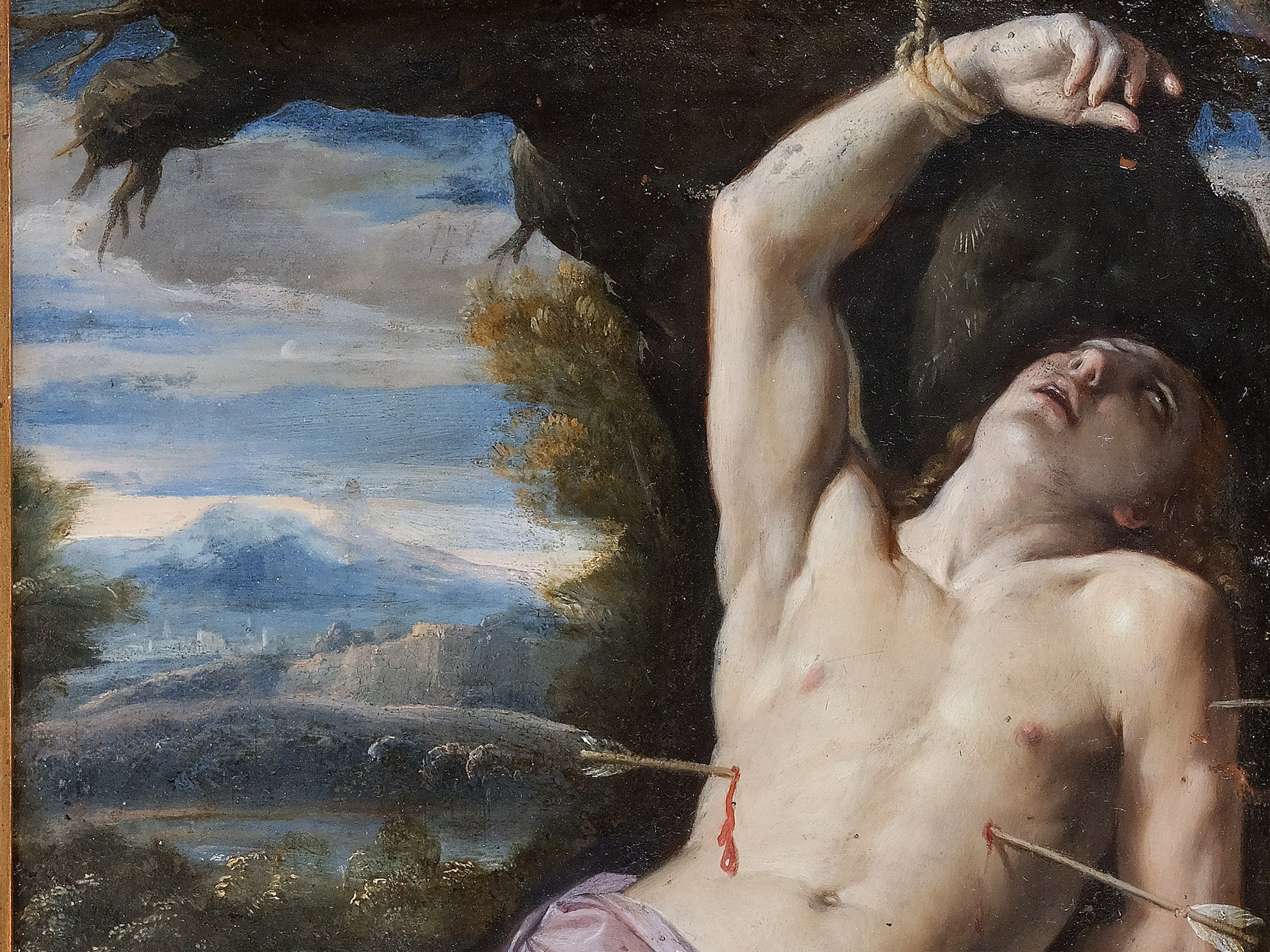
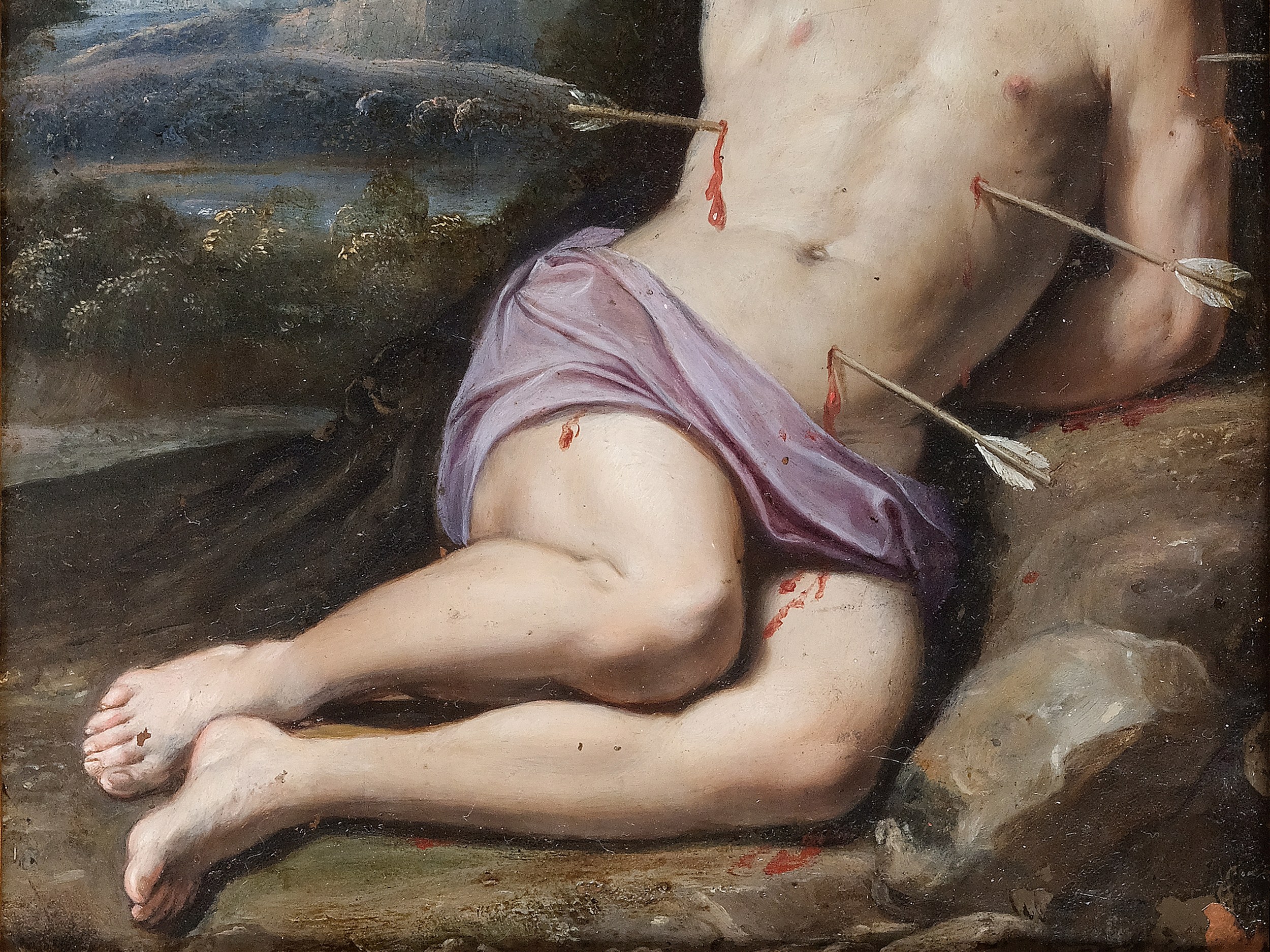
In the foreground of the painting, the saint is depicted naked, clothed only in a purple loincloth. He is tied to an old tree trunk with his right arm raised above his head. His body forms a dynamic S-line: his head is thrown back, his gaze directed upwards, between rapture and unconsciousness. His left hand is clasped behind his body, his legs are bent to the left and depicted as slightly cramped. Several arrows pierce his body, blood trickling from the wounds. The saint lies half against a rocky outcrop that supports his posture. The tree and rock frame the saint, who stands at the center of the composition. The lighting is of central importance: the light source falls directly on the body, whose flesh tone appears almost white. In this way, the muscular body is dramatically staged in its martyrdom in order to arouse compassion and sympathy in the viewer.
On the left, a peaceful landscape opens up with a lake, trees, and a hilly mountain range. The sky changes from light blue to gathering gray—a mood that reflects the dramatic events in the foreground. The moment depicted by Reni shows the saint shortly after being shot by the arrows, after he has already fallen to the ground: alone, left to his fate, and yet still tied to the tree with one arm. This connection prevents him from falling completely and emphasizes the moment between life and death. His mouth is slightly open, his eyelids heavy, his long hair falling over his shoulders. The contrast between the light-colored body and the dark tree trunk further emphasizes the figure of the saint.
The motif follows the typical iconography of Saint Sebastian, but Reni lends it a special emotionality. Compared, for example, to Jusepe de Ribera's depiction of Sebastian from 1651, who looks up to the sky with an open posture, Reni's figure appears introspective and spiritualized. He is not alert, but introverted, the pain shifted inward. While Ribera shows the dramatic moment of intercession with God, Reni hints at a state of exhaustion, the slow surrender of the body, physical and spiritual devotion. The twisted posture increases the dynamism and expression of suffering, the stigmata becoming part of an almost idealized staging of the body. Particularly impressive is the fine folds of the purple perizonium, which underscore Reni's pursuit of formal elegance.
In this composition, pathos merges with physical beauty. Reni makes martyrdom not only a representation of pain, but also a representation of enlightenment: Saint Sebastian becomes a symbol of divine purity, his body a bearer of light. This spiritualization and the pursuit of an ethereal ideal of beauty make Guido Reni's work the epitome of Baroque devotion and a visualization of the Catholic faith in the 17th century.











최근 확인한 경매
경매품 리스트를 확인하려면 로그인하세요
관심있는 경매품
경매품 리스트를 확인하려면 로그인하세요