


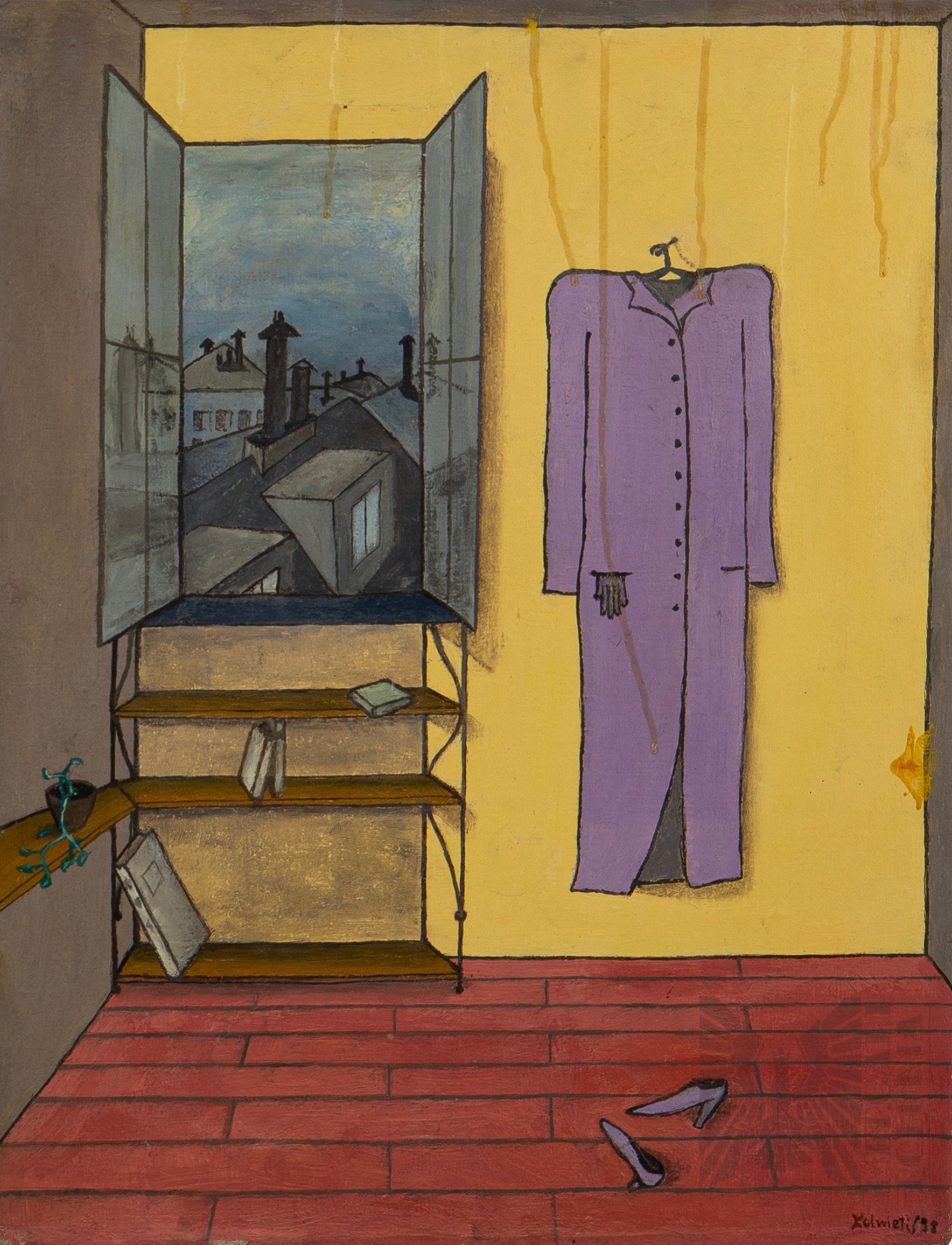
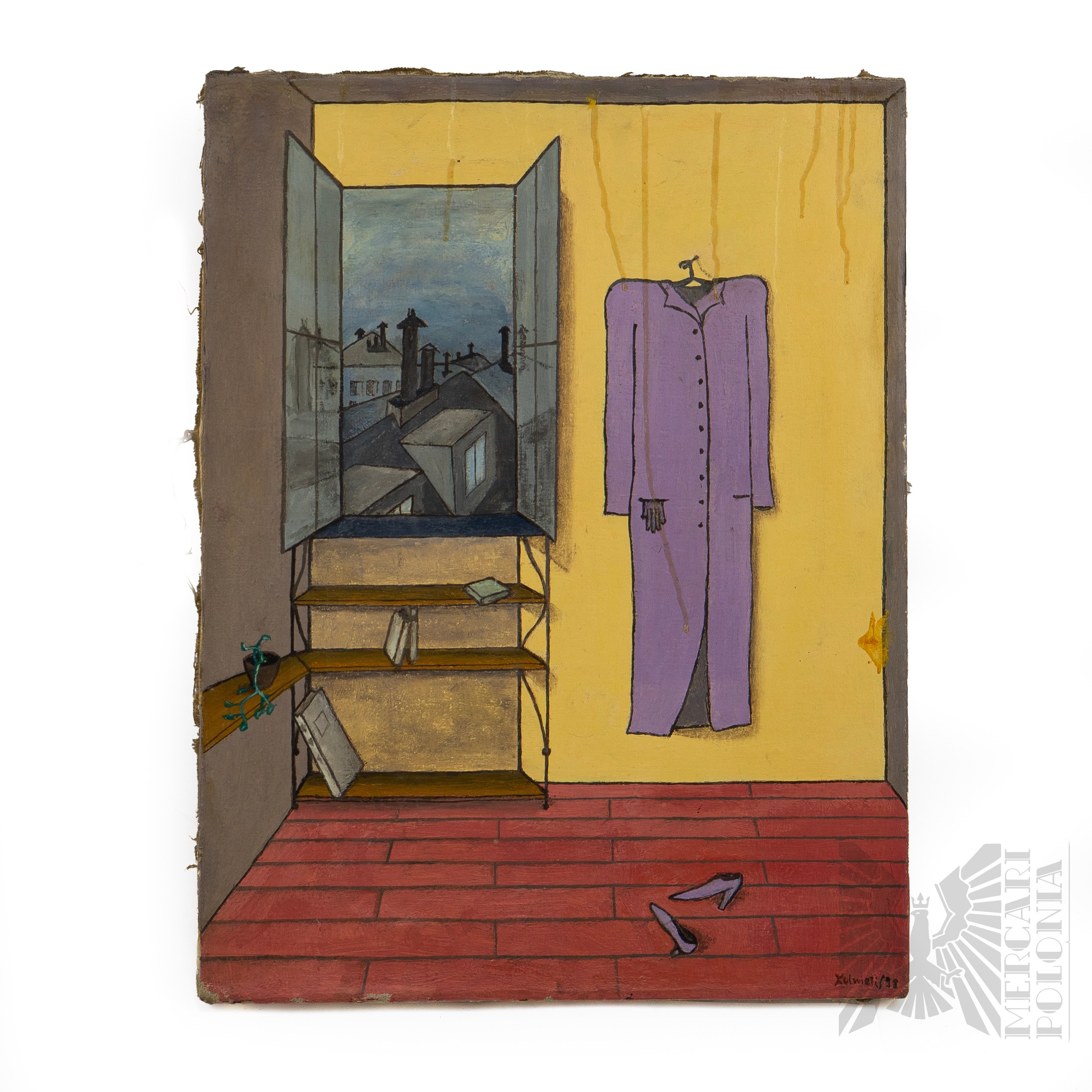
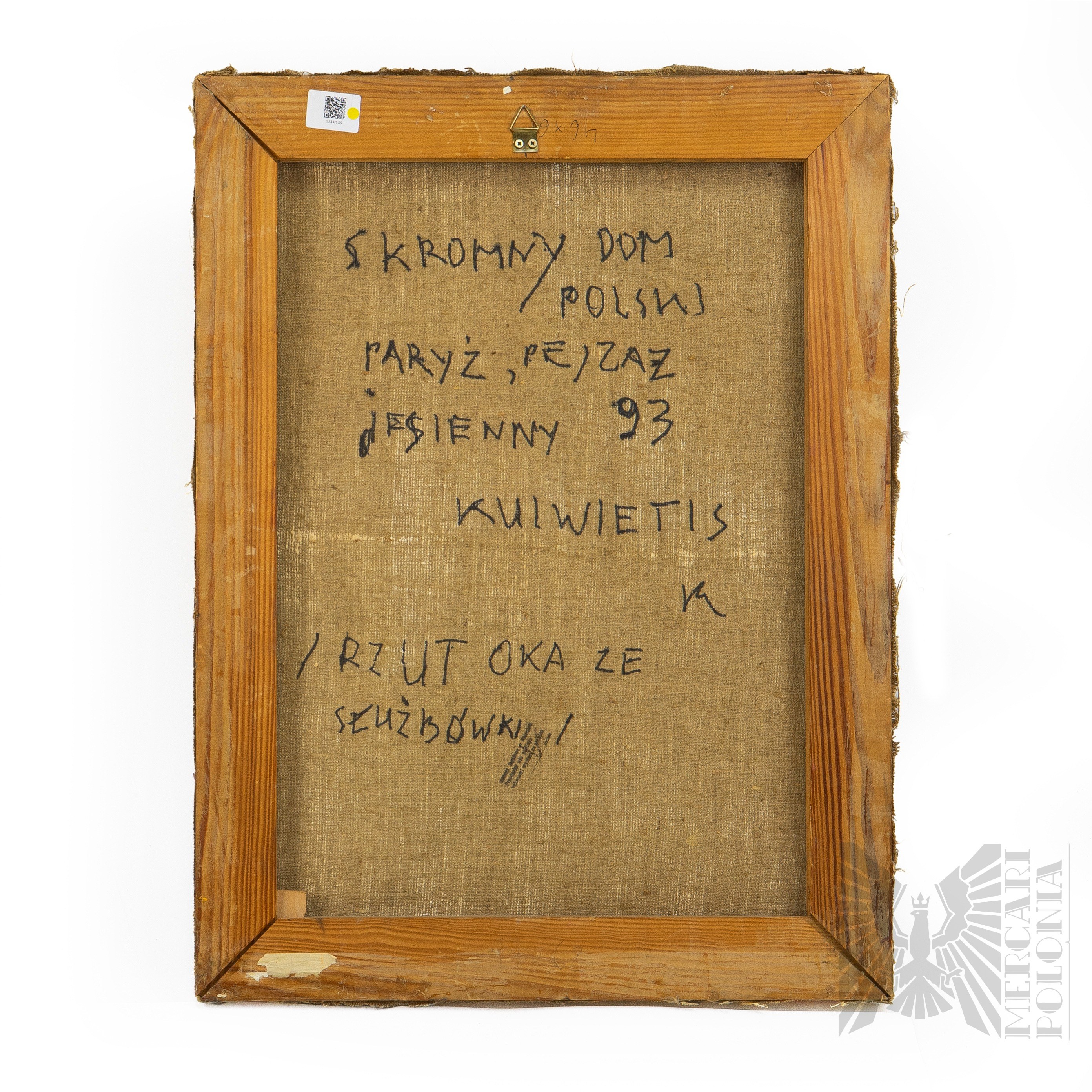
The interior of a room (an office) with a view through the window of a gray-blue autumn landscape in Paris. The decor is minimalist—the only piece of furniture is a bookshelf; on the wall hangs a purple coat, and next to it, on the floor, are high-heeled shoes matching the coat’s color. The walls are yellow, and the floor is brick. Oil on canvas, signed “Kulwietis 93,” with the following inscription by the artist on the reverse: “A Modest Polish Home, Paris, Autumn Landscape 93, A Glance from the Staff Apartment, Kulwietis K.”
Condition as shown in the photos.
Dimensions: 46.5 cm x 61.8 cm
Condition as shown in the photos.
Krzysztof Kulicki (1938–2026)—Polish scientist (chemist), writer, painter, and social activist.
He was born on February 7, 1938, in Warsaw. He earned a degree in chemistry and a Ph.D., after which he began his research career in the team of Prof. Sylwester Kaliski at the Institute of Plasma Physics and Laser Microsynthesis at the Military University of Technology. He conducted research on thermonuclear energy, for which he received the Minister’s State Award.
In the 1980s, he worked as a chemistry lecturer at the University of Tiaret (Algeria). After returning to Poland, he was affiliated with, among others, the Central Research and Development Center for Research and Teaching Equipment “Cobrabit.” He also conducted research on water treatment technologies, developing his own patented solutions in this field.
At the same time, he pursued literary and artistic activities. He made his debut as a writer in 1972 with the novel *Straight Ahead*. He is the author of over a dozen works of prose, including *Those Few People* (1974), “Niedobre ulice” (1978), “Zbiegowie z ulicy snów” (1979), “Plac Zgody” (1982), and “KIF” (1989). His later book, “Wehikuł czasu.pl” (2022), is autobiographical and serves as a summary of his life experiences.
He was a member of the Polish Writers’ Union (Warsaw Branch). From 2006 to 2013, he served as the founder and president of the Association for the Promotion of Polish Creativity.
As a painter, he worked under the pseudonym Kulwietis, a reference to his family’s Lithuanian roots (the surnames Kulwieć/Kulvietis). He began creating art in the 1990s, exhibited his works in Warsaw galleries and abroad (including in Paris, at the renowned “Bastille” art fair), and his paintings are found in private collections in the West. Kulwietis’s paintings were executed in a distinctive style characteristic of art brut, and he often depicted female portraits.
He died on January 8, 2026, in Warsaw. He was buried at the Powązki Military Cemetery.
He left behind a body of work that combined scholarly, literary, and artistic pursuits, exemplifying an artist with wide-ranging interests and interdisciplinary activities.











최근 확인한 경매
경매품 리스트를 확인하려면 로그인하세요
관심있는 경매품
경매품 리스트를 확인하려면 로그인하세요