


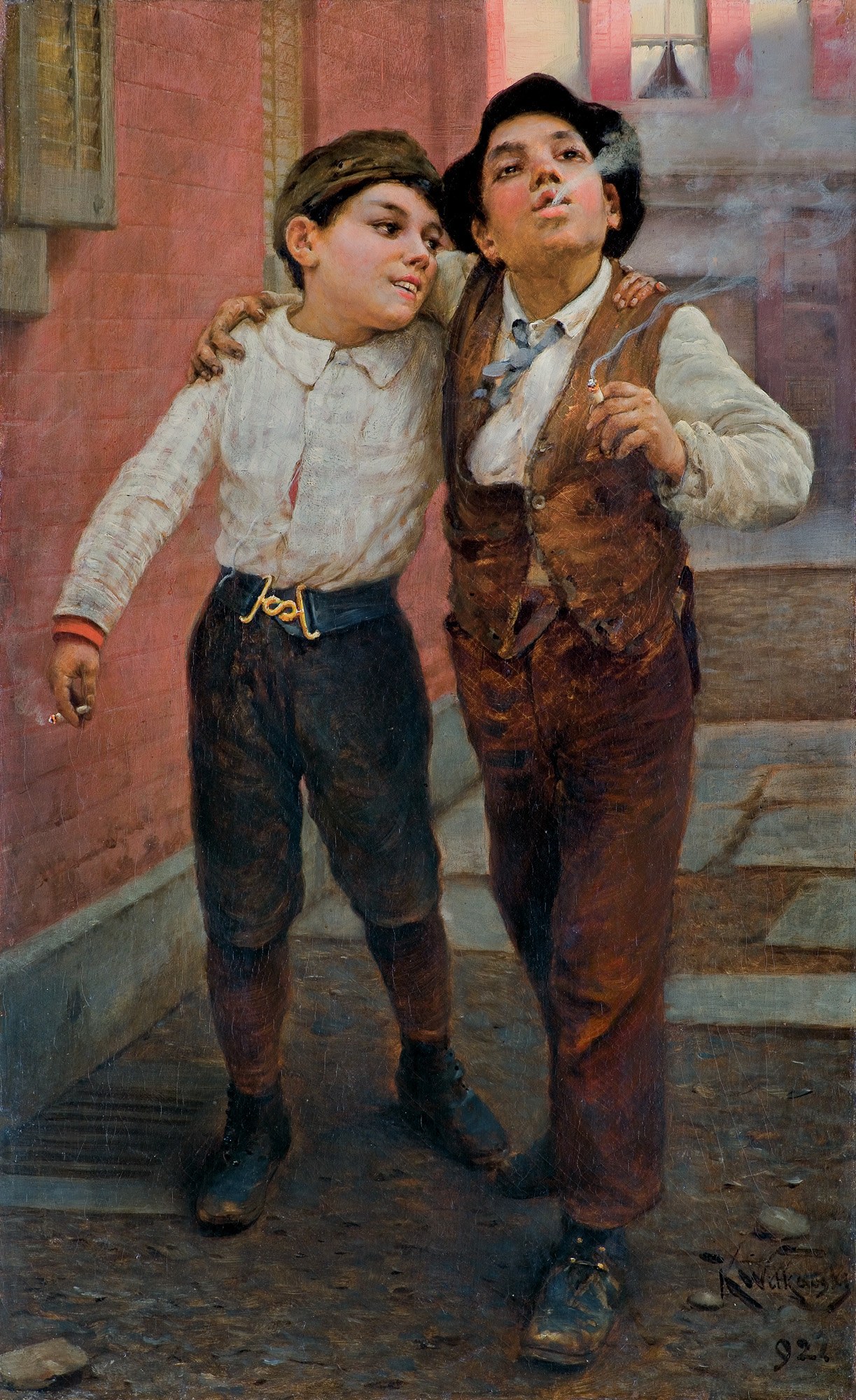
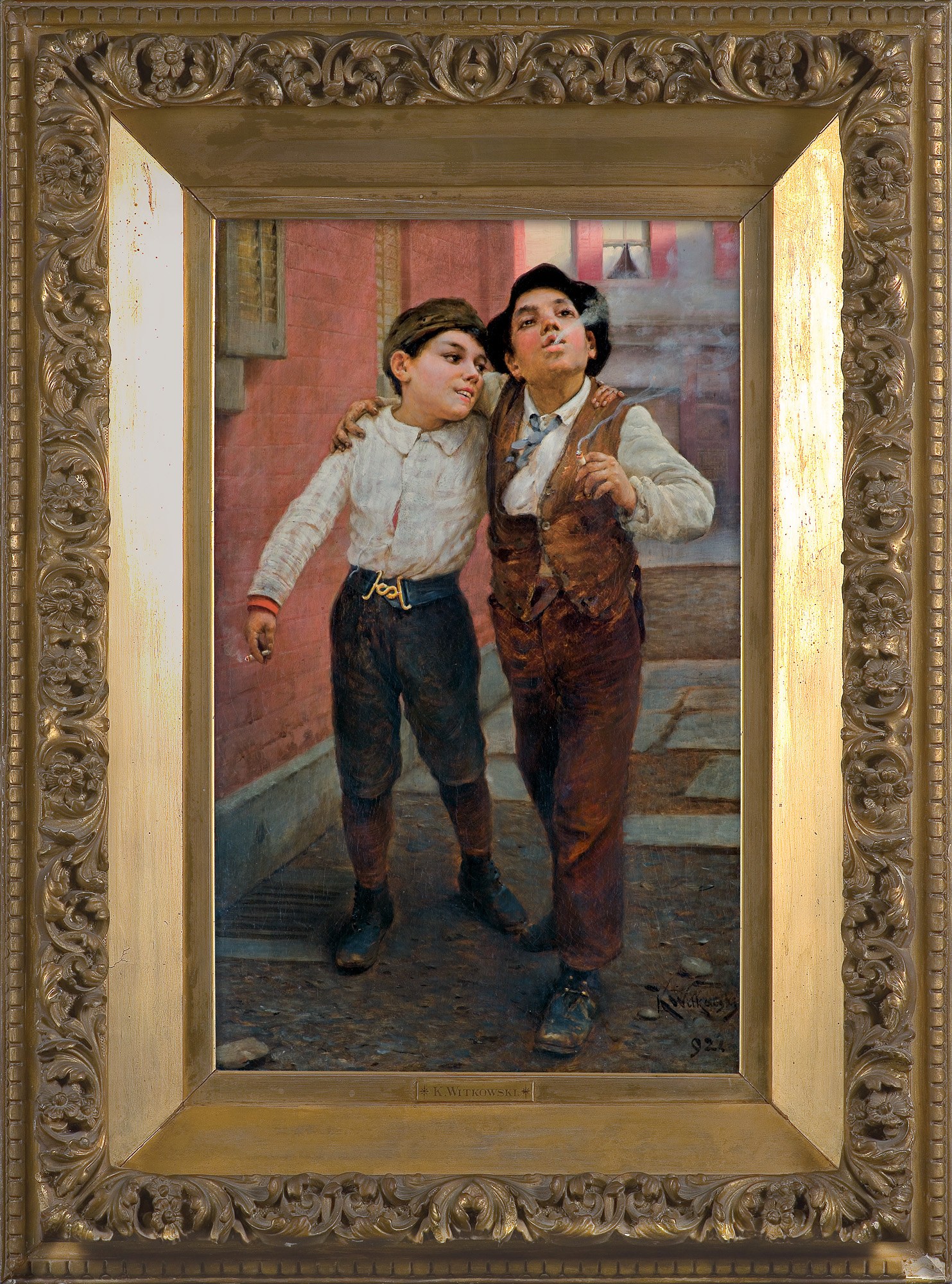
66 x 40.5 cm - oil on canvas
signed lower right: K. Witkowski | 92 [date repeated]
This painting by Karl Witkowski, a Polish--American artist, a student of Jan Matejko and Karl von Piloty, depicts two young, poor boys walking side by side down a city street with lit cigarettes in their hands. The older of the two, wearing a vest and a hat, has his arm around his companion, which lends the entire scene a playful air of feigned adulthood. Despite their modest attire, their clean faces and cheerful gazes reflect the painter’s tendency to idealize the image of street children.
Although Witkowski was a sought-after portraitist of the wealthy elite overseas, it was precisely such scenes depicting newspaper vendors and young flower girls that earned him lasting recognition. This work perfectly combines the realism of everyday life with the sentimentality and humor characteristic of the artist’s work.
Karol Dominik Witkowski (Jazłowiec 1860 – Newark, New Jersey 1910) – a painter of portraits and genre scenes featuring children. In the United States, where he spent half his life, he is known as Karl Witkowski. He was born in Jazłowiec, Ukraine, and graduated from school in Czortków. Drafted into the Austrian army, he drew portraits of officers, including Prince Wilhelm of Württemberg, commander of the XI Corps in Lviv. In 1881, he briefly studied at the School of Fine Arts in Kraków under the guidance of Jan Matejko. In 1882, he began his studies at the Academy of Fine Arts in Munich. Then, in 1884, he left for New York, from where, after three years, he moved to Paris, where he continued his studies at the Académie Julian and exhibited the paintings he created during that time in Parisian galleries. In 1889, he returned to the United States and settled in Newark, temporarily moving to nearby Irvington and Vaisburg. He painted widely acclaimed portraits, but it was his sentimental yet realistic paintings depicting children on the streets of Newark (The Shoeshine Boy, The First Cigarette, The Newspaper Boy, Soap Bubbles) that brought him true, widespread popularity. He exhibited his paintings several times in New York between 1891 and 1910. They also appeared in various galleries and at art auctions. Many of them were published as large-format reproductions. A significant number of the artist’s paintings are housed at the Newark Museum.










최근 확인한 경매
경매품 리스트를 확인하려면 로그인하세요
관심있는 경매품
경매품 리스트를 확인하려면 로그인하세요