


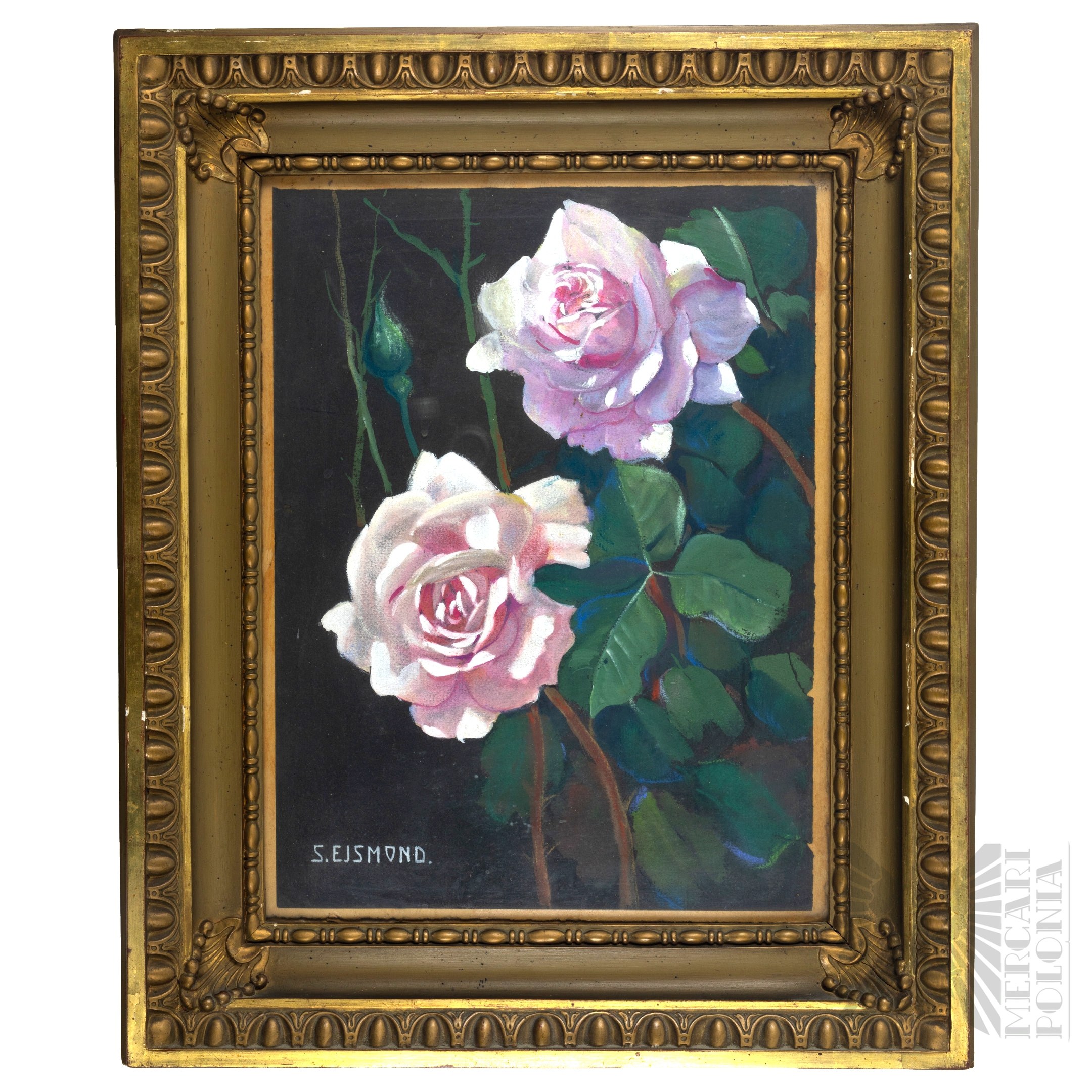
Stanisław Ejsmond (1894–1939), “Roses,” pastel on cardboard
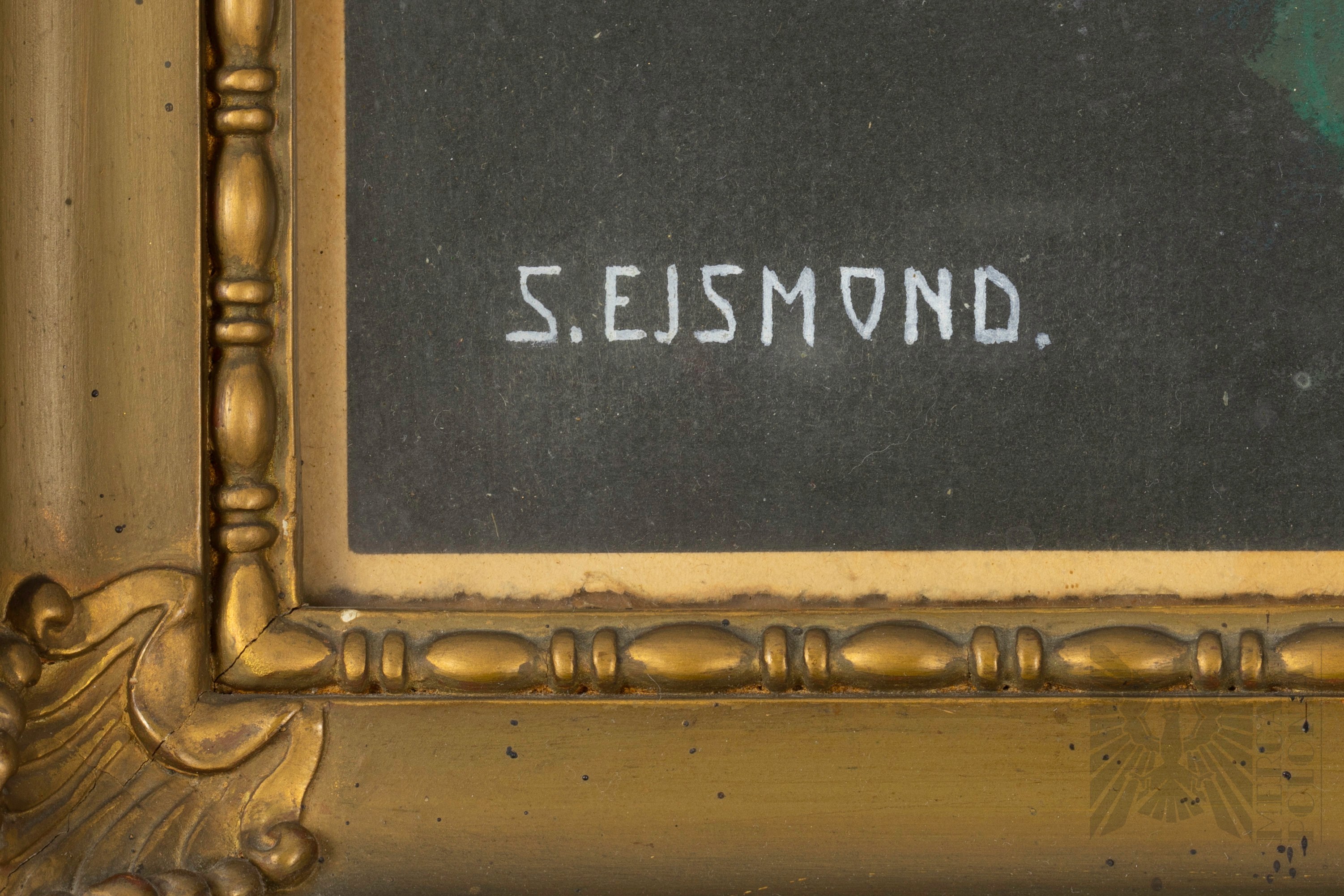
Poland, first half of the 20th century. Dimensions of the work: 31 × 23 cm; dimensions with frame: 45 × 37 cm. Signed in the lower left corner: “S. EJSMOND.”
A vertical composition depicting two fully bloomed roses and a closed bud on leafy stems. The flowers are arranged diagonally: the larger one in the upper right part of the composition, the other lower down on the left. The petals are in shades of white, light pink, and cool violet, with darker accents within the flowers. The leaves and stems are rendered in deep greens, occasionally transitioning into shades of blue and brown. The dark, greenish-black background highlights the bright rose blooms, drawing the viewer’s attention to them.
The work is an intimate floral study. The soft modeling of the petals is contrasted with the more defined lines of the stems and leaves. The variation in tones and subtle transitions in light and shadow emphasize the three-dimensionality of the flowers and the delicacy of their surfaces.
Mounted in a wide, profiled frame with a gilded surface, decorated with bands of repeating ornamentation and corner floral motifs. The work is mounted behind glass.
Painting Dimensions: 31 cm x 23 cm
Frame Dimensions: 45 cm x 37 cm
Stanisław Ejsmond (1894–1939) was primarily a painter of flowers, but he also participated in the rescue of the collection of Warsaw’s Zachęta Gallery in September 1939. This latter aspect constitutes an important addition to his biography.
He was born in Dąbrówka. He studied painting under his father, Franciszek Teodor Ejsmond, a representative of genre painting associated with the tradition of the Munich School. He made his debut in 1910 at the Zachęta in Warsaw, with which he remained associated as an exhibiting artist and an activist in the Society for the Encouragement of Fine Arts.
He most often painted flowers, though he also created portraits and still lifes with hunting motifs. He worked in oil, watercolor, and pastel. His floral compositions were not merely a side project: at the General National Exhibition in Poznań in 1929, he exhibited two watercolors—“Roses” and “Rhododendron.”
His interest in this subject emerged early on. As early as the June 28, 1913, issue of *Tygodnik Ilustrowany*, a reproduction of his *Poppies* was published; A piece of this reproduction is part of the collection of the National Museum in Warsaw. This is concrete evidence of the young painter’s presence in the art world of that time.
With regard to the pastel shown here, it is particularly significant that the flowers are treated as a subject in their own right: without a vase or elaborate props, with an emphasis on the arrangement of the petals, color variations, and light. Bright roses emerging from dark green foliage create a decorative composition grounded in careful observation of nature.
In September 1939, Ejsmond, as vice president of the TZSP, participated in escorting Jan Matejko’s “The Battle of Grunwald” and “Skarga’s Sermon” to Lublin. He was killed during the bombing of the city.











최근 확인한 경매
경매품 리스트를 확인하려면 로그인하세요
관심있는 경매품
경매품 리스트를 확인하려면 로그인하세요