color woodcut, ink, paper, 40x27 cm, artist's signature, publisher's mark on the back
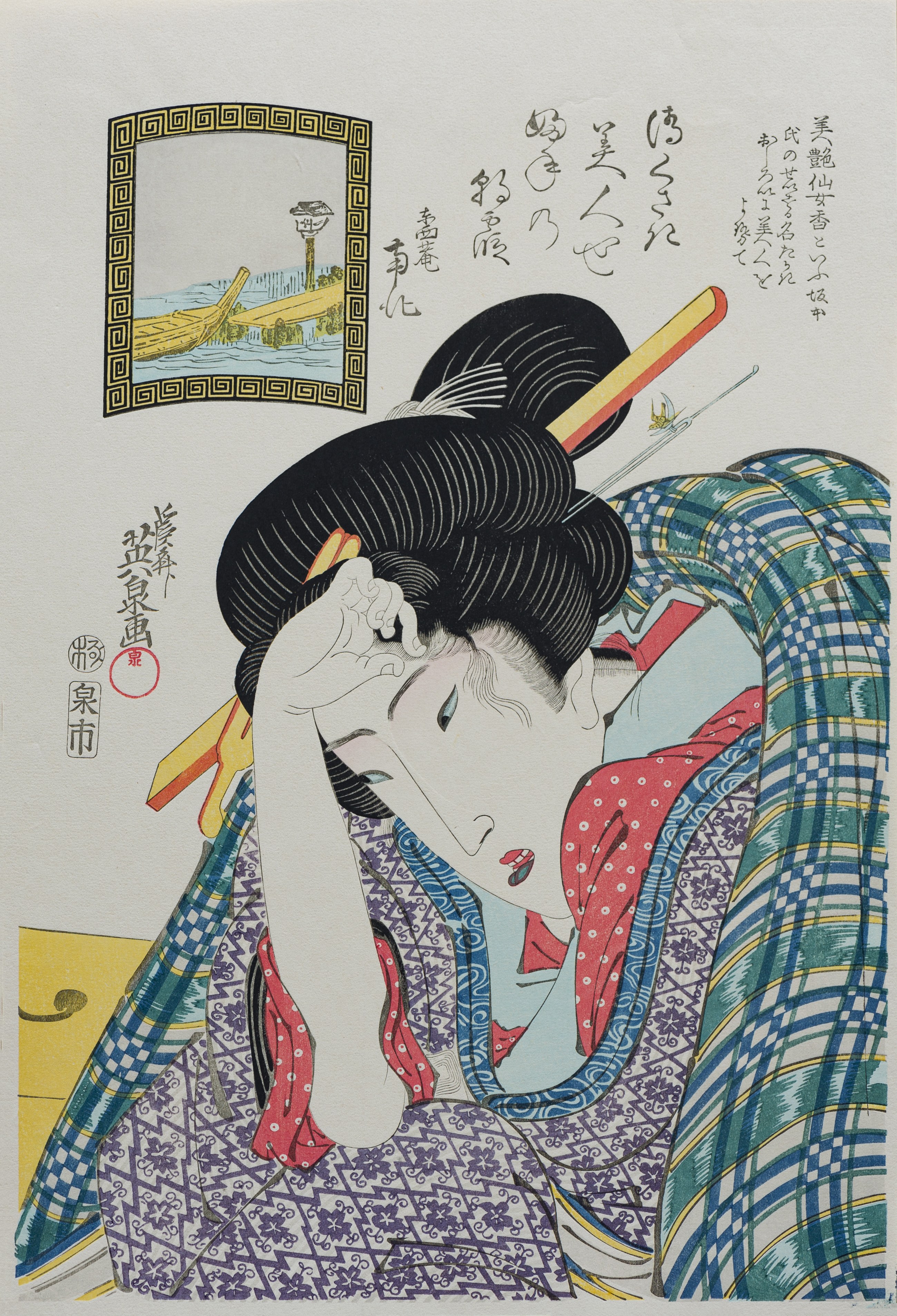
The original Japanese title Asagasumi (Morning Mist) and the depiction of an empty, docked boat suggest that the lady was entertaining a client during a party on the river the previous evening. A rather unusual feature of this design is the small inscription in the upper right corner, which is an advertising text stating: "The famous Bien Senjo-ko face powder, produced by Sakamoto, adds beauty to beautiful women." This appears to be "product placement."
Keisai Eisen, also known as Ikeda Eisen, is widely regarded as one of the prominent figures in Japanese woodblock printmaking, along with well-known artists such as Kunisada and Kuniyoshi. While Kunisada gained notoriety for his kabuki prints and Kuniyoshi became known for his depictions of warriors, Keisai Eisen focused primarily on creating stunning prints of bijin (beautiful women) that still captivate collectors today. Keisai Eisen was born in 1790 in Edo (now Tokyo), where he absorbed the city's vibrant culture. His father, a respected calligrapher and poet, introduced Eisen to the world of brushwork, and young Zenjiro (Eisen's childhood name) began formal training under Hakkeisai, a master of the Kano painting style. After the death of his father, Eisen sought the help of Kikugawa Eizan, one of the leading masters of bijin-ga. Under Eizan's tutelage, Eisen honed his craft and began to develop his own distinctive style. At the beginning of his career, Eisen's works were strongly influenced by his master's romantic style, but in the early 1820s Eisen began to create his own artistic identity. Eisen's artistic style is characterized by a unique sensuality. Unlike the earlier bijin-ga prints, which emphasized grace and idealization, Eisen's works depicted a more worldly, overt sensuality, with an emphasis on open sexuality. This tendency is even more evident in his erotic prints. Eisen was a highly educated man. He wrote under the pseudonym Ippitsuan and was well known for his writings about life in a flowing world. In his autobiography, "Notes of a Nameless Old Man," Eisen portrayed himself as a reckless drunkard and a frequent visitor to Yoshiwara, Edo's famous red-light district. His writings reflect a deep commitment to the pleasures of the moment, but also reveal the intellectual side of his work.
The ukiyo-e woodcuts have been printed several times since the Edo period, always using the traditional method. The best publishers in Japan adhered to the same rigorous standards as 19th century publishers. In the 1950s and 1970s, as interest in Edo period woodcuts increased again, the reissue of prints by great masters from the golden age of Ukiyo-e began. Some of the world's finest printmakers and carvers were employed for this purpose. The resulting works are among the highest quality editions ever produced.





![Eisen Keisai (1790-1848), Oiran [kurtyzana najwyższej rangi], ok. 1830-1845](https://img1.one.bid/img/8771/2639842_1w.webp?1761412103)