


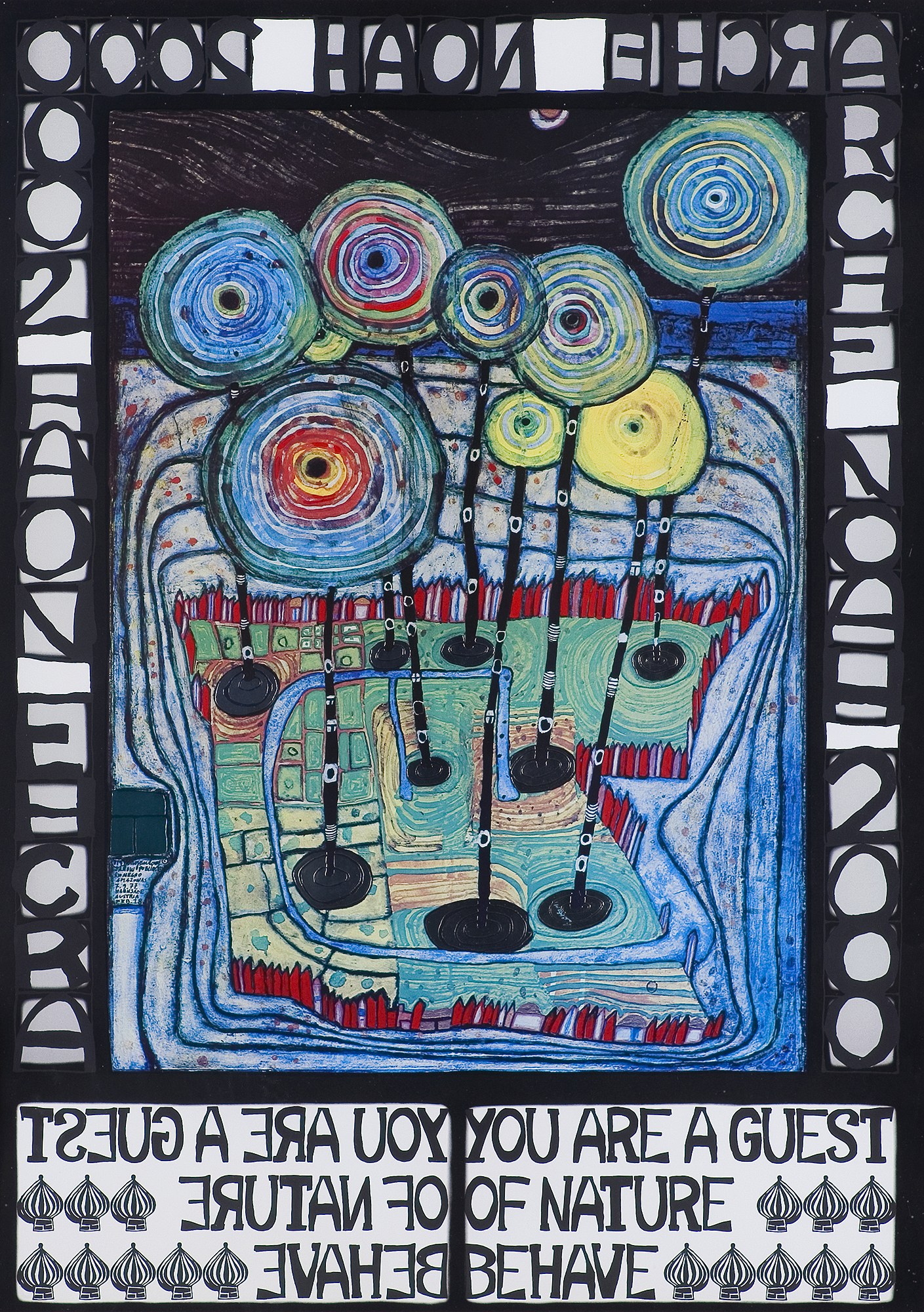
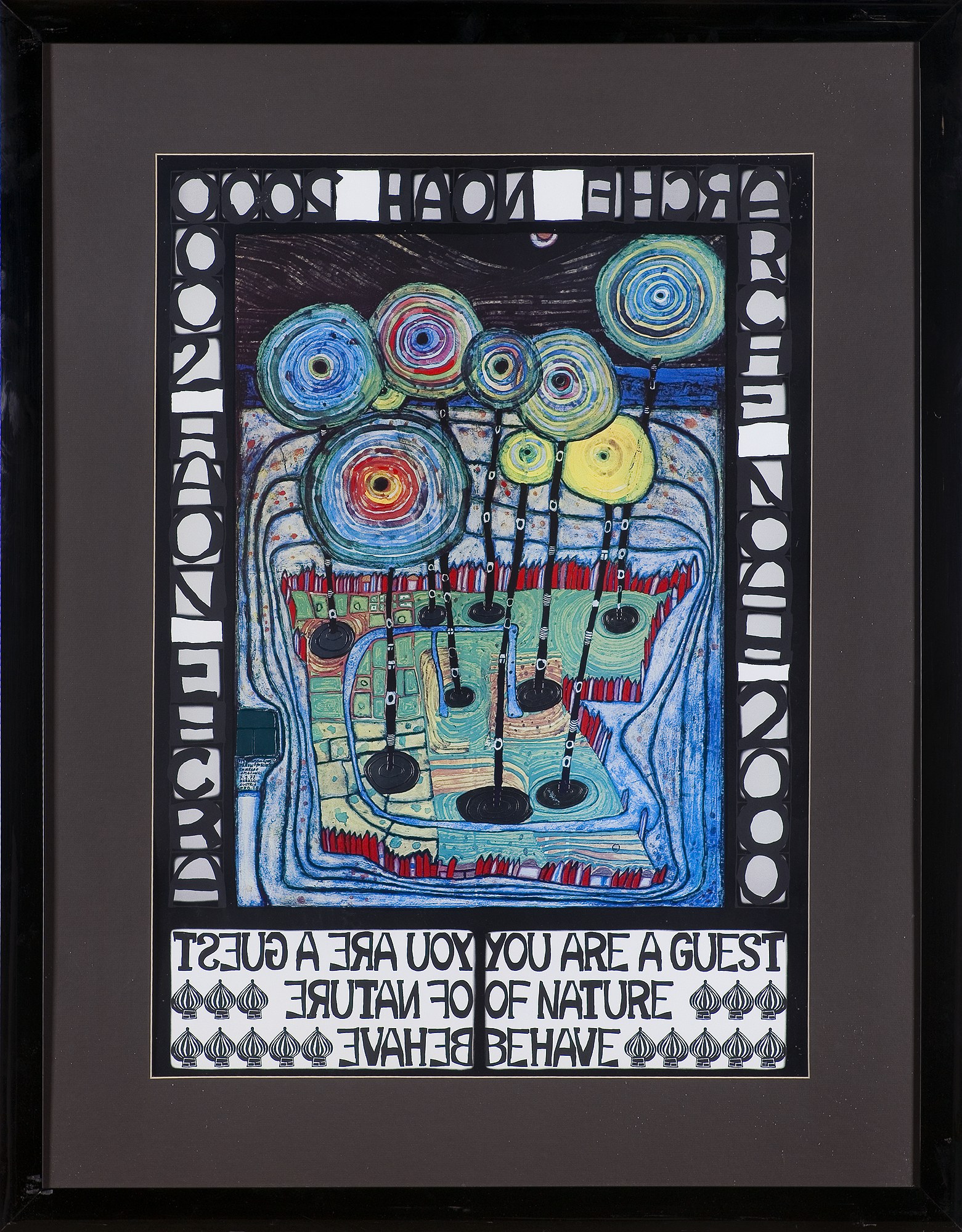
81.0 x 57.5cm - color offset, paper
81 x 57.5 cm (in light passe-partout)
l.d. metric from plate: 775 [in circle] Hundertwasser © | JARDIN PUBLIQUE | RIO NEGRO | AMAZONAS | 7.9.77. | HAHNSACE [?] | AUSTRIA | FEB.78
Friedrich Stowasser began his studies at the Vienna Academy in 1948, but abandoned them after 3 months in favor of extensive travel in Europe (Italy, France). He remained an autodidact, most strongly influenced in his early youth by the art of Gustav Klimt and Egon Schiele. His own distinctive style, a combination of the restless, edgy Art Nouveau of these two ancestors with the Neo-Expressionism and Informel-type abstraction he encountered in Paris, took shape around 1949. That year he changed his name to Hundertwasser (he did not adopt the name in its final form until 1961). In 1953 he painted his first spiral, from then on a constant motif in his work. The artist's life and career were spent in constant travel around the world. In 1976, in connection with an exhibition at Warsaw's National Museum, he also visited Poland. During these trips he worked and exhibited, and also gave lectures, sometimes combined with art actions. In 1959 he won a prize at the 5th Sao Paulo Biennale, in 1962 he exhibited at the Venice Biennale, in 1964 his retrospective in Hanover was accompanied by the first catalog of his oeuvre. From 1968, aboard the sailing ship "Regentag," he traveled the seas of Europe, and in 1973 sailed for the first time to New Zealand, which he was to visit more frequently from then on. In the late 1970s and early 1980s he began to promote pacifist and ecological ideas, designing emblems, stamps, posters, organizing actions, etc. In 1980 the first architectural designs for an "open house" were created, and in 1983 the so-called Hundertwasser House in Vienna - both completed in 1986. His lavish, decorative, folkloric art was popular with both the public and critics.











최근 확인한 경매
경매품 리스트를 확인하려면 로그인하세요
관심있는 경매품
경매품 리스트를 확인하려면 로그인하세요