


[WARSAW—Kanonia Street in the Old Town—panoramic photograph]. [1925]. Photograph, 11.1 x 16.4 cm, by JanBułhak in Vilnius.
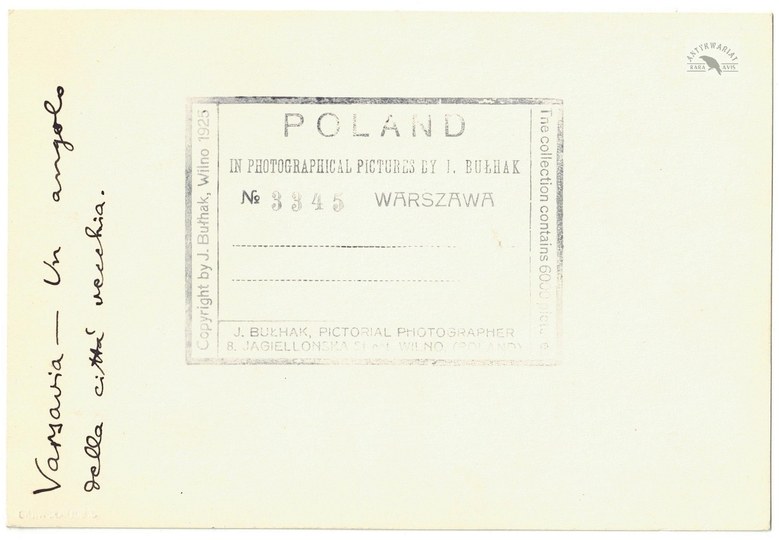
A picturesque view of the buildings lining the street, which takes the form of a three-sided square located behind St. John’s Cathedral in Warsaw, between Dziekania and Jezuicka Streets; the street’s name refers to the canonries —the homes of the canons of St. John’s Collegiate Church. (Wikipedia). In the lower right corner, the imprint reads: “J. Bułhak Vilnius.” The photograph is part of the author’s series “Poland in Photographs by Jan Bułhak.” On the reverse, a stamp reads: “POLAND in photographic pictures by J. Bułhak. No. 3345 WARSAW / J. Bułhak, Pictorial Photographer, 8 Jagiellońska Street. Vilnius (Poland) / The collection contains 6,000 pictures / Copyright by J. Bułhak, Vilnius 1925” and a handwritten identification in ink, in Italian. In very good condition.
J. Bułhak (1876–1950)—an outstanding Polish photographer, the doyen of Polish photography, a philosopher and theorist, founder of the Vilnius Photo Club in 1927, and a co-founder of the ZPAF after World War II. He established his first studio at the urging of Ferdynand Ruszczyc. For a time, he worked in Hugo Erfurt’s studio in Dresden. His first works in Vilnius were created between 1912 and 1919 and were devoted mainly to landscapes and monumental architecture. It was precisely these themes that became central to his work, and he focused primarily on them for the rest of his life. He was a pioneer of landscape photography. His collection of approximately 10,000 photographs, “Poland in Photographic Landscapes,” and his photo archive of Polish and foreign images were destroyed by fire in Vilnius in 1944. After the war, through 1946, he took approximately 1,000 photographs documenting the destruction and reconstruction of Warsaw and approximately 2,000 photographs from the Western Territories. He published numerous albums, portfolios, and postcards featuring photographs, mainly from the Borderlands and especially from the Vilnius region. He was also the author of many textbooks on the aesthetics and techniques of photography and regional studies, as well as the initiator of historical research on photography.











최근 확인한 경매
경매품 리스트를 확인하려면 로그인하세요
관심있는 경매품
경매품 리스트를 확인하려면 로그인하세요