


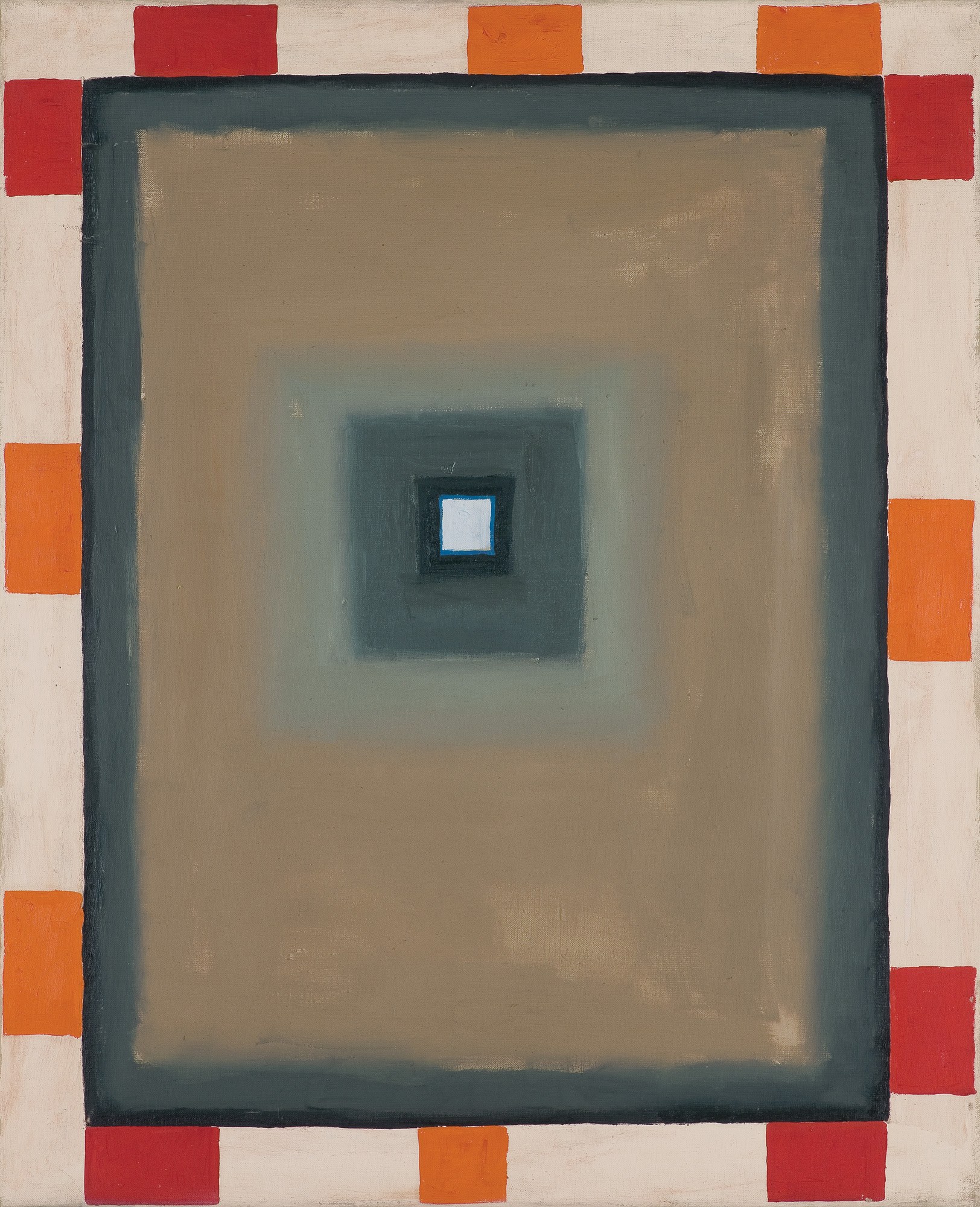
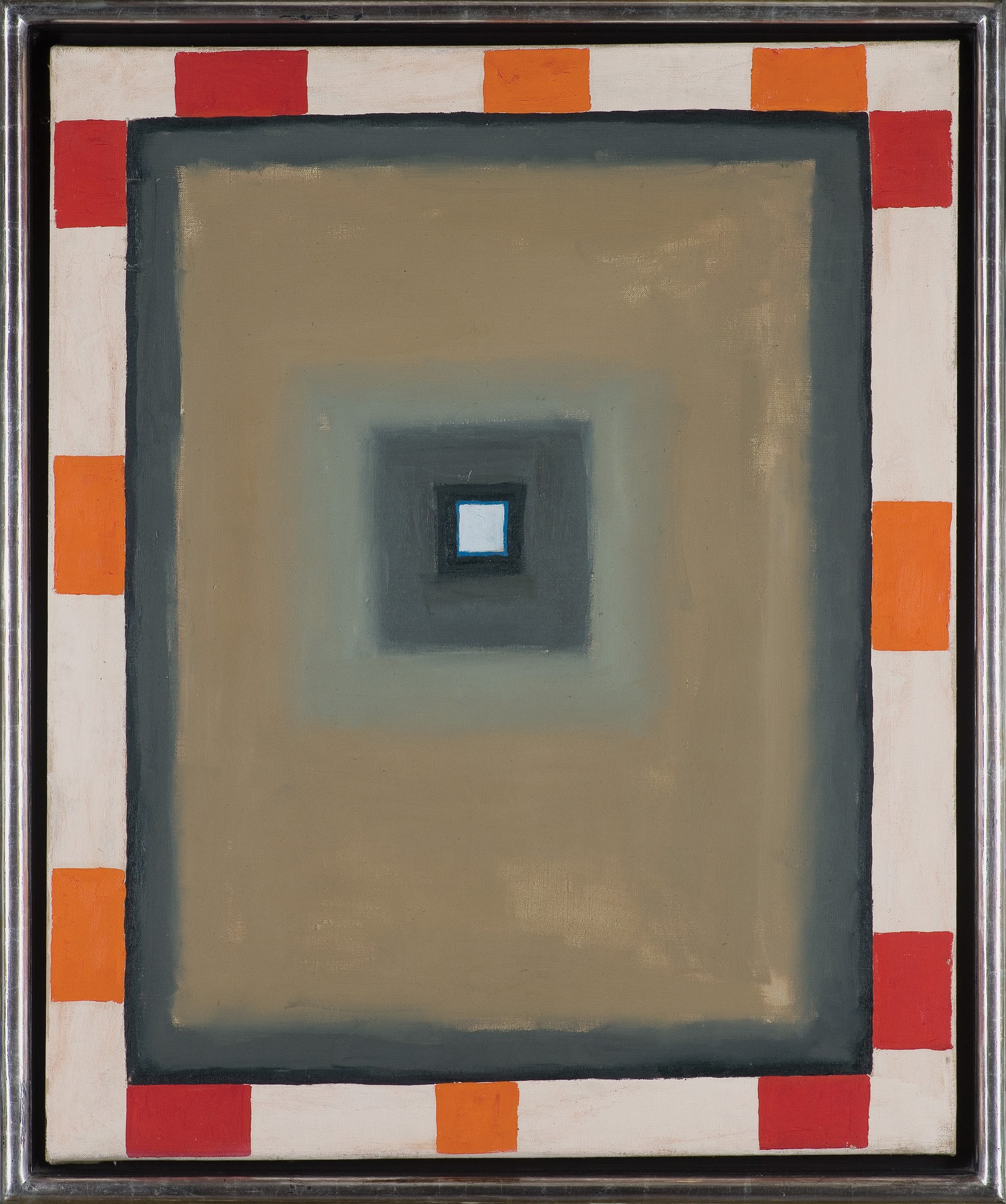
100 x 81 cm - oil on canvas
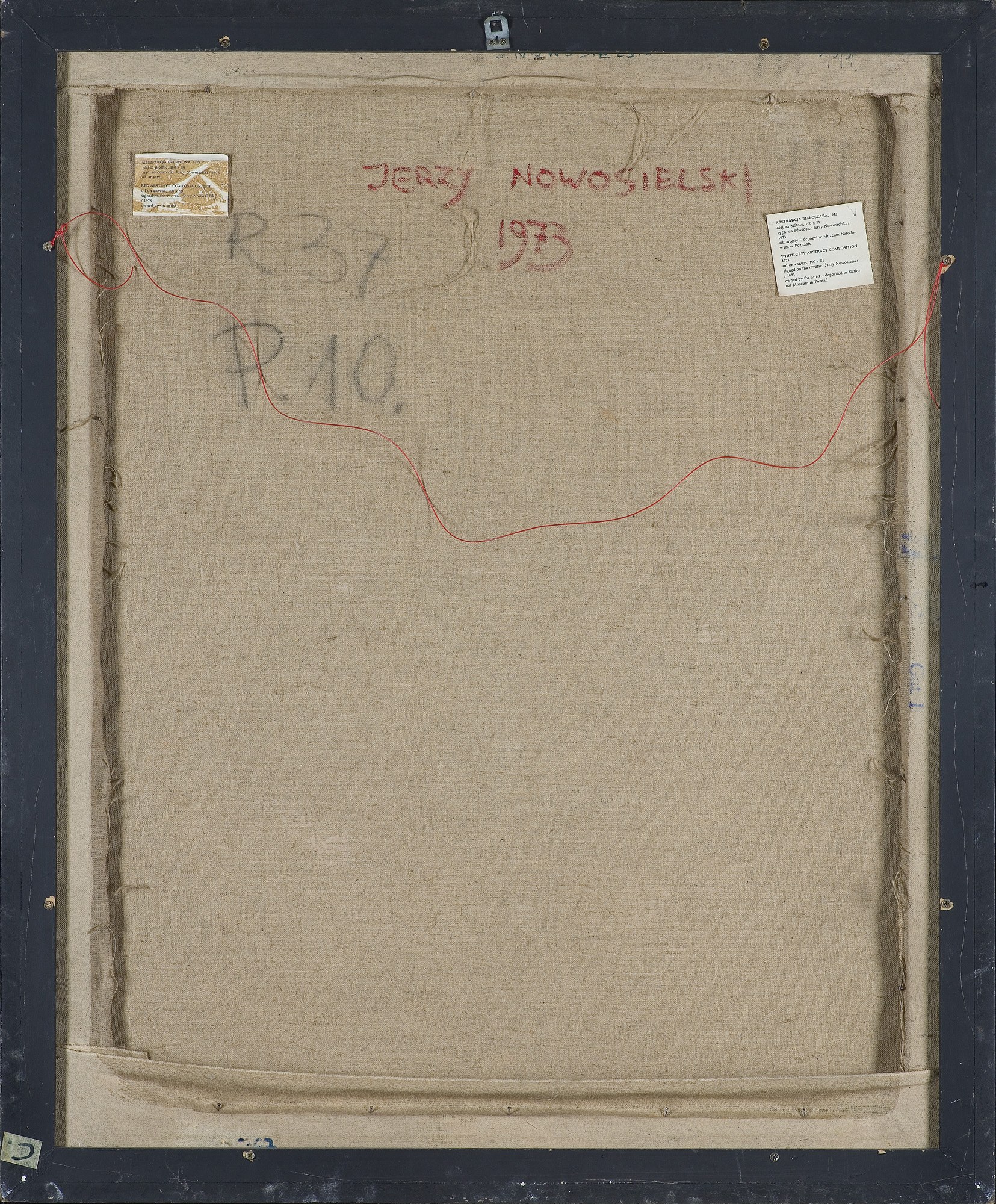
signed on the reverse, center: JERZY NOWOSIELSKI | 1973, in crayon, lower left R 37 | P. 10., above on the rolled edge of the canvas, center: J. NOWOSIELSKI, bottom: 111
On the reverse, top left and bottom right: labels with the painting’s details and information about its deposit at the National Museum in Poznań.
The authenticity of the painting was verified in consultation with Andrzej Szczepaniak—art historian, exhibition curator, and executive director of the Starmach Gallery.
In all of contemporary painting, there is no geometry quite as inspired (...) Nowosielski’s abstraction is the other hemisphere of his painterly world. Without it, he would not spin so precisely and fervently around his own axis and his own sun.
Jerzy Tchórzewski, 1993, quoted in: Krystyna Czerni, *Nowosielski*, Kraków 2006, p. 62
The trend of geometric abstraction began in Jerzy Nowosielski’s work in 1947 and has since been constantly intertwined with figurative painting. This coexistence of two forms of expression was not merely a purely aesthetic choice, but stemmed from a profound inner search. The artist himself emphasized the significance of this tension: This division of my painting into two major currents is significant in that, against the backdrop of this duality—which was a true torment for me—I arrived, as it were, in the heat of an internal struggle, at certain theoretical formulations concerning icon painting (Zbigniew Podgórzec, Conversations with Jerzy Nowosielski, Kraków 2014, p. 210).
Nowosielski saw exceptional spiritual potential in abstract art. He pointed to the connection between abstraction and the icon and repeatedly emphasized that the icon is imbued with the spirit of abstract art. The pursuit of realism and free creation through abstract forms complement one another in icons, existing on equal footing.
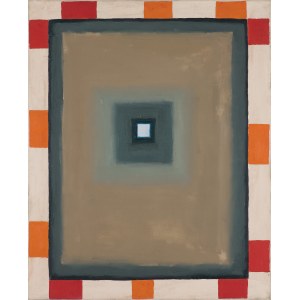
On a formal level, the presented painting mesmerizes with its arrangement of concentrically converging planes in shades of brown and gray, drawing the viewer deep into the composition, to the very heart of its bright, luminous field. The whole is framed by a rhythmic border, reminiscent of the borders found in icon painting.
The painting has been exhibited, mentioned, and reproduced in, among others: The painting has been exhibited, reproduced, and described in:
– Jerzy Nowosielski. Painting Exhibition, BWA Exhibition Pavilion, Kraków, January–February 1974, cat. no. 111;
– Jerzy Nowosielski. Painting, Rzeszów, House of Art, March–April 1975, cat. no. 37;
– Jerzy Nowosielski. Painting, Poznań, Old Market Square, Arsenał, August–September 1976, cat. no. 10;
– Jerzy Nowosielski, ed. Andrzej Kostołowski, Włodzimierz Nowaczyk, National Museum in Poznań, 1993; catalog accompanying the exhibitions: National Museum in Poznań, March 28–May 30, 1993; National Museum in Wrocław, June 25 – September 19, 1993; “Zachęta” Gallery in Warsaw, October 4–November 1, 1993; the painting is listed in the inventory of works exhibited, item 182, p. 267 (under the title White-Gray Abstraction).
– Jerzy Nowosielski, [ed.] Starmach Gallery, Nowosielski Foundation, Kraków 2003, ill. on p. 354, cat. no. 499.
♣ Droit de suite: ♣ A fee resulting from the right of the artist and his heirs to receive remuneration in accordance with the Act of February 4, 1994, on Copyright and Related Rights (droit de suite) will be added to the Purchase Price.
Jerzy Nowosielski (Kraków 1923 – Kraków 2011) began his studies at the Kunstgewerbeschule in Kraków in 1940. In 1942, he spent just under a year at the Lavra of St. John the Baptist near Lviv. There, he studied painting and the history of icons. After returning to Kraków in 1943, he reestablished contact with the circle that would become the Kraków Group. After the war, he continued his studies at the Academy of Fine Arts in Kraków under the supervision of Prof. Eugeniusz Eibisch (1945–1947). At the First Exhibition of Modern Art in Kraków in 1948–49, he exhibited paintings in the style of geometric abstraction. During the era of Socialist Realism, he did not exhibit, instead devoting himself to set design and painting Orthodox and Catholic churches. In 1955, he held his first solo exhibition in Łódź, and in 1956, he participated in the 28th Venice Biennale. From 1957 to 1962, he taught at the State Higher School of Fine Arts in Łódź, and subsequently at the Academy of Fine Arts in Kraków, where he lectured at the Department of Painting until his retirement in 1993. In the second half of the 1950s, he developed a distinctive style for his nudes, landscapes, and figurative interior scenes, which he attributed to his fascination with icons and his experience with sacred art. In 1976, he resumed working on monumental projects, creating, among other things, murals, Stations of the Cross, and stained-glass designs for the Church of Divine Providence in Wesoła near Warsaw (1976–1979). The artist was widely recognized as an authority in the field of art rooted in spiritual values.
Jerzy Nowosielski died on February 21, 2011, in Kraków.








최근 확인한 경매
경매품 리스트를 확인하려면 로그인하세요
관심있는 경매품
경매품 리스트를 확인하려면 로그인하세요