


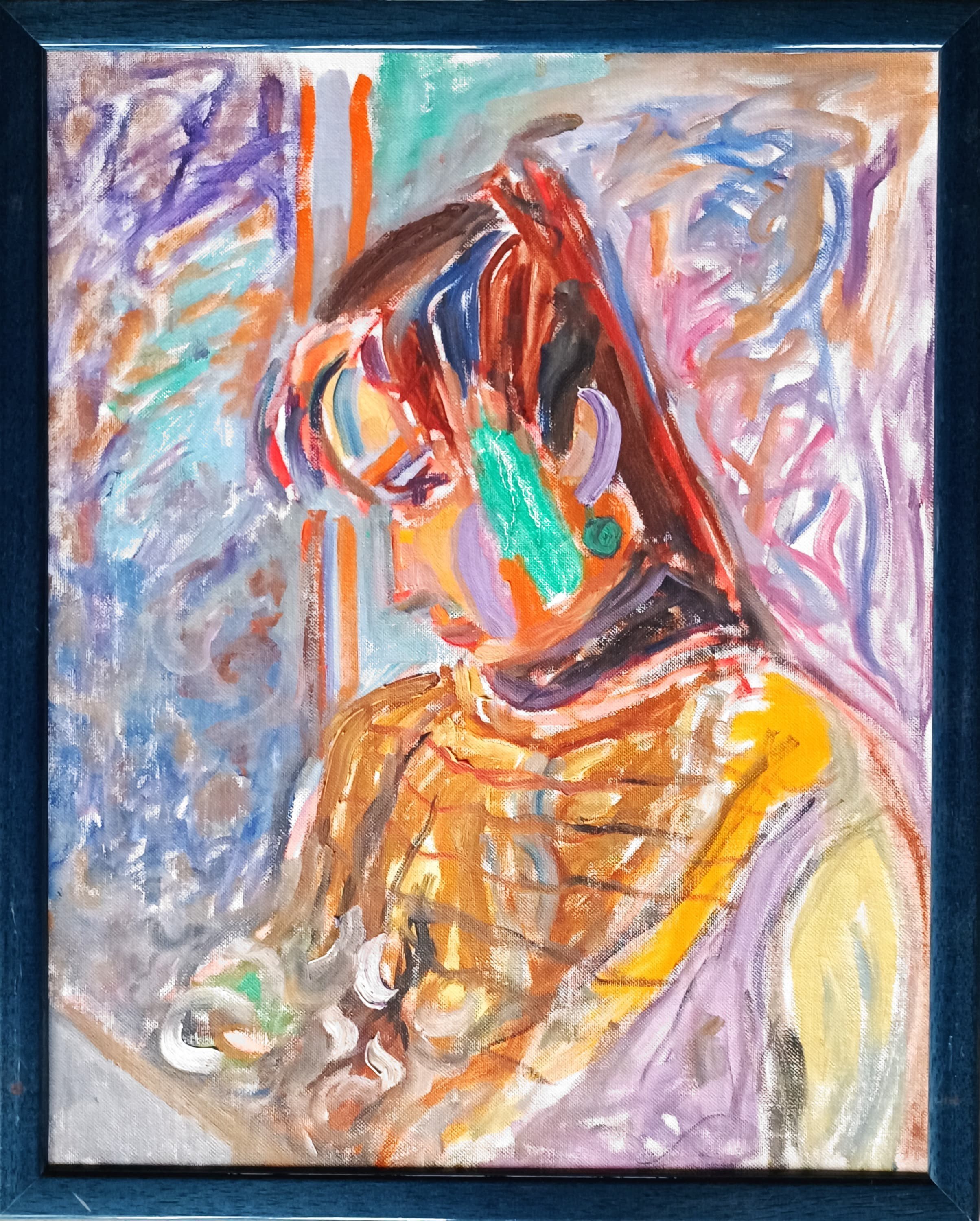
Lutka Pink / by Ludwika Pinkusiewicz (Sznajdla Łaja Pinkusewicz) (1906–1998), Portrait of a Woman
Acrylic on canvas, 54.5 x 44 cm (frame) / 49.5 x 38.5 cm (inside frame)
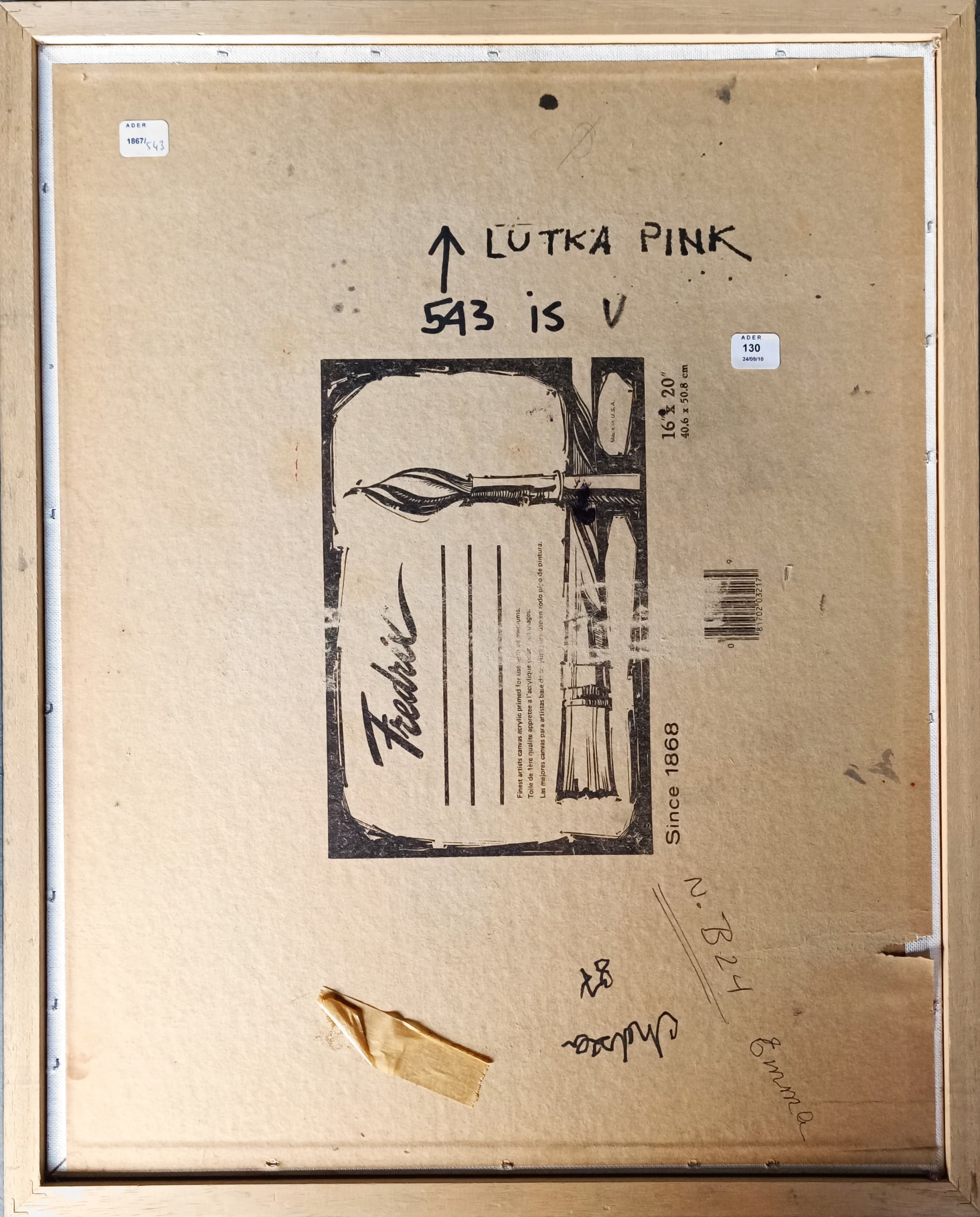
Inscribed on the reverse, signed Lutka Pinka (markings characteristic of the Paris collection of the artist’s heir), dated 1987 (date the painting was created?).
*
Lutka Pink (née Szajndla Łaja Pinkusiewicz) was born in 1906 in Warsaw and graduated from the Warsaw Academy of Fine Arts. In 1933, she settled in Paris with her fiancé, later husband, Kazimierz Zielenkiewicz—also a painter—thanks to a scholarship he had received. During the war, Pink lost the family members who had remained in Poland, while she herself went into hiding in Auvergne and later in Aix-en-Provence. After the war, Pink returned to Paris, but she was less involved with the émigré community and focused primarily on French and international artistic circles. Among her close and distant acquaintances and friends were figures such as Picasso, Braque, Chagall, Ernst, and Restany. In her art, Pink evolved from figurative paintings, clearly inspired by the works of the great 20th-century masters such as Cézanne, Matisse, and the Post-Impressionists—especially the Nabis, whom she knew personally, having met both Bonnard and Vuillard before the war; the latter helped her secure a French government scholarship—toward abstraction. Starting in the 1960s, Pink traveled back and forth between Paris and New York, a fact that is also clearly evident in her work, where, beginning in the 1960s, one can find not only the influence of European abstraction but also that of American abstraction, such as de Kooning. Toward the end of her life, Pink came full circle, so to speak, returning to figurative art. Pink’s work fits perfectly into the international artistic trends of the postwar period, and its defining characteristic—whether the work is abstract or figurative—remains its immense spontaneity, expressiveness, the dominance of color—which, however, is not aggressive but full of energy—perfectly reflecting Pink’s own persona, as she cited “the joy of life, nothing but the joy of life” as her main inspiration. Lutka Pink died in New York in 1998. As early as the late 1940s, she was a well-known and acclaimed artist, exhibiting her works in numerous solo exhibitions around the world and participating in group exhibitions, including such renowned ones as the Paris Salon des Réalités Nouvelles, and her works are held in prestigious collections around the world.
[JR]










