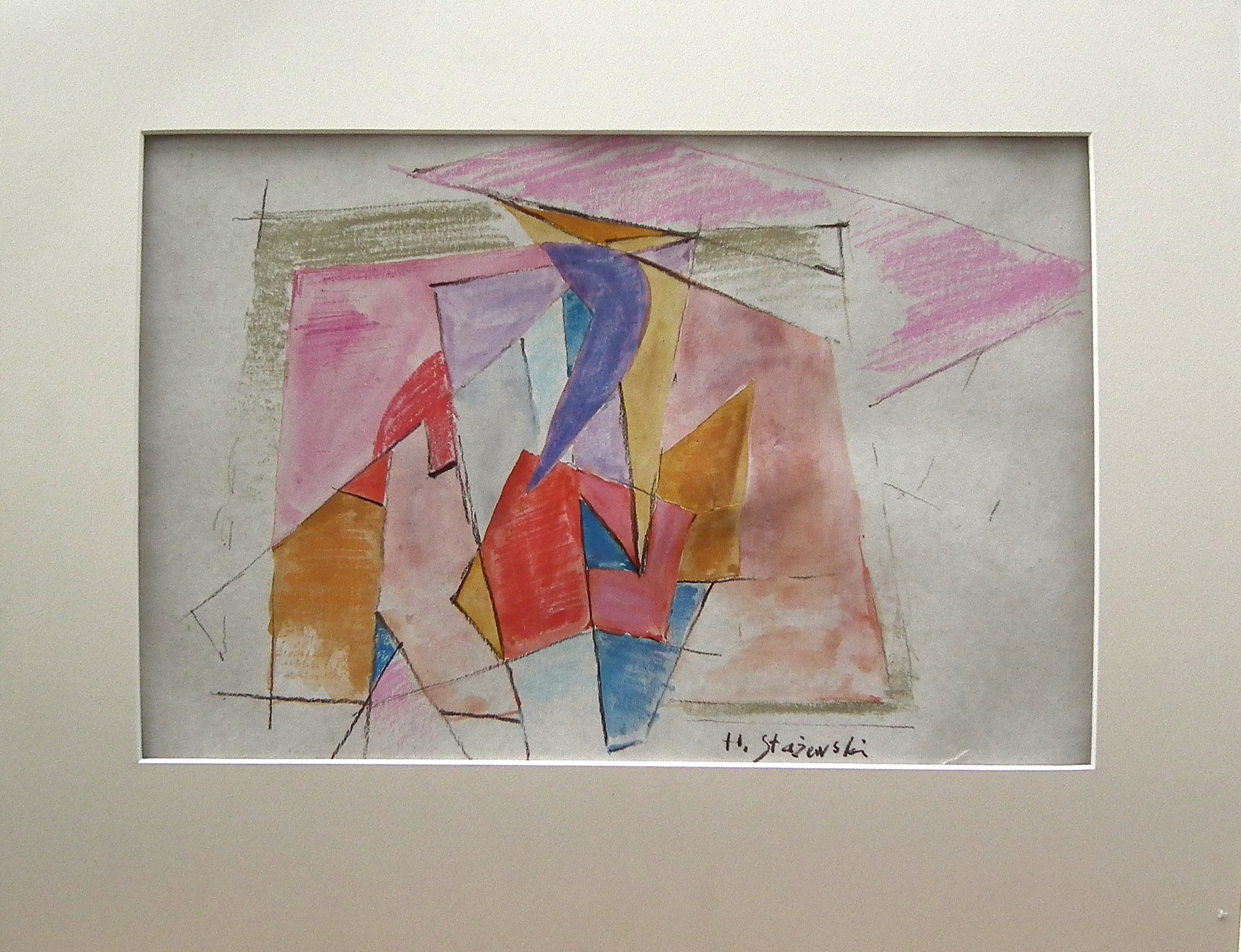
sketch made in mixed technique(crayon,watercolor) on cardboard, 25x37 cm, signed.p.d.H.Stażewski
We see here a dynamic arrangement of interpenetrating planes and lines.The work has a certain lightness and painterly quality.
good condition
collection- Poland
Henryk Stażewski (Warsaw 9 I 1894 - Warsaw 10 VI 1988) studied at the School of Fine Arts in Warsaw from 1913 to 1920. At the beginning of his career, he painted still lifes. He temporarily exhibited with the "Formists" grouping (1922). He also took part in the Exhibition of New Art in Vilna in 1923. From that time on he worked under the influence of constructivism. In addition to painting compositions, he also worked in book graphics, designed interiors, furnishings and set designs - these were mostly theoretical and studio works. Polish and international avant-garde groups, with which he exhibited and collaborated as a publicist, were as follows: "Blok" (1924-1926), "Praesens" (1926-1930), "Cercle et Carré" (1929-1931), "Abstraction-Création" (1931-1939), "a. r." (1932-1939). He also belonged to the Circle of Advertising Graphic Artists (1933-1939). In 1930 he was a co-organizer of a collection of works by artists of the international avant-garde intended for the Lodz museum (now in the Museum of Art in Lodz). After World War II, he lived and worked in Warsaw. In the 1940s and 1950s, he made attempts to adapt to the demands of figurative art. From this period come drawing and painting compositions on the themes of labor, construction, as well as monumental projects. After 1956, widely recognized as the patron saint of the Polish avant-garde, he already practiced exclusively abstraction of Constructivist origin. He created cycles of works that were studies of planes, lines, colors in various arrangements in relation to each other. With the appearance of cool perfection, he knew how to imbue them with the emotion of a direct touch, the trace of a hand. In addition to painting and derivative forms, such as collages, reliefs, multiples, he created spatial forms and graphics (he authorized serigraphic replicas of his works). He was the recipient of many national and international awards and honors, including the Herder Prize, Vienna 1972.