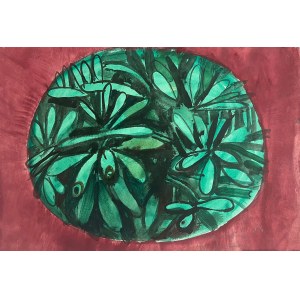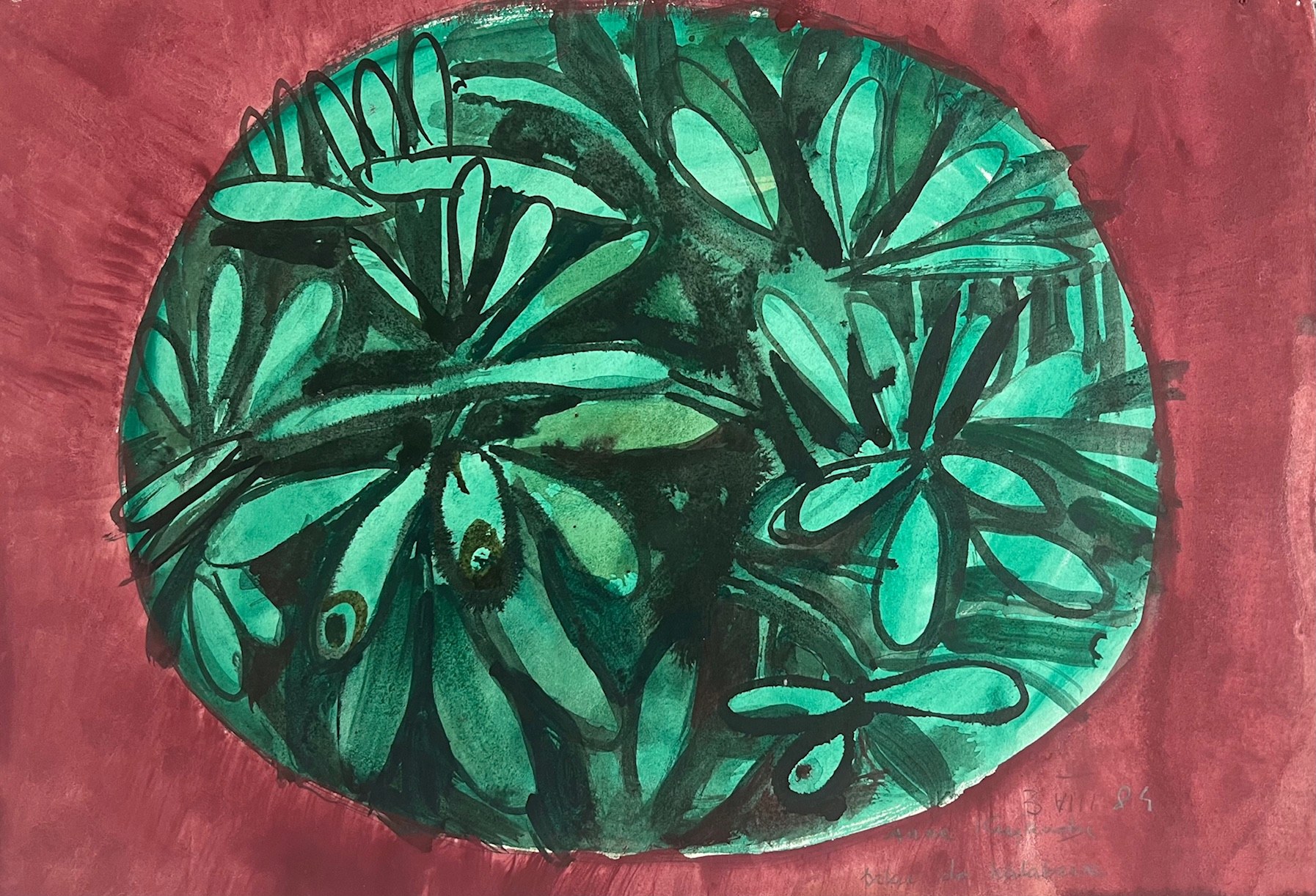
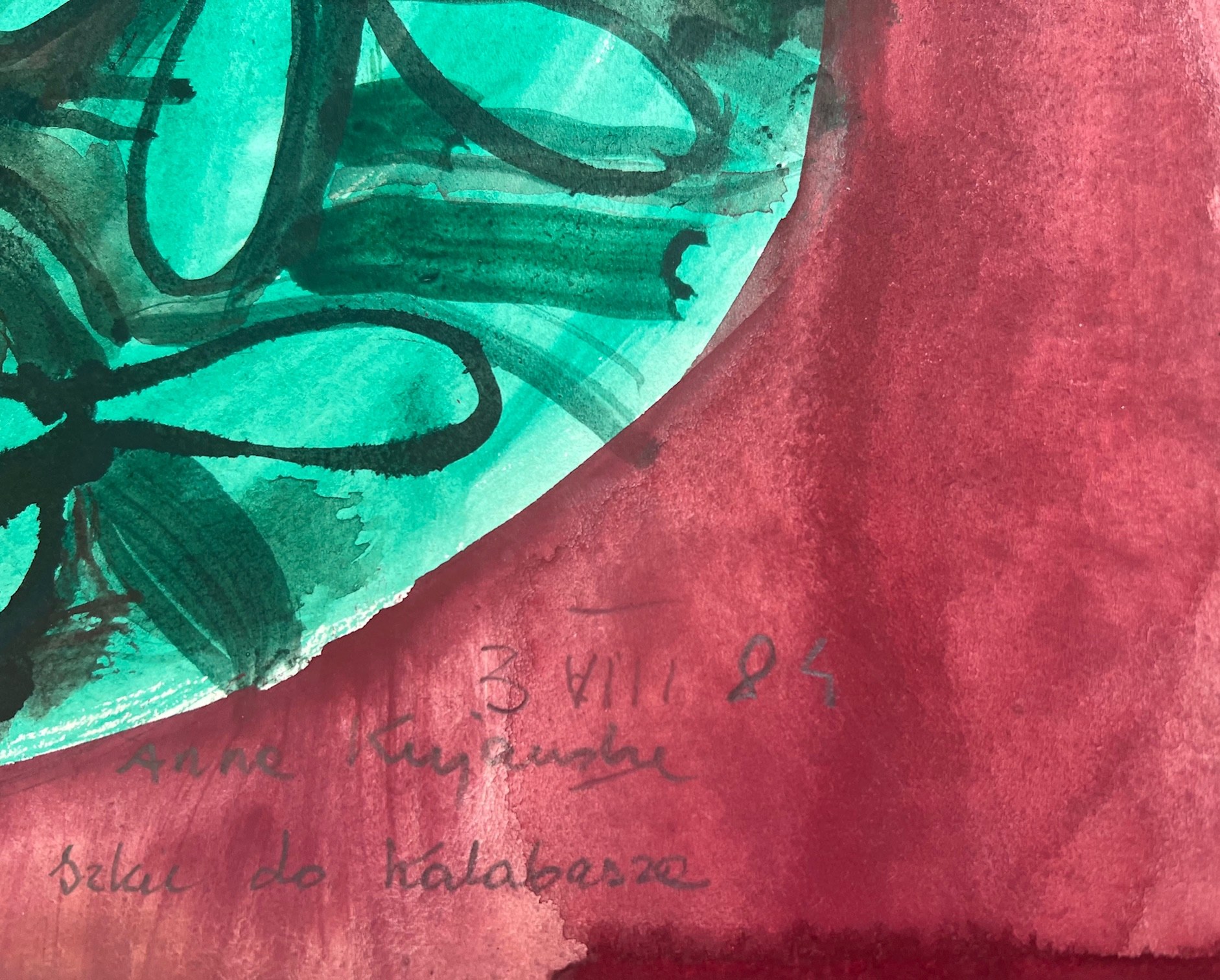
Anna Szpakowska-Kujawska (1931), Sketch for a Calabash, acrylic on paper, 42x30 cm, 3.VIII.84. Calabashes are African calabashes, a type of pumpkin that grows in the tropics. When dried, they are used by the local people as vessels for water and food products. During her stay in Africa, the artist was enthralled by the shapes of these plants and became inspired to paint on them, analogous to painting on Greek vases in the sense of decorating everyday vessels, which are transformed into works of art by superimposed drawing. The sketch presented here is one idea of a motif that was to be transferred to a calabash, but is also a work of art in itself. The earthy colors and floral motifs give this painting a decorative quality that draws the viewer's attention. Lower right corner signature, title and day date of creation of the sketch. The work has collector and investment value. Very good condition, unframed. The gallery can realize the framing of the painting at the order and expense of the buyer.
Anna Szpakowska-Kujawska (1931) received her diploma from the Wroclaw State Academy of Fine Arts (now the Academy of Fine Arts) in 1956. Since 1961, she was a member of the Wroclaw School (later Wroclaw Group), bringing together the most outstanding young artists in Wroclaw, most of them students from Prof. E. Geppert's studio. In 1968, the artist presented works from her "Atoms" series at the legendary "Under the Mona Lisa" gallery in Wroclaw, run by Jerzy Ludwinski. She was a participant in the Wrocław '70 Art Symposium, as an artist and co-organizer in Marian Bogusz's team. From 1977 to 1984 she lived in Nigeria, where she taught painting and drawing at the Kwara College of Education in Illorin. Her stay in Africa, as well as numerous other trips, had a great impact on the artist's work, resulting in successive series of works. Versatile in her use of materials and forms of work, she expresses herself in drawing, painting, reliefs, sculptures, objects and spatial installations, using natural materials (calabashes, plant fragments), ceramic techniques and her own techniques. Her painting and other forms fall into several currents of contemporary art from expressionism and magic realism to painterly conceptual forms. It is noteworthy that the expressionism and surrealism in the artist's works stem from the intellectual subjugation of emotions and awareness of the creative process. The artist's works can be found in museum collections including the National Museum in Wroclaw, the Art Museum in Lodz, as well as in private collections at home and abroad.