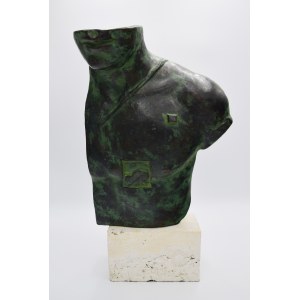
Cast, patinated bronze, stone base; total height: 47 cm, sculpture dimensions: 36 x 27 cm;
Signed at bottom: Mitoraj;
On the back, numbers: D 544 (larger letters and numerals) / 1000 HC (smaller letters and numerals, patinated).
"I guess the thing is more about sentiments, impressions, rather than some formal and cold search for form. Sculptures with me are born from emotions, from atmospheres, not from formal search for composition," the artist said. He used a language recognizable to all, showing modern man, with all his - as he described himself - cracks, injuries, difficulties.
- This is art for today," he said.
For antiquity was one of the artist's main sources of inspiration. When creating his sculptures, he referred directly to mythology or Greek Roman history, sometimes already in the title of the work itself: Icarus, Centauro, Eros, Mars, Gorgona, Paesaggio Ithaka. As art critics note, the artist, while evoking the beauty and ideal proportions of classical sculptures, at the same time reinterpreted them, modernized them. He made the viewer aware of the imperfection of human nature through deliberate cracks and damage to the surfaces of statues. Igor Mitoraj deserves to be called a "Renaissance man." This is due to many aspects of his life, the artistic path he traveled, as well as the classical aesthetics he emphasized. This outstanding sculptor was educated at the Academy of Fine Arts in Cracow, in the studio of Tadeusz Kantor, to whom he owed two pieces of advice. The first was a lesson in perception and aesthetic sensitivity, and the second was invaluable advice that influenced Mitoraj's career. Tadeusz Kantor recommended that the young artist go abroad. Among other things, motivated by this in 1968, the artist left Poland to settle in Paris. There he established cooperation with the renowned ArtCurial gallery, among others. He was a participant in the Venice Art Biennale. He has repeatedly presented his sculptures in Italy. The fruit of his first exhibition in Rome, in 1984, was the decision to move to Italy, to the picturesque sculptor-populated village of Pietrasanta, near Carrara. Igom Mitoraj found his "place on earth." In the village where he settled he valued the boundless space, and often created outside the studio. He appreciated the Italian way of life.
( source polskieradio.pl; dzieje.pl)