


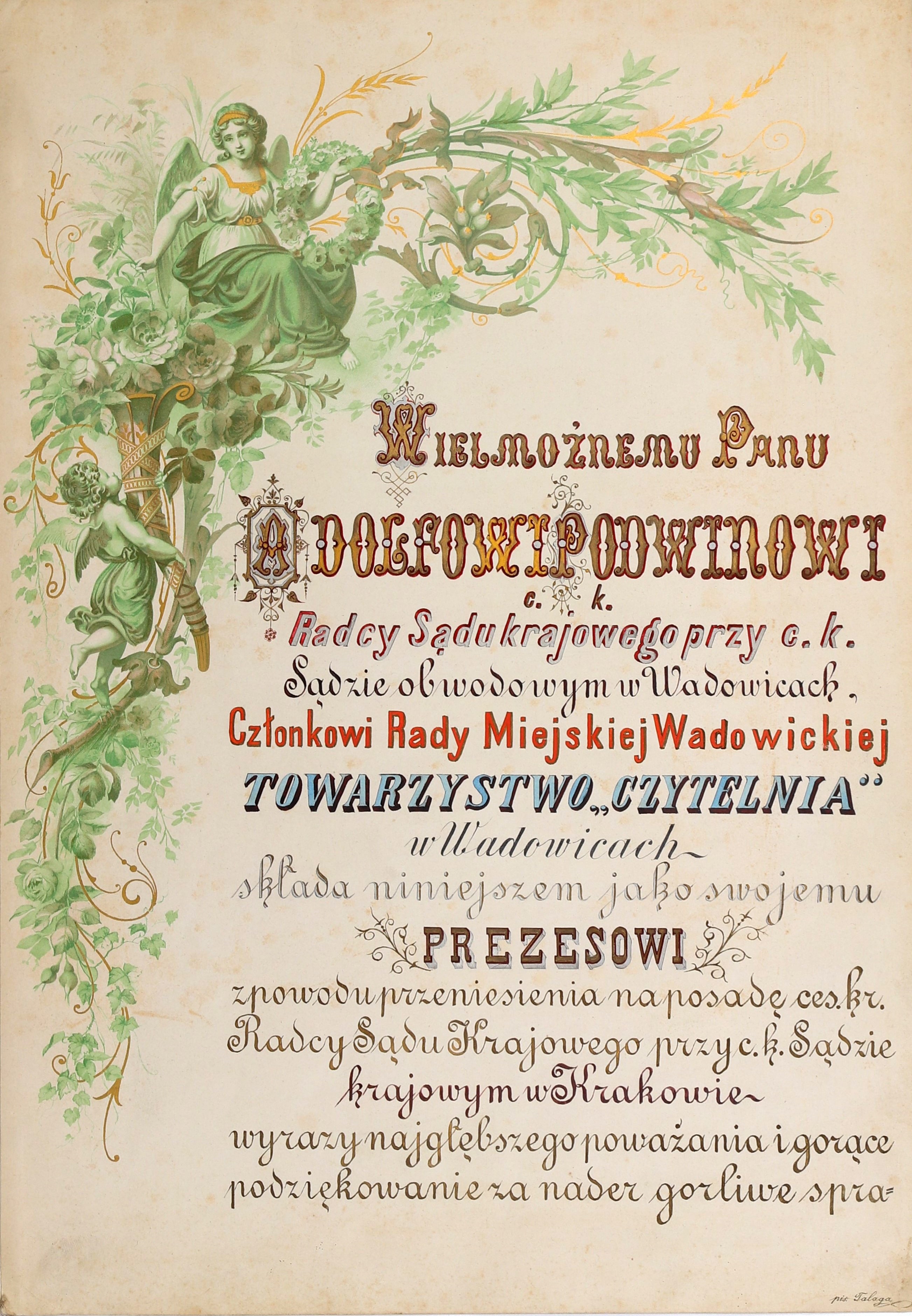
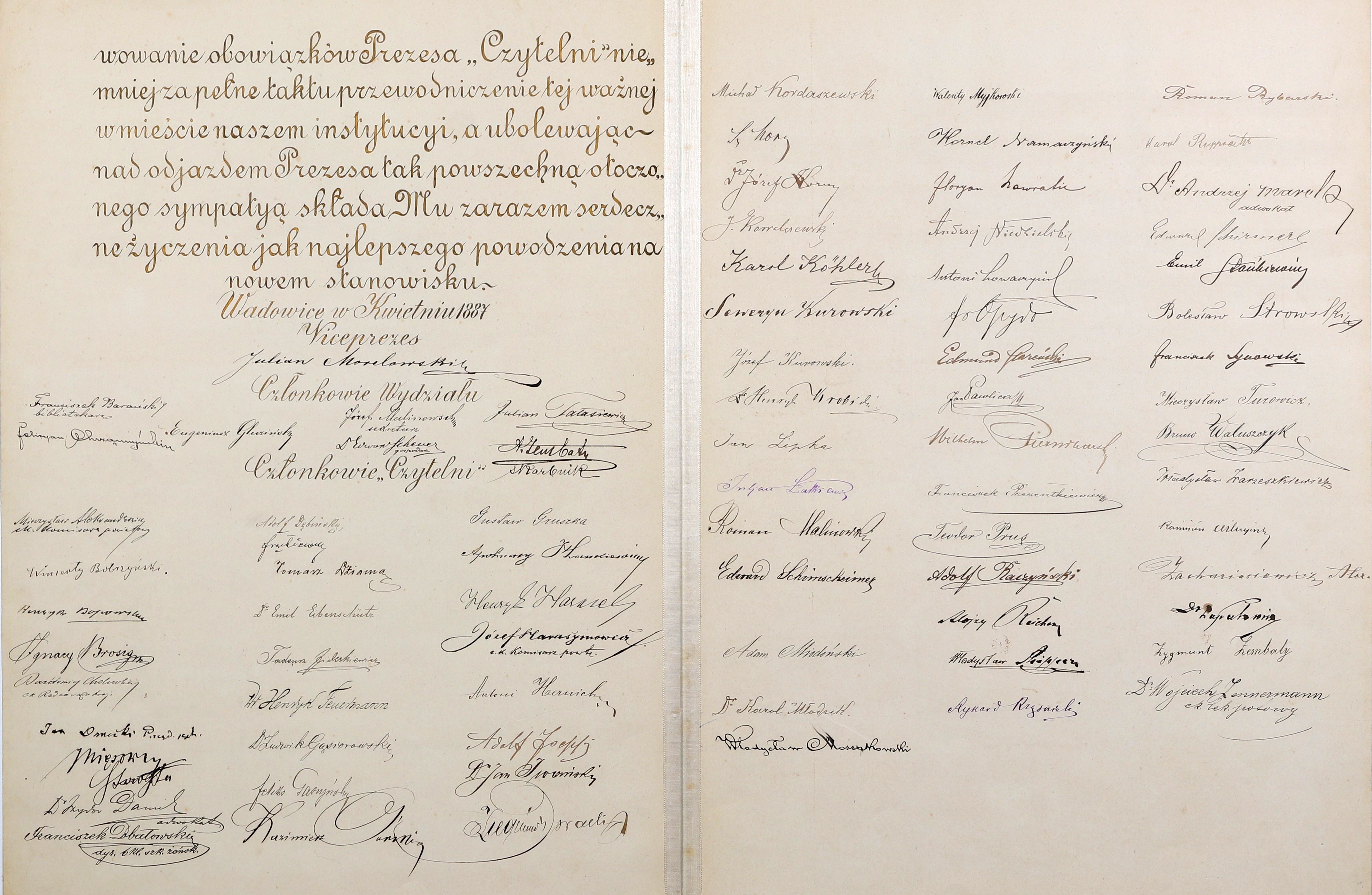
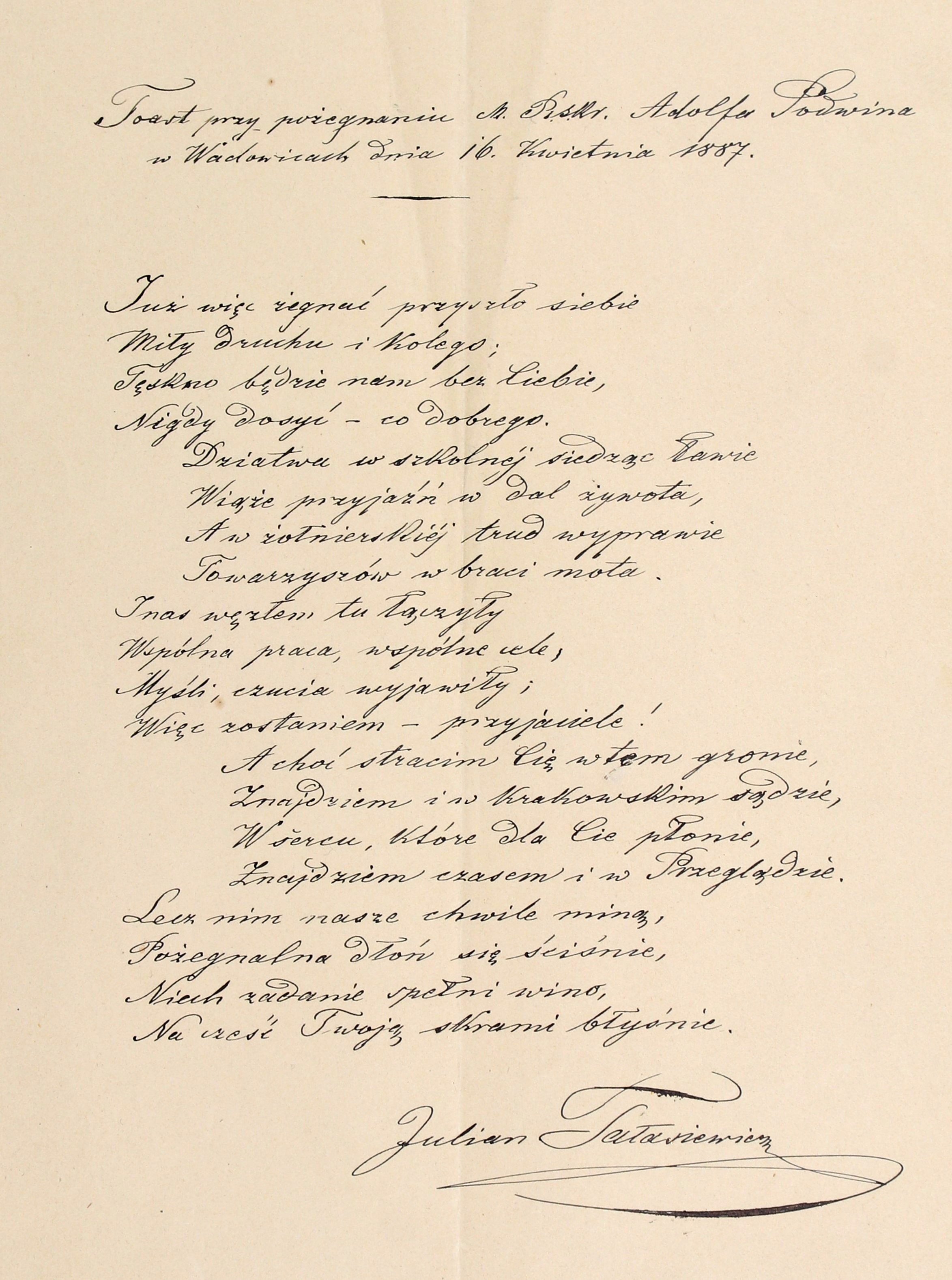
WADOWICE. A letter of thanks to Adolf Podwin—a judge and author of children’s books, including *Chodźcie tu dziatki*(Come Here, Children), published by Michał Arct, 1900; To His Excellency Adolf Podwin, Imperial-Royal Counselor of the Provincial Court at the Imperial-Royal District Court in Wadowice, Member of the Wadowice City Council, the “Czytelnia” Society in Wadowice hereby extends to its president, on the occasion of his transfer to the position of Imperial-Royal Provincial Court Counselor at the Imperial-Royal Provincial Court in Kraków, its deepest respect and heartfelt thanks for his most diligent performance of the duties of President of “Czytelnia” and for his tactful leadership of this institution, so important to our town; and, while regretting the departure of the President, who is so widely held in esteem, we extend to him our heartfelt wishes for the greatest success in his new position, Wadowice, April 1887; below and on the adjacent page, handwritten signatures of the Society’s Board—the elite of Wadowice at the time; chromolithograph with handwritten text (in the lower right corner, the author’s signature: inscribed: Talaga), with gilding; 4 pages bound with a ribbon, slight soiling, delicate rust spots; dimensions 313x446 mm; accompanied by a manuscript by the aforementioned Julian Tałasiewicz—a toast delivered in honor of Adolf Podwin: Toast upon the farewell of Major General Adolf Podwin / in Wadowice on April 16, 1887. / So now it is time to bid you farewell / Dear friend [ original spelling – author’s note] and colleague; / We will miss you dearly, There is never enough – of what is good...; 4 pages (text on one), pages in excellent condition, crease marks; sheet dimensions 210x265 mm.
Signed members of the Society’s Board: Julian Morelowski – Vice President (was a member of the Wadowice branch of the Sokół Gymnastics Society – author’s note), department members: Franciszek Barański – librarian (was a member of the department of the Sokół Gymnastics Society in Wadowice – author’s note), Felicjan Chrząszczyński (?), Eugeniusz Gluziński, Józef Malinowski – secretary, surname illegible – host, Julian Tałasiewicz (judge, counselor at the court in Wadowice, author of numerous publications, not only on legal topics – author’s note), A. Zembaty – treasurer; below, in three columns and in alphabetical order, the signatures of the remaining members of the Reading Room, with notes in several places indicating their roles: Mieczysław Aleksandrowicz – imperial-royal district commissioner, Wincenty Bobrzyński (a classical philologist teaching at the gymnasium – author’s note), Henryk Bojanowski (?), Ignacy Brosig (mayor of Wadowice – author’s note), Bartłomiej (?) Cholewka – Austro-Hungarian court counselor, the next three names illegible, Dr. Izydor Daniel (attorney, member of the Sokół Gymnastics Society in Wadowice – author’s note), Franciszek Dbałowski – director of a girls’ school, Adolf Dębnicki, Frąckiewicz, Tomasz Dzianna, Dr. Emil Eibenschütz, Tadeusz Fiderkiewicz, Dr. Henryk Feuermann, Dr. Ludwik Gąsiorowski (member of the executive board of the Sokół Gymnastics Society in Wadowice – author’s note), Feliks Gaszyński, Kazimierz (surname illegible), Gustaw Gruszka, Apolinary Hankiewicz (court counselor – author’s note), Henryk Hamsel (?), Józef Harasymowicz – imperial-royal county commissioner, Antoni Hernicki, Adolf Joepl (?), Dr. Jan Iwański (later mayor of Wadowice, member of the executive committee of the Sokół Gymnastics Society in Wadowice – author’s note), Siegmunt Iwacki (?), Michał Kordaszawski (member of the Wadowice branch of the Sokół Gymnastics Society – author’s note), S. Korn (Szymon Korn, head of the religious community – author’s note), Dr. Józef Korn (councilman and court assessor, member of the Wadowice branch of the Sokół Gymnastics Society – author’s note), J. Kowalewski (?), Karol Köhlerh (district judge – author’s note), Seweryn Kurowski (participant in the January Uprising, deputy mayor of Wadowice, pharmacist; he owned the tenement house where Karol Wojtyła was later born and raised – author’s note), Józef Kurowski (middle school teacher, member of the executive committee of the Sokół Gymnastics Society in Wadowice – author’s note), Dr. Henryk Krobicki, Jan Lipka (deputy state prosecutor in Kraków, national court counselor at the District Court in Wadowice – author’s note), Julian Łatkiewicz, Roman Haliniowski, Edward Schimscheirner, Adam Miodoński (member of the Wadowice branch of the Sokół Gymnastics Society – author’s note), Dr. Karol Młodzik (member of the Wadowice branch of the Sokół Gymnastics Society – author’s note), Władysław Mossakowski, Walenty Myjkowski (a professor at the Wadowity Gymnasium in Wadowice, brother of Jan Myjak-Myjkowski, a folk movement activist in Galicia and a folk poet – author’s note), Kornel Namoczyński, Florian Nawrocki, Andrzej Niedzielski (a member of the executive committee of the Sokół Gymnastics Society in Wadowice – author’s note), Antoni Nowaczyński (counselor at the District Court in Wadowice, later a judge at the Court of Appeals, father of Adolf—writer, playwright, satirist, poet, journalist, essayist, critic, and political and social activist—author’s note), Dr. Franciszek Opydo (physician, long-time mayor and honorary citizen of Wadowice, president of numerous social institutions – author’s note), Edmund Pareński (participant in the January Uprising, notary in Jasło – author’s note), Jan Pawlica (middle school teacher, member of the executive board of the Sokół Gymnastics Society in Wadowice – author’s note), Wilhelm (surname illegible), Franciszek Prezentkiewicz (middle school teacher – author’s note), Teodor Prus (teacher – author’s note), Adolf Raczyński (Imperial-Royal Councilor of the Provincial Court, Councilor at the District Court), Alojzy Reicher (treasury counsel, member of the executive committee of the Sokół Gymnastics Society in Wadowice – author’s note), Władysław Ripper (performed carpentry and masonry work on the construction of the Wadowice Sokół headquarters – author’s note), Ryszard Rząśnicki (Rzęśnicki, participant in the January Uprising – author’s note), Ryszard Rybarski (Imperial-Royal secretary of the district criminal court – author’s note), Karol Ruppreht, Dr. Andrzej Snarski – attorney, Edmund Schirmer (school principal, teacher – author’s note), Emil Stankiewicz (member of the Wadowice branch of the Sokół Gymnastics Society – author’s note), Bolesław Strowski (member of the Wadowice branch of the Sokół Gymnastics Society – author’s note), Franciszek Synowski, Mieczysław Turowicz (Imperial-Royal Counselor of the Provincial Court, member of the Wadowice branch of the Sokół Gymnastics Society – author’s note), Bruno Waluszczyk, Władysław Warzeszkiewicz, Kazimierz Wilczyński, Aleksander Zachariasiewicz, Dr. Tadeusz Zapałowicz (physician, titular Major General of the Polish Army – author’s note), Zygmunt Zembaty (a member of the executive committee of the Sokół Gymnastics Society in Wadowice – author’s note), Dr. Wojciech Zonnermann – a field doctor.









