


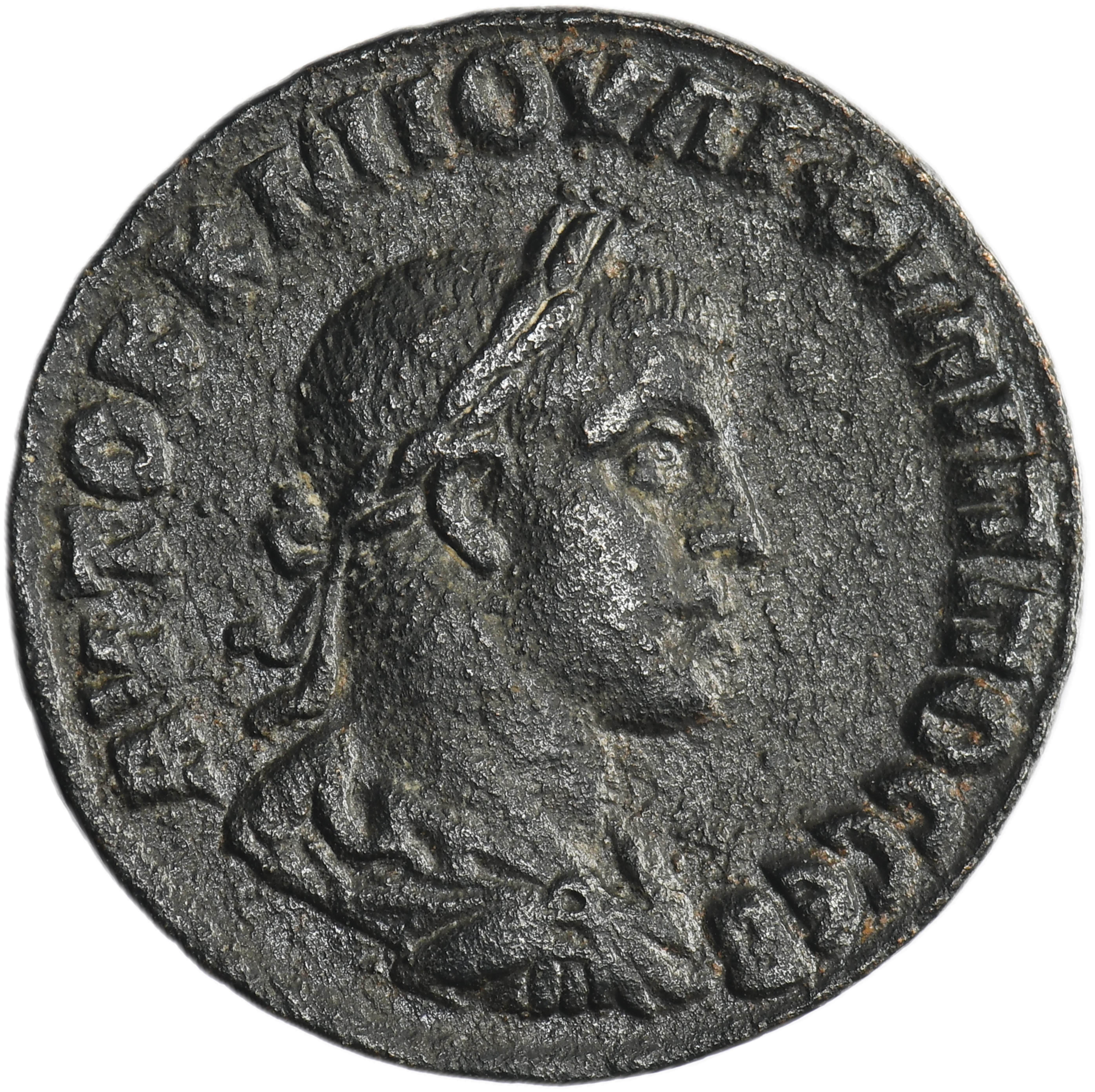
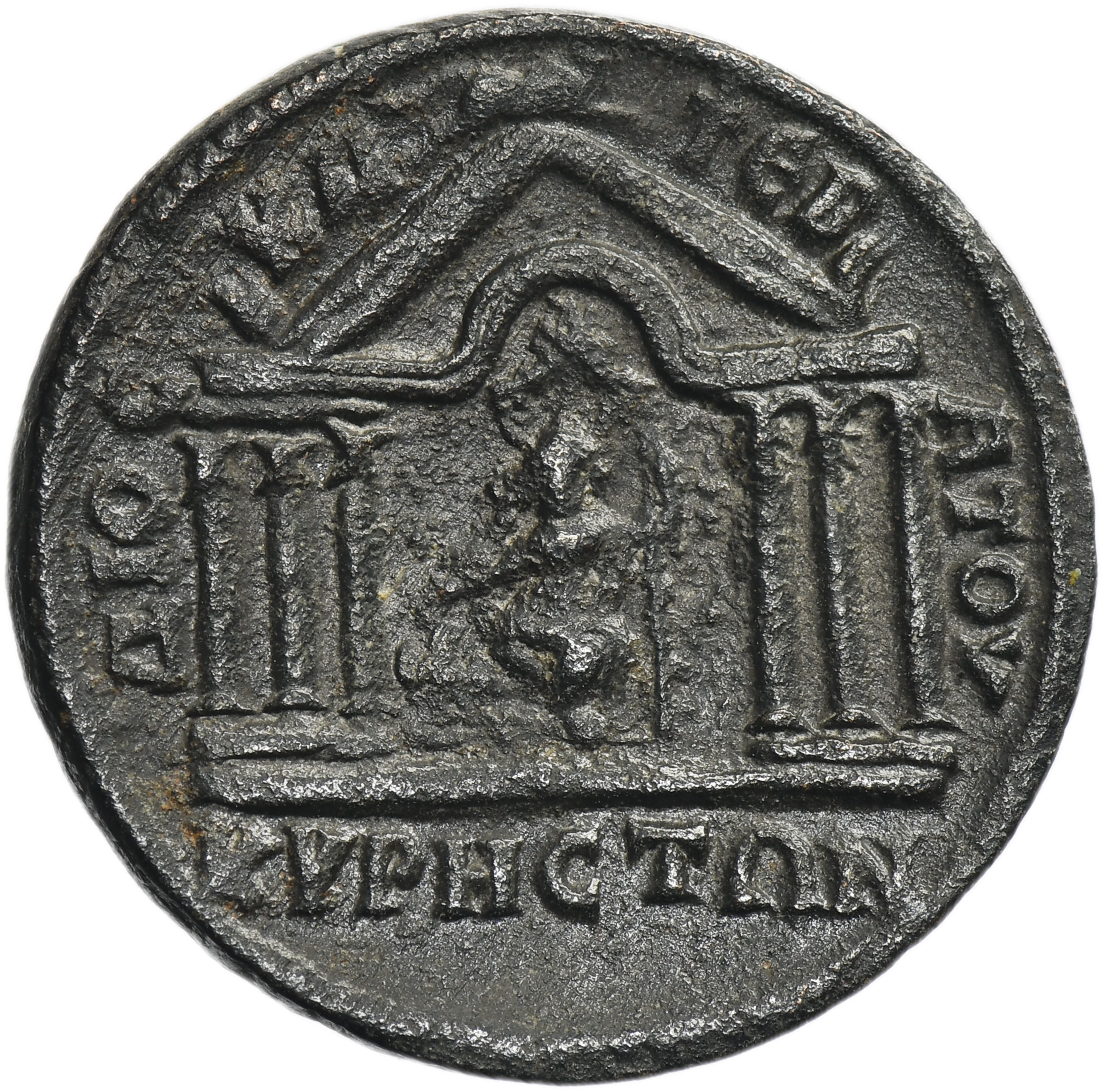


Provincial bronze issue of Philip I “the Arab” (AD 244–249), struck at Cyrrhus in Syria, belongs to the civic coinage of northern Syria, where representations of local cults and sanctuaries played a central role.
The obverse shows a laureate bust of the emperor facing right, with the Greek legend ΑΥΤΟΚ Κ Μ ΙΟΥΛΙ ΦΙΛΙΠΠΟϹ ϹΕΒ, giving his full titulature as autokrator and augustus. Both the form of the legend and the portrait style correspond to established conventions of mid-3rd century Syrian provincial coinage, where Greek was consistently employed.
The reverse depicts a hexastyle temple, within which stands a statue of Zeus, accompanied by the legend ΔΙΟϹ ΚΑΤΕΒΑΤΟΥ ΚΥΡΗϹΤΩΝ. This type refers to the local cult of Zeus Katabates (“Zeus who descends”), a deity attested in epigraphic and numismatic evidence from Cyrrhus. Temple representations of this kind are characteristic of provincial coinage, providing direct visual references to specific sanctuaries and their importance within the civic and religious life of the city.
Roman Provincial
Syria, Philip I (244-249), AE, Cyrrhus mint
Obverse: laureate, draped and cuirassed bust right
AVTOK K M IOVΛI ΦIΛIΠΠOC CCB
Reverse: temple with six columns enclosing statue of Zeus seated facing
ΔΙΟϹ ΚΑΤΕΒΑΤΟΥ ΚΥΡΗϹΤΩΝ
Diameter 28 mm, weight 15.52 g











