


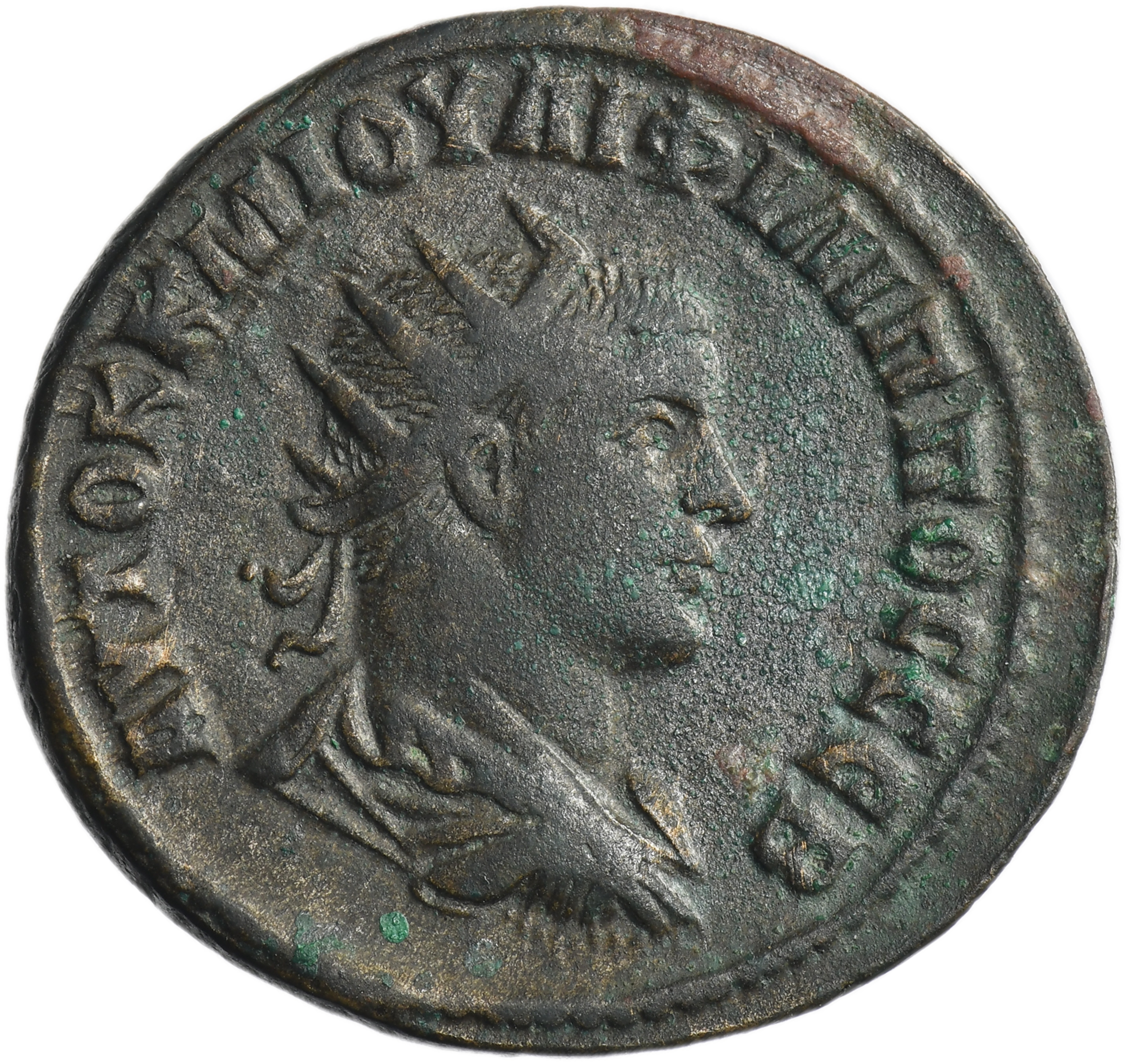
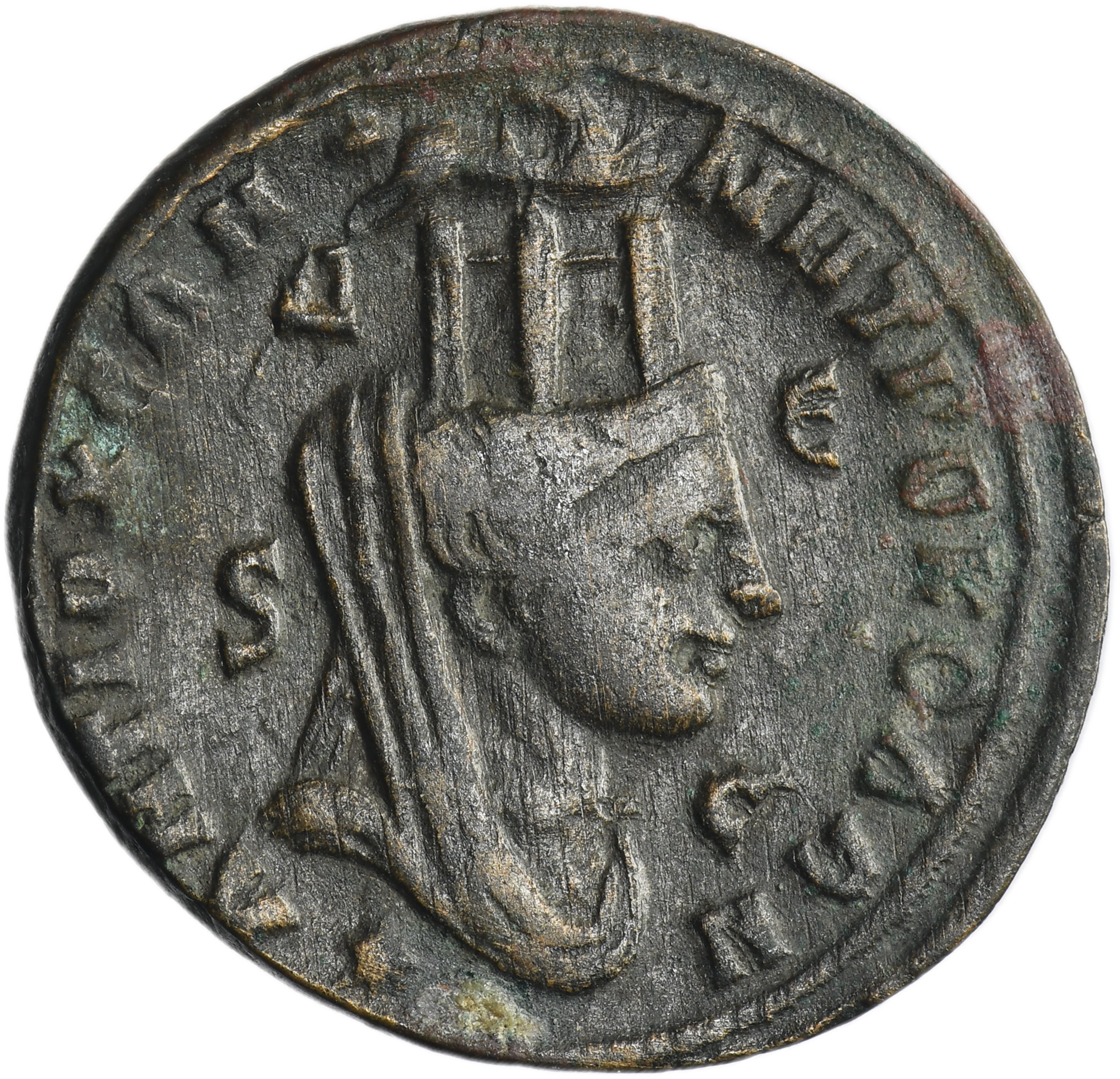


Provincial bronze issue of Philip I “the Arab” (AD 244–249), struck at Antioch in Syria between AD 247–249, belongs to the representative coinage of one of the most important urban centers of the eastern empire, serving as both provincial capital and a major administrative and economic hub.
The obverse shows a radiate bust of the emperor facing right, with the Greek legend ΑΥΤΟΚ Κ Μ ΙΟΥΛ ΦΙΛΙΠΠΟC ϹΕΒ, giving his full titulature (autokrator, imperator, augustus). The use of Greek is characteristic of Antiochene coinage, reflecting the city’s strong Hellenistic cultural identity despite its central role within the Roman administrative system.
The reverse depicts the head of Tyche wearing a mural crown, facing right, with the legend ΑΝΤΙΟΧΕΩΝ ΜΗΤΡΟ ΚΟΛΩΝ, referring to the city as the “metropolis of the colony.” Tyche, as the personification and protector of the city, was one of the principal iconographic motifs of Antioch, and her representations on coinage are among the most distinctive symbols of the metropolis. The mural crown emphasizes her protective role and the urban significance of the city.
In the fields appear the marks Δ–E and S–C, with a star below, a characteristic feature of Antiochene issues of this period. The letters Δ–E are interpreted as officina (workshop) marks, as confirmed by studies of mint organization in 3rd-century Antioch.
Roman Provincial
Syria, Philip I (244-249), AE 247-249, Antioch mint
Obverse: radiate, draped and cuirassed bust right
AVTOK K M IOVΛI ΦIΛIΠΠOC CCB
Reverse: turreted head of Tyche right, Δ-E / S-C across fields, star below
ΑΝΤΙΟΧΕΩΝ ΜΗΤΡΟ ΚΟΛΩΝ
Diameter 31 mm, weight 19.59 g











