


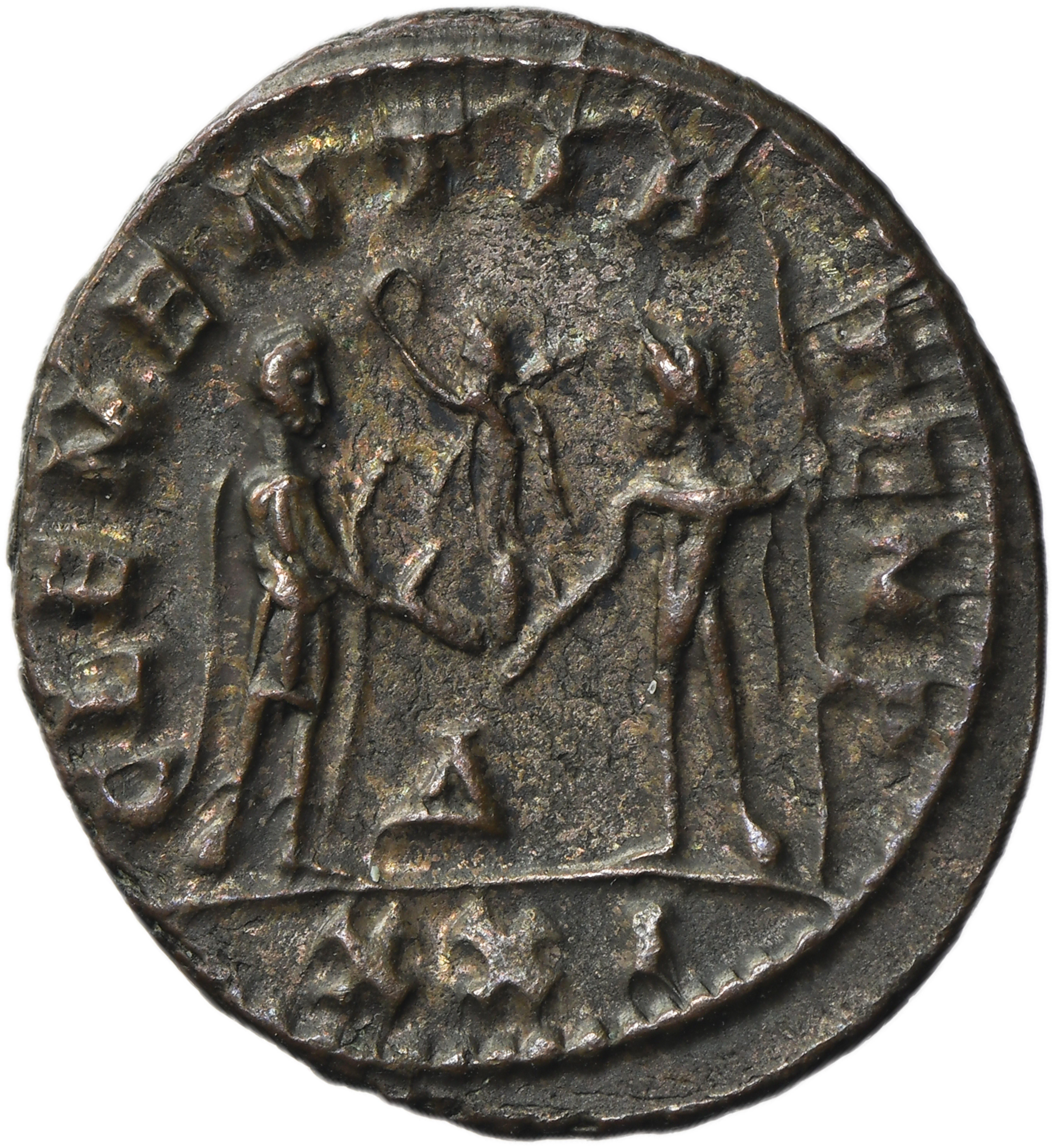


Antoninian of Carinus (AD 282–285), struck at the mint of Cyzicus between AD 283–285, belongs to issues from the final phase of his reign, when the empire functioned under a system of co-rulers and coinage played a key role in expressing the legitimacy and authority of imperial power.
The obverse presents a radiate, draped and cuirassed bust facing right, with the legend IMP M AVR CARINVS P F AVG, giving his full titulature as Pius Felix Augustus. The radiate crown denotes the antoninianus denomination, which by this period had become a billon coin, as confirmed by metallurgical studies.
The reverse shows the emperor standing right, holding a parazonium, receiving Victory on a globe from Jupiter standing left with a sceptre, with the legend CLEMENTIA TEMP. This complex composition belongs to the developed iconographic repertoire of the late 3rd century, emphasizing divine legitimation of imperial rule. Victory on a globe symbolizes dominion over the world and military success, while its presentation by Jupiter signifies divine approval of the emperor’s authority.
The legend CLEMENTIA TEMP(orum) refers to the clemency and favorable nature of the times, forming part of a propagandistic message presenting the reign as stabilizing and beneficial to the state. Such formulas are well attested in the coinage of the late 3rd century and reflect broader ideological themes of the period.
The mint marks Δ in the field and XXI in the exergue are characteristic of the Cyzicus mint’s control system. The mark XXI is generally interpreted as indicating a ratio in the alloy (approximately 1/20 silver content), a conclusion supported by metallurgical analysis of contemporary coinage.
Roman Imperial
Carinus (282-285), Antoninianus 283-285, Cyzicus mint
Obverse: radiate, draped and cuirassed bust right
IMP M AVR CARINVS P F AVG
Reverse: Emperor standing right, holding parazonium, receiving Victory on globe from Jupiter standing left, holding sceptre, Δ in lower centre, XXI in exergue
CLEMENTIA TEMP
Diameter 22 mm, weight 4.02 g











