


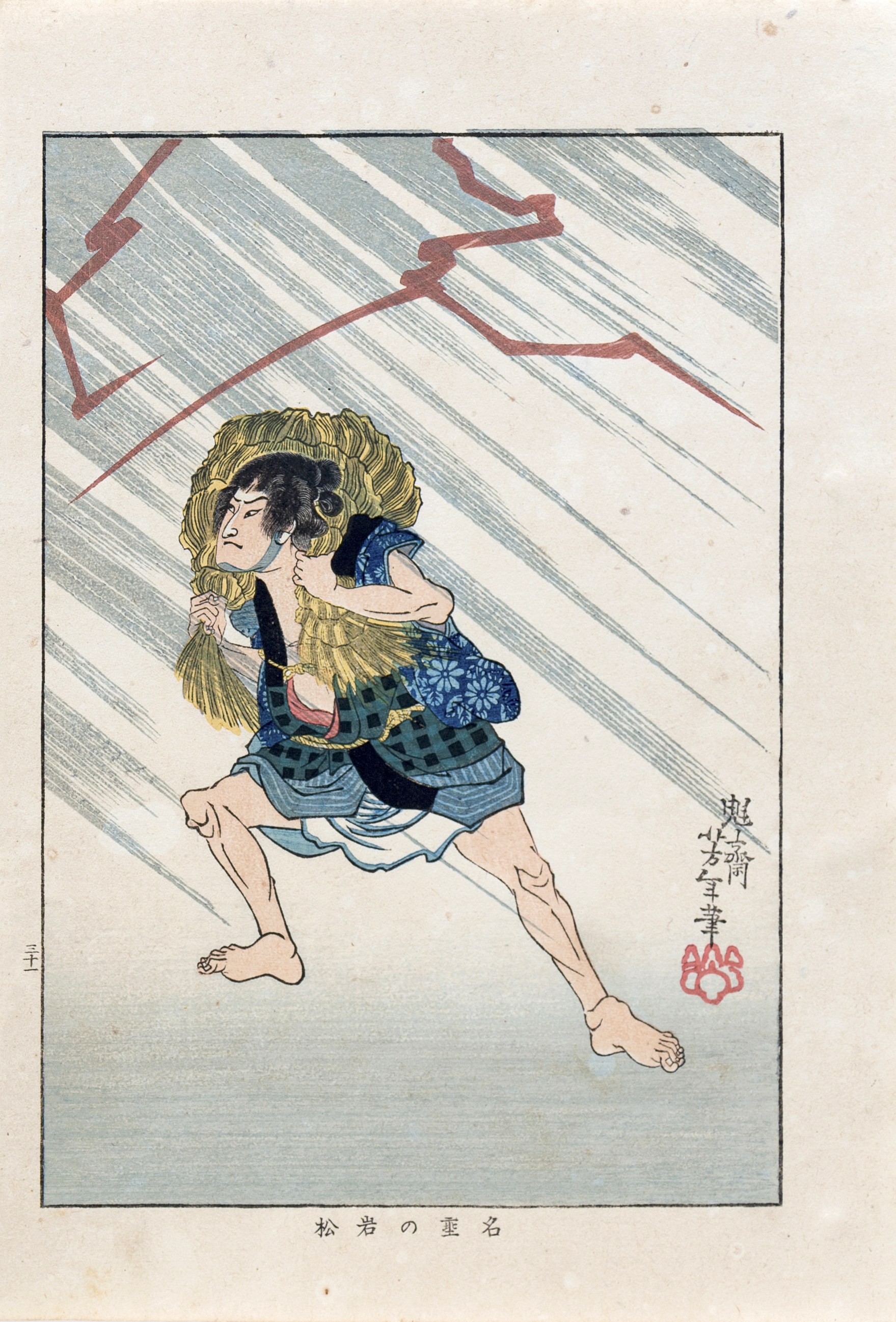
color woodcut, paper, 24x16 cm, artist's signature
The woodcut is from the series "Biographies of Modern Men," designed by Yoshitoshi in the 1860s and published in 1920 in a simplified and reduced form as a sashi-e (woodcut illustration) for the album "Kinsei Kyogiden." The series dates from fairly early in Yoshitoshi's career, when he was about twenty-six years old, two decades before the creation of his well-known masterpieces such as the great series "One Hundred Aspects of the Moon" (1885-1892) and "New Forms of the Thirty-Six Spirits" (often referred to simply as "Thirty-Six Spirits") (1889-1892). "Biographies of Modern Men" depicts heroes, villains and strong men in a deadly confrontation between two gangs in Shimosa Province in 1849. Like modern gangs, these two groups of criminals and outlaws fought a brutal war to the death.
Tsukioka Yoshitoshi (1839-1892) is widely regarded as the last great master of the ukiyo-e genre. He is also considered one of the greatest innovators of the form. His career spanned two eras - the last years of Japan's Edo period and the first years of modern Japan after the Meiji Restoration. Like many Japanese, Yoshitoshi was interested in innovations from the West, but over time he became increasingly concerned about the loss of traditional Japanese culture, including traditional woodblock prints. Toward the end of his career, Yoshitoshi waged an almost lonely battle against time and technology. While he worked in the old style, Japan was adopting Western methods of mass reproduction, such as photography and lithography. Nevertheless, in a Japan that was turning its back on its own past, he almost single-handedly managed to push traditional Japanese woodblock printing to a new level.
Yoshitoshi was born in Edo on April 30, 1839. As a young boy, he showed extraordinary artistic talent and a keen interest in classical Japanese literature and history. At the age of 11, he began studying with the famous Kuniyoshi. Kuniyoshi, a leading woodblock artist of the time, developed a close relationship with his student and named him Yoshitoshi. Yoshitoshi Tsukioka published his first print with moderate success in 1853, a triptych depicting the famous clash between the Taira and Minamoto clans. In the early 1860s, Yoshitoshi's prints focused on kabuki themes and historical scenes, as well as foreigners. As the 19th century progressed, ukiyo-e felt the impact of the modern era, particularly with the introduction of synthetic pigments. Yoshitoshi learned to use these colors with subtlety and skill, maintaining his works to the highest printing standards throughout his career. After Kuniyoshi's death in 1861, Yoshitoshi went into business for himself, taking Toshikage as his first apprentice in 1863. With the rise of political instability in Japan in the late 1860s, he entered his "bloody period," an era marked by images of graphic violence and extravagant brutality.
As the Meiji period modernized, Yoshitoshi Tsukioka suffered a nervous breakdown in 1872, living in poverty and ceasing all artistic production. A year later, he resumed work, adopting the artistic pseudonym Taiso, meaning "Great Resurrection," and realizing his creative potential. While Yoshitoshi continued to depict battle scenes in his ukiyo-e woodcuts, he turned his attention to more current events and slowly moved away from overt violence to the psychological struggles of individuals. In 1885 he began one of his most acclaimed series, One Hundred Views of the Moon (1885-1892). During the last decade of his life, Yoshitoshi designed numerous illustrated books and several other popular series, including Thirty-Two Aspects of Women (1888) and Thirty-Six Ghosts and Strange Apparitions. (1889-1892). In the spring of 1892, he suffered a final mental breakdown and was committed to Sugamo Asylum. He died on June 9, 1892 at the age of 53.
From ghost stories to folklore, from violent clashes to gentle moonlight, Yoshitoshi offers not only compositional and technical brilliance, but also unfettered passion.










