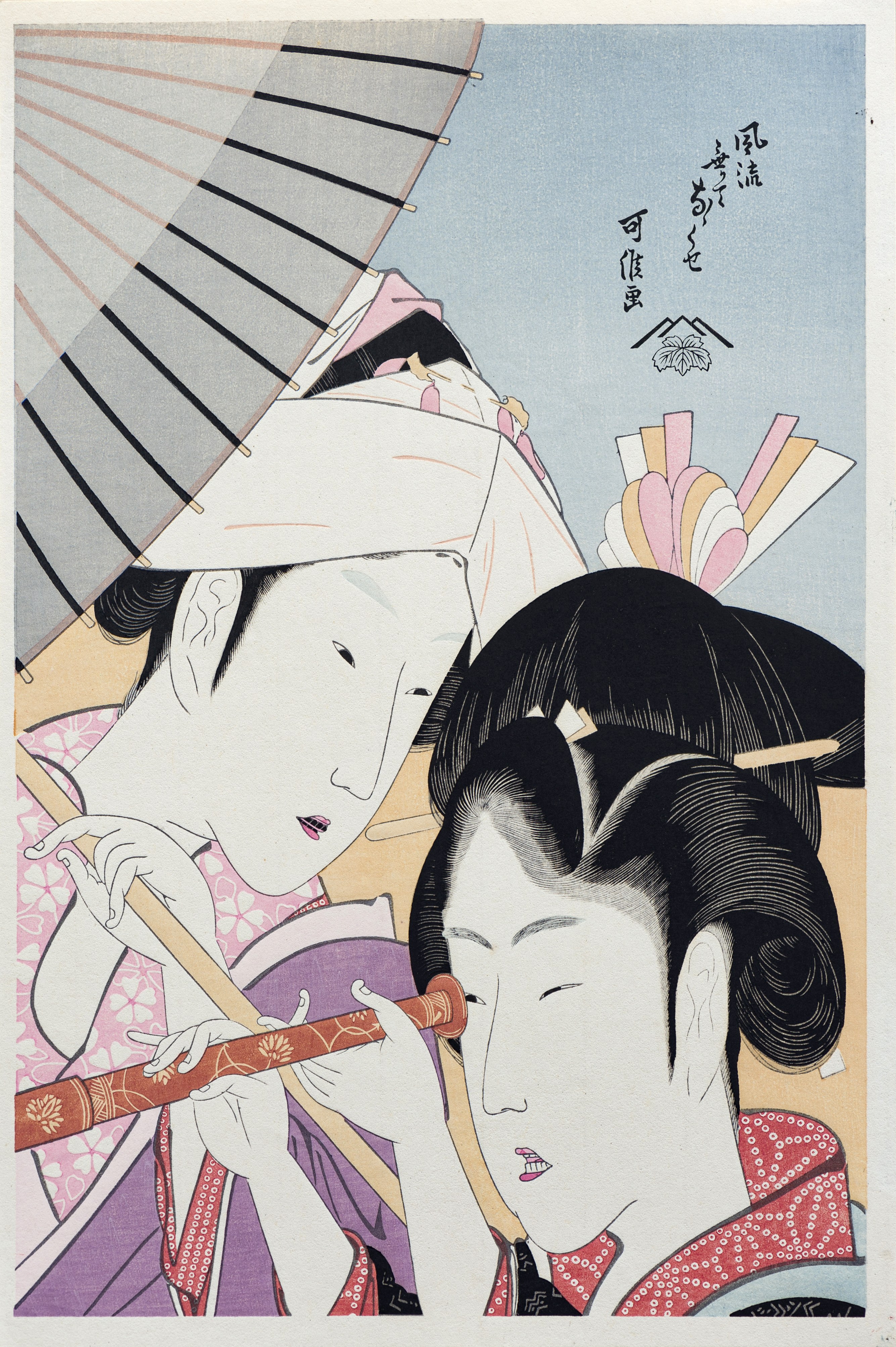
Color woodcut, ink, paper, 40x27 cm, artist's signature
The work comes from a period in Hokusai's career when he was known for his images of beautiful women. Here we see two upper-class women taking a trip. One of them is holding an umbrella, while the other is observing through a telescope.
Hokusai Katsushika, known mainly by the name Hokusai (born October 31, 1760 in Edo (now Tokyo), died May 10, 1849 there) - one of Japan's most prominent and prolific painters and creators of colorful woodcuts in the ukiyo-e style. The name Katsushika Hokusai is known worldwide, but it was a pseudonym that the artist used instead of his real name, which was Kawamura Tetsuzo. When signing works, he used many (at least thirty) pseudonyms, including Shunrō, Sōri, Taito, Manji. Although it is unclear why he changed his name, some researchers believe it was to test his talent and increase sales.
From an early age, Hokusai had a passion for drawing. He studied at the studio of Katsukawa Shunsho. He became known as an extremely prolific artist, a great draughtsman, landscape artist, illustrator and caricaturist. In his paintings, usually populated with a multitude of figures, he recreated Japan of the time. Among other things, he painted flowers, turtles, pheasants, roosters, one hundred poems, bridges and cascades. Persuaded by his students, he published 15 volumes of sketches and drawings entitled Manga (1814). His works had a profound influence on European Impressionists such as Claude Monet and others. His best-known work is a series of ukiyo-e woodcuts titled 36 Views of Mount Fuji, which was created between 1826 and 1833 during the Taito period. In addition to paintings and drawings, he created illustrations for more than 500 books, some of which he wrote himself. Around 1820, when Katsushika Hokusai was over 60 years old, he took the name Iitsu. Around 1830 he published a timeless woodcut masterpiece, "Thirty-six Views of Mount Fuji." The series originally consisted of 36 prints, as the title suggests. However, it was so well received that 10 more woodcuts were later added. These exquisite works depict the power and majesty of nature, while showing man's place in relation to the world around him. Hokusai died at the age of 90, which was considered an exceptionally long life in his time. He remained engaged in artistic creation until the end. It is said that he created as many as 30,000 works during his lifetime. The impact of Hokusai's works was so significant on world culture that his name was included in a list of "The LIFE Millennium" - 100 most important events and people of the last 1,000 years, published in 1988 by American Life magazine.
In the second half of the 20th century, Japanese artists and publishers collaborated to reproduce famous woodblock prints for interested collectors looking for rare designs. New blocks were created, and the prints were painstakingly printed by artisans using the same method as the 19th century originals - one block for each color. Reissues of woodblock prints are an opportunity to collect and enjoy the famous designs by renowned Japanese artists.