


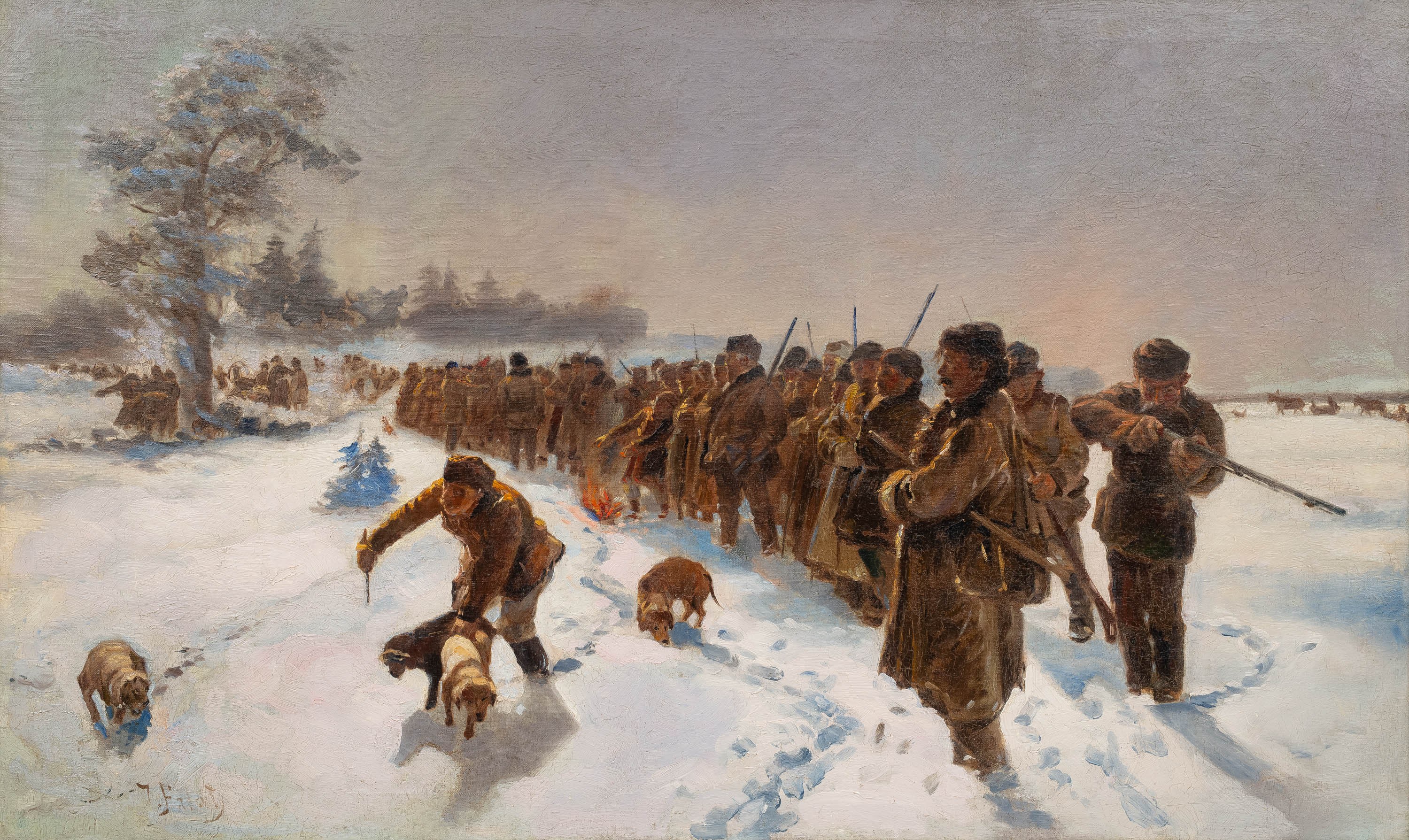
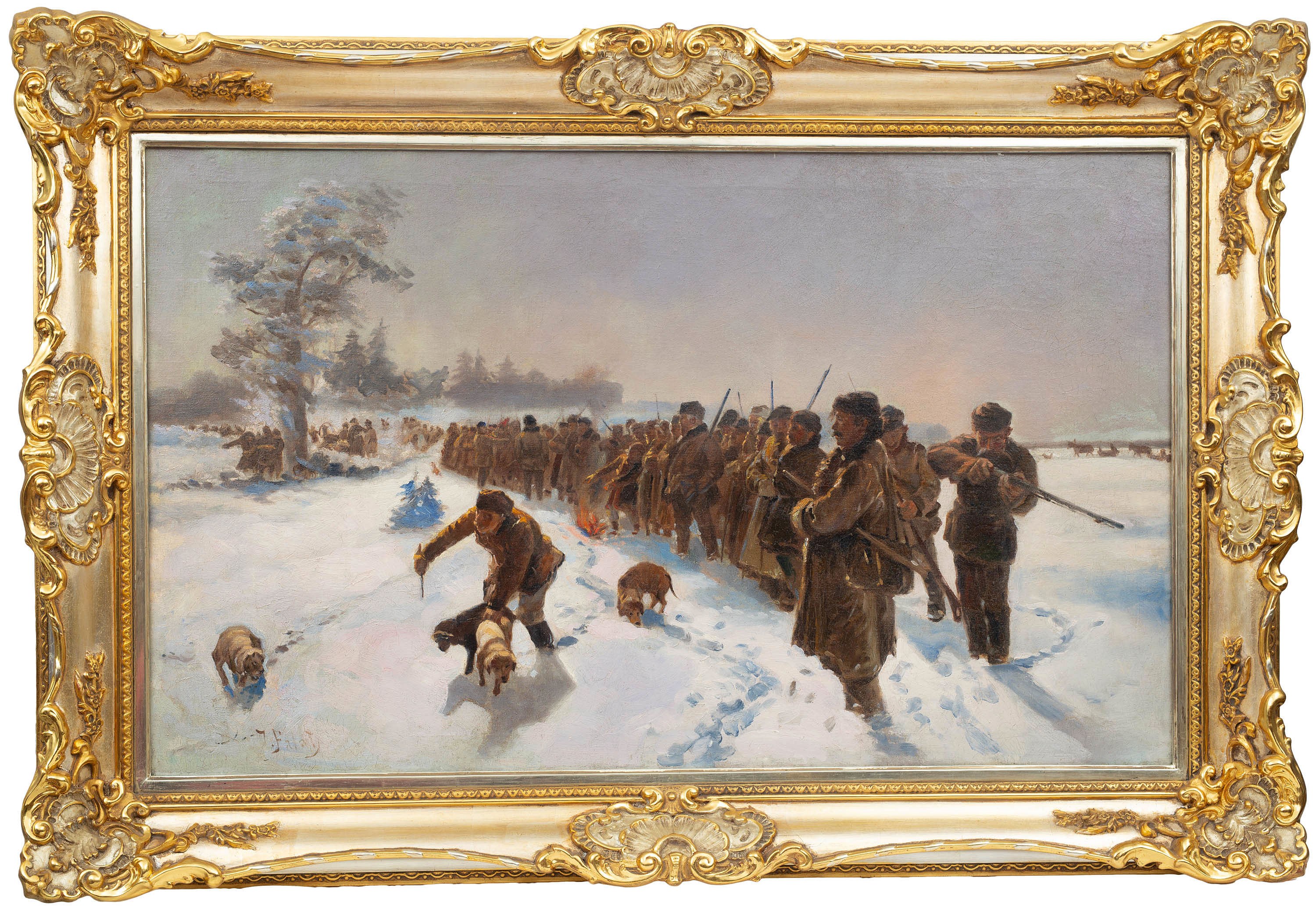
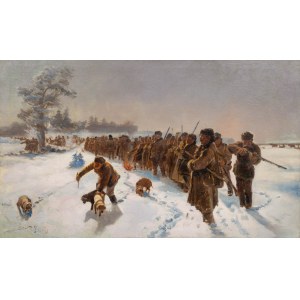
oil, duplicated canvas, 68 × 108 cm
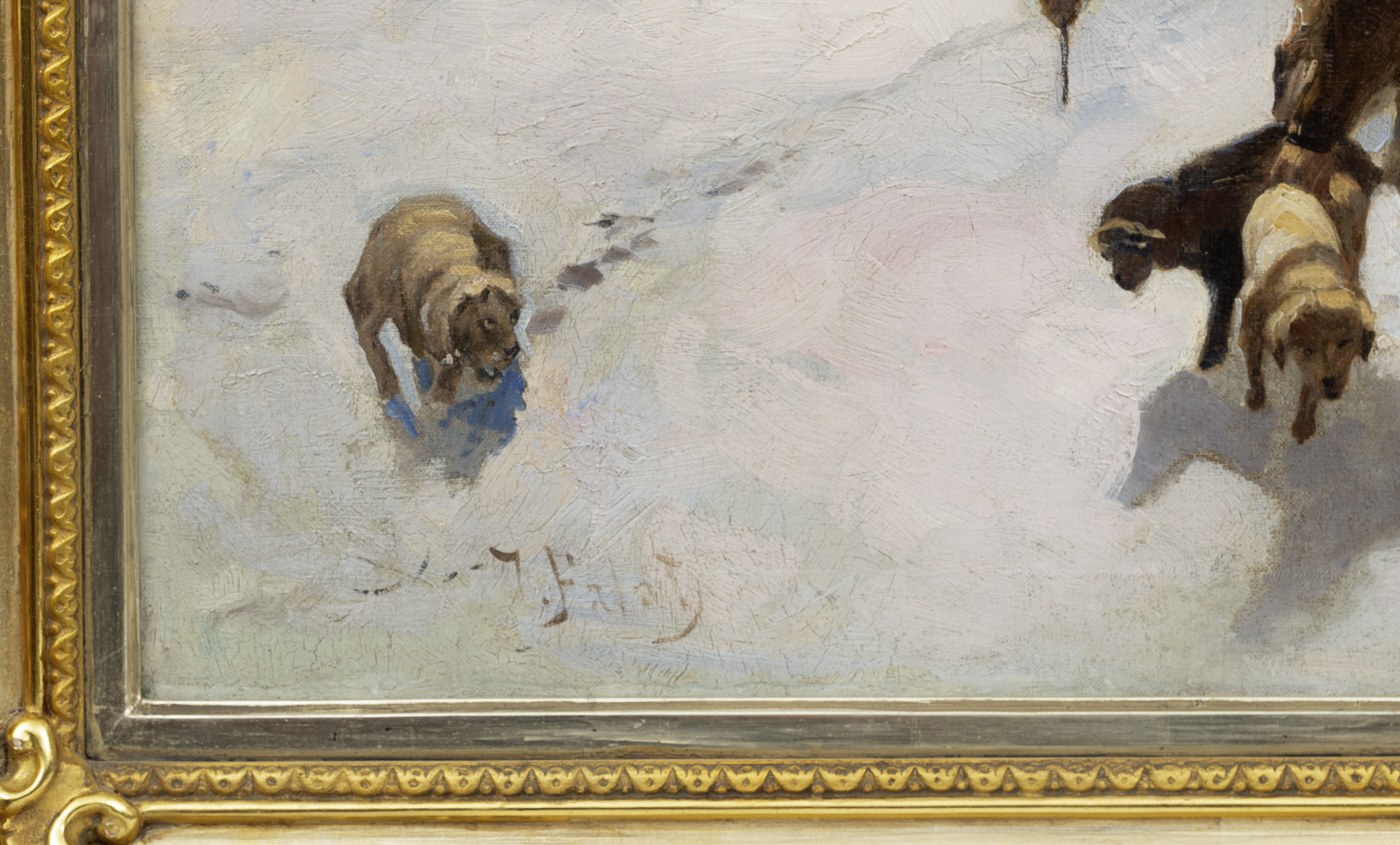
Signed l. d.: "J. Fałat"
"Hunting scenes became one of the most important subjects in Julian Fałat's work. Individually interpreted, they aroused the admiration of the public and critics. (...) Fałat's paintings enjoyed such great popularity probably because hunting and gamekeeping were an important element of Polish noble culture. The artist's hunting compositions were also fascinated by Henryk Sienkiewicz, a bard of Sarmatism. Fałat was not interested in the type of hunting par force, so popular in Polish painting of the 19th century, but rather in the individual reactions of people and the tension that accompanied them. Among the rich set of works, several thematic groups can be distinguished, which he repeatedly depicted: the hunting trip, the chase, the hunters' rest and the return from the hunt. The first compositions were created in 1886 during his stay in Nesvizh, at the famous hunt arranged for Prince William of Prussia."
(Anna Król, "Julian Fałat", [exhibition catalog] Stalowa Wola 2010, pp. 54-55)
Fundamental to the artistic achievements of Julian Fałat are two trends dominating his work, which are at the same time a recognizable feature of his works. We are, of course, talking about the so-called Fałat snows, depicting river bends, and the realizations devoted to hunting themes. Especially the latter category of works occupies an honorable place in Fałat's ouevre due to their importance in the development of the painter's artistic career. A moment of great significance turned out to be his participation in hunting parties organized in Nesvizh, which were entertained by Prince Antoni Radziwill and Prince of Prussia, later Emperor Wilhelm II Hohenzollern. The event resulted in the creation of dozens of compositions, a dozen of which in the form of photographic reproductions were published and issued in a commemorative portfolio. It also developed the artist's already demonstrated interest in hunting themes (cite, for example, the compositions "Forest Landscape with Game," 1879; "Highland Hunters," 1881) and brought publicity among critics and the public. Within the works inspired by hunting, it is possible to distinguish in Fałat's works and cite, following Jerzy Malinowski, four basic thematic circles: going out to hunt, approaching the game (hunting), hunters' rest after hunting, and returning from hunting. (J. Malinowski, "Julian Fałat", Warsaw 1985, p. 29). The presented multi-panel composition "Before the Hunt" shows a large group of hunters preparing for the hunt. The men, standing in groups, are checking their weapons, talking and warming themselves by the fires. One of them, stepping out of the crowd, calls the dogs to him. The white of the snow in a gray-pink glow contrasts with the dark brown silhouettes of the men. "In the hunting scenes, Fałat used formal tricks borrowed from Japanese woodcuts. One of them became the contrasting juxtaposition of light and dark patches. The dark silhouettes of hunters, game, and trees begin to stand out sharply against the white snowy background" (Jerzy Malinowski, "Julian Fałat," op.cit., p. 31).
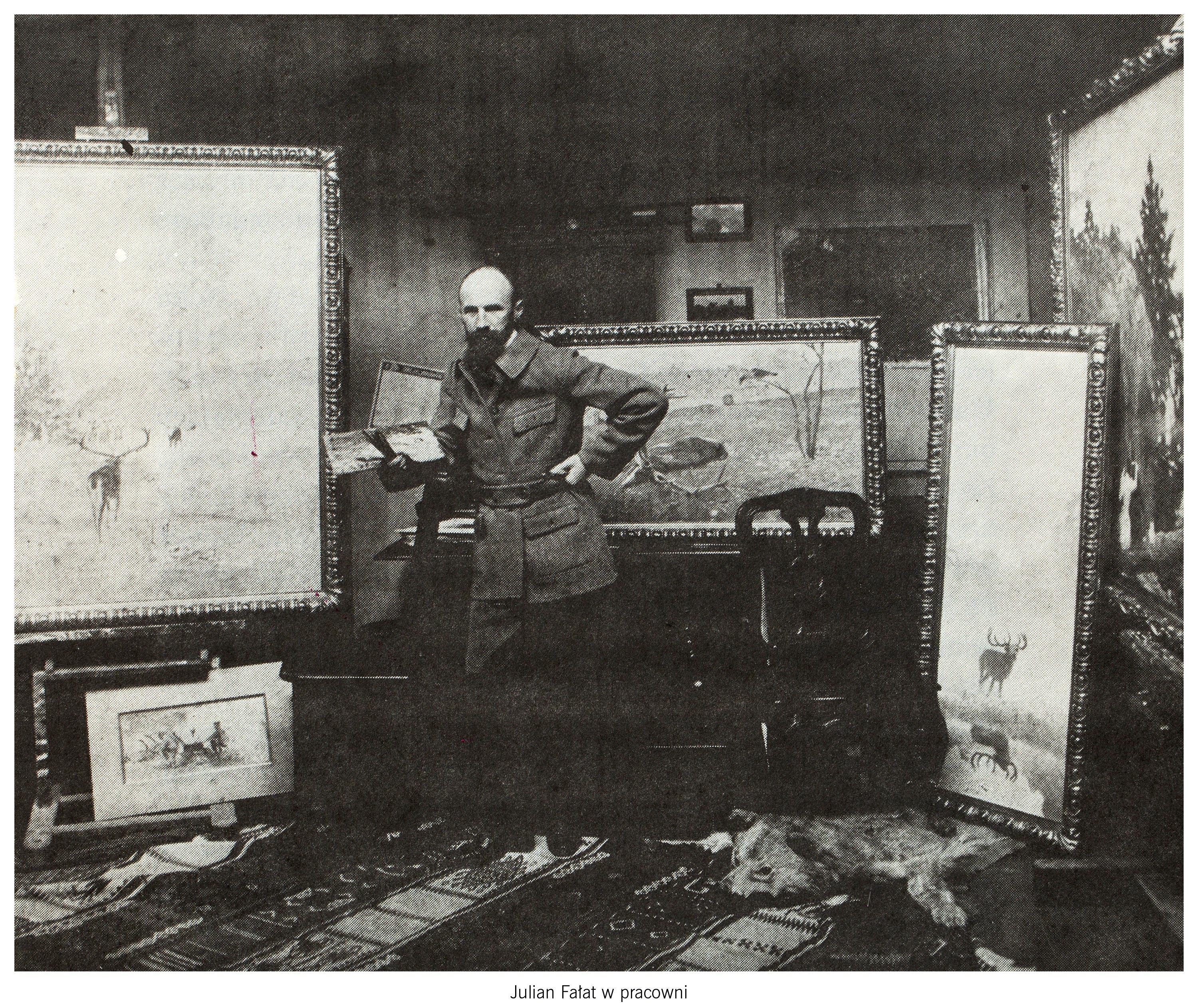
Julian Fałat in the studio Julian Fałat, "Memoirs," Katowice 1987, p. 85.
Pg. 70










최근 확인한 경매
경매품 리스트를 확인하려면 로그인하세요
관심있는 경매품
경매품 리스트를 확인하려면 로그인하세요