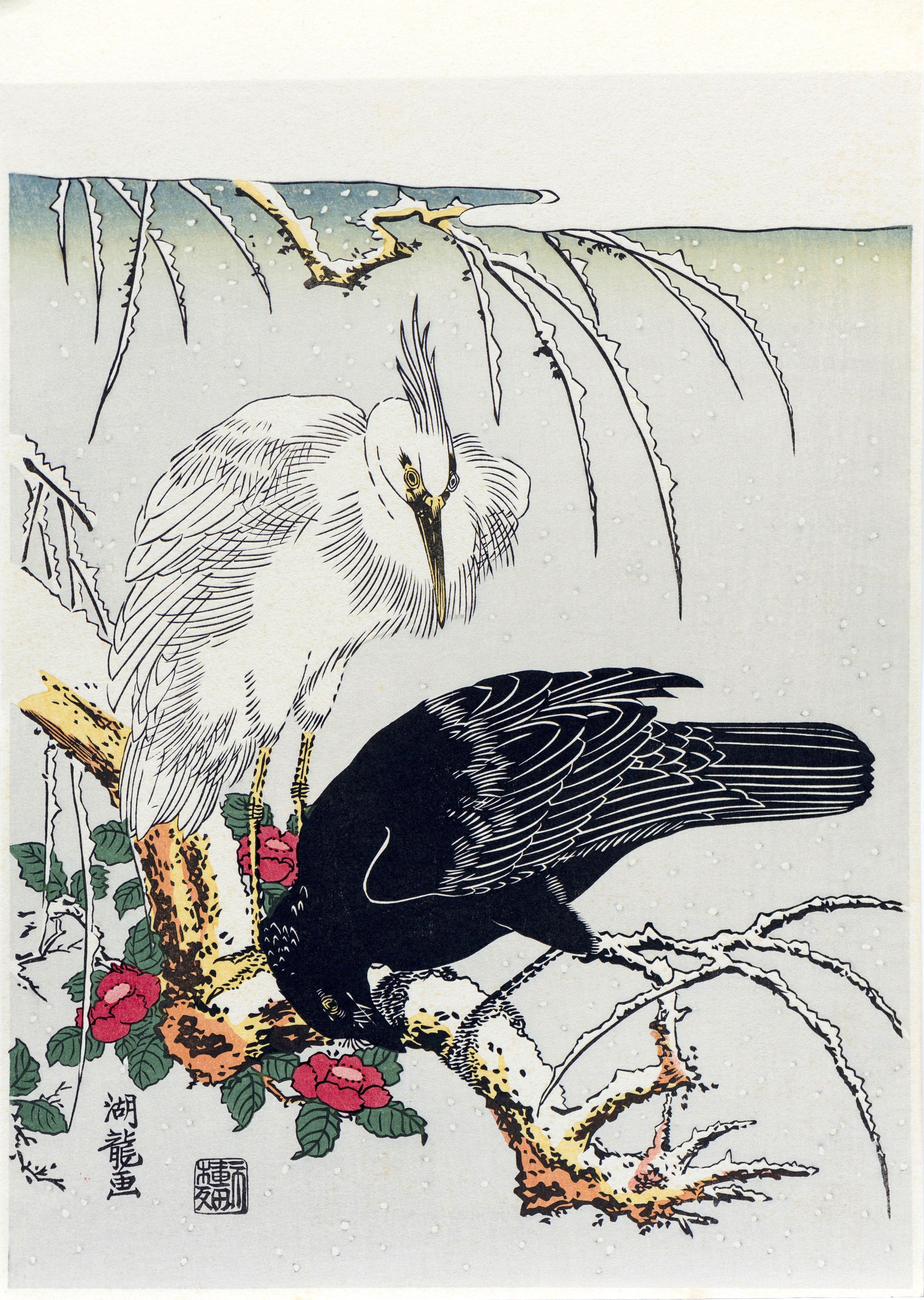
color woodcut, ink, paper, 28x19.5 cm, artist's signature, publisher's mark on the back
A beautiful scene depicting a white heron and a large black raven, classic Japanese symbols signifying innocence and bad luck respectively, sitting on camellia branches in late winter. Fresh snow covers the willow branches surrounding the scene, with flakes falling from the sky, but a few intense red camellia flowers are also visible.
Koryūsai was born in 1735 and worked as a samurai in the service of the Tsuchiya clan. After the death of the clan head, he became a stray rōnin and moved to Edo, where he settled near the Ryōgoku Bridge in the Yagenbori district. In 1769, under the pseudonym Haruhiro, he became a graphic designer, initially creating designs with samurai themes. In 1770, ukiyo-e printmaking master Harunobu died, and around the same time Koryūsai began creating prints in a similar style, depicting life in the entertainment districts. Koryūsai created a total of 2,500 known designs, and according to art historian Allen Hockley, "Koryūsai was probably the most prolific artist of the 18th century." He designed at least 350 hashira-e prints, numerous kachō-e prints depicting birds and flowers, and a huge number of erotic shunga prints.
This beautiful reissue of the design comes from the famous Tokyo publisher Adachi, one of the most respected publishers of the 20th century. Adachi's woodcuts were printed to the highest quality standards, with excellent color and fine detail. Adachi's woodblock printers were known as the best in the industry. The Adachi Group also selected interesting and diverse subjects for its prints and was the sole publisher of many famous old ukiyo-e paintings.